









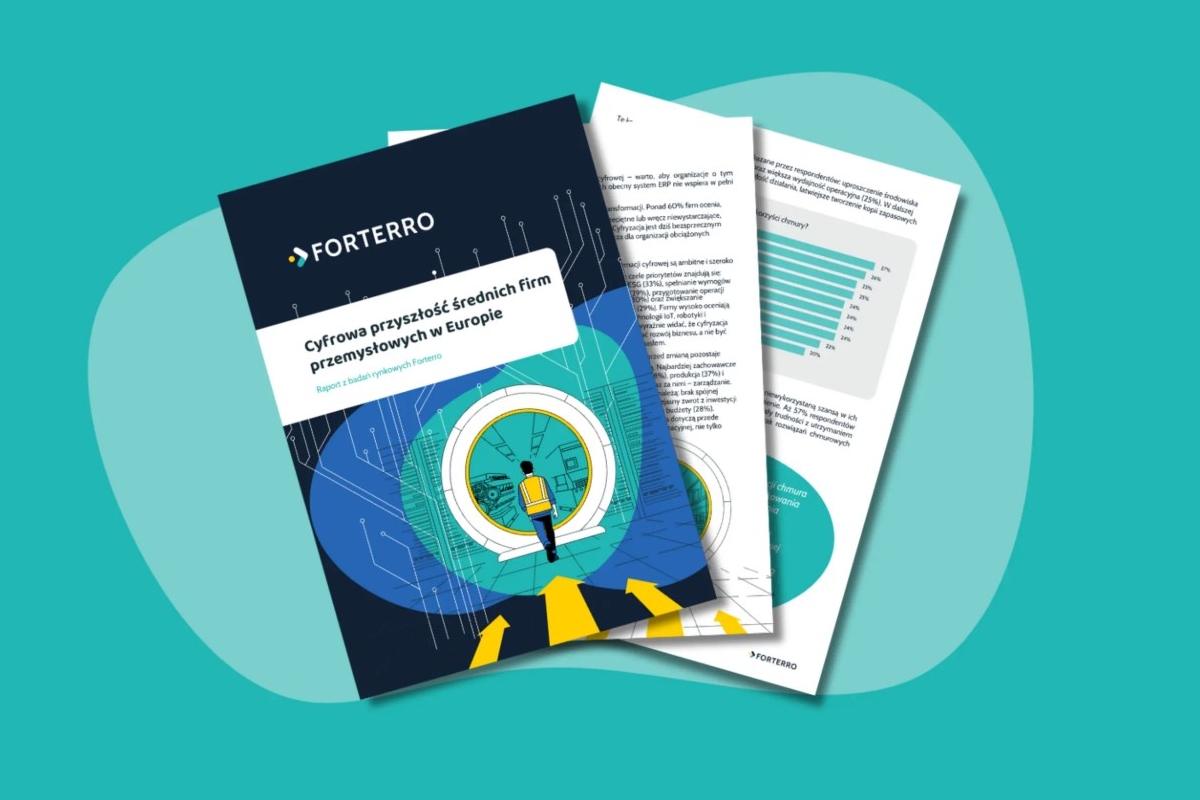
More than 60% of medium-sized industrial enterprises in Europe believe that the pace of their digital transformation is too slow, according to the latest report by the Forterro Group, “The Digital Future of Mid-Sized Industrial Companies in Europe.” However, companies are aware that without modern technologies, particularly cloud ERP systems and artificial intelligence-based solutions, maintaining competitiveness will become increasingly difficult.
The study by the Forterro Group, which includes the BPSC ERP system manufacturer, was conducted among 1,252 decision-makers from manufacturing and wholesale companies across five European countries. It reveals a clear gap between ambitions and real progress in digitalization.
Cloud ERP
As many as 57% of respondents believe that companies delaying migration to the cloud will face increasing market problems, and 49% point out that the lack of cloud solutions limits the ability to utilize AI and generative AI.
Industrial companies know where they should be heading, but they often lack the resources, competencies, or internal determination to accelerate change. A cloud ERP system is no longer just a technological choice; it is becoming a strategic decision. It is what enables business scaling, compliance with regulatory requirements, and the real-world application of artificial intelligence in daily operations.
– comments Bartosz Michalczyk, Principal, Cloud Transformation at Forterro.
The report shows that currently, 39% of companies use cloud ERP, while 28% still rely solely on on-premises systems. Over the coming years, however, the share of cloud solutions is expected to rise to 45%, while on-premises is projected to fall to 20%. The main barriers to transformation are limited budgets (32%), concerns about data security (31%), and a lack of management commitment (30%).
Artificial intelligence and skill gaps
Industrial enterprises are increasingly viewing AI as a practical business tool. It is expected to bring the greatest value in areas such as cybersecurity (30%), business analytics (30%), and predictive maintenance (28%). A prerequisite for success remains consistent data and a modern ERP platform that integrates operational and informational processes.
Effective use of AI requires not only data and tools but also the appropriate competencies within the organization. These, however, are often lacking. The Forterro report reveals a significant skill gap in key areas:
- 42% of companies lack cybersecurity specialists,
- 41% complain about a lack of experts for ERP system maintenance and development,
- 40% do not have staff knowledgeable in AI.
Every second entrepreneur (49%) admits that these shortages directly delay project implementation, and more than half of the companies (55%) have had to retrain existing employees just to use new tools.
Regulations and the Digital Product Passport
A significant challenge for the sector is also upcoming regulations, including the EU’s Digital Product Passport (DPP), which will come into effect in 2026. Meanwhile, only half of the surveyed companies declare readiness for these changes, with the main barriers being the complexity of regulations (42%) and a lack of resources (42%).
Regulations, cybersecurity, and cost pressure make delaying the decision to modernize IT systems increasingly risky. Companies that invest in modern ERP, the cloud, and digital competencies today are building resilience against future crises and gaining a real competitive advantage.
– concludes Bartosz Michalczyk from Forterro.
The Forterro report shows that despite numerous barriers, the European mid-sized industry is aware of the direction of change. Consistent investment in technology, skill development, and treating digitalization as a long-term business strategy rather than a one-off project will prove crucial.
The full report is available at the link
Source: Forterro Group