








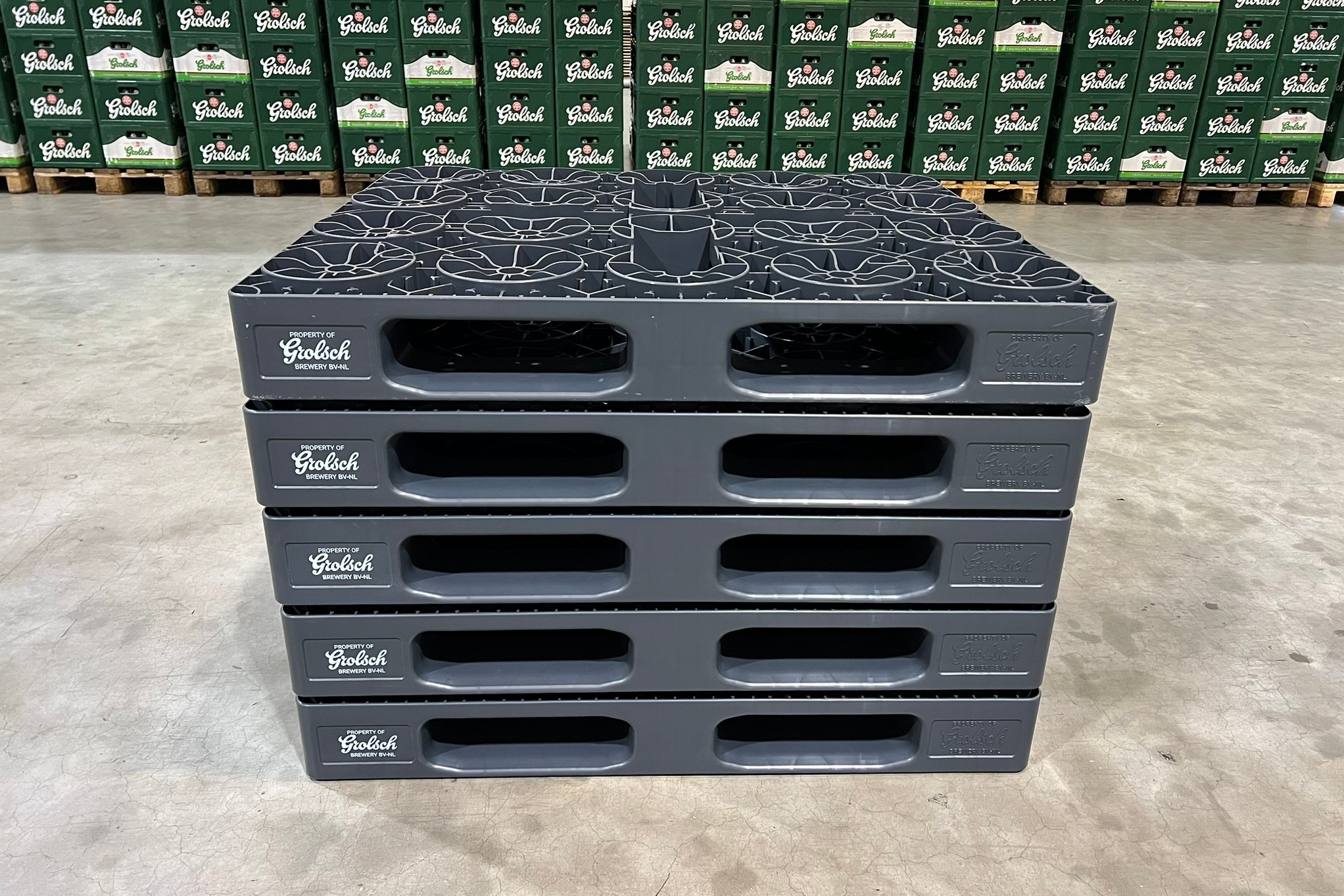
Hoofddorp, sustainable reusable packaging specialist Schoeller Allibert and Dutch brewery Royal Grolsch are taking another step towards a circular economy in their latest joint project by introducing sustainable pallets made from recycled plastic.
The Royal Grolsch brewery, based in Enschede, the Netherlands, combines centuries of craftsmanship tradition with an open approach to innovation. To achieve its sustainability goals and meet operational requirements, Grolsch has partnered with Schoeller Allibert. The packaging specialist is an expert in innovative materials derived from recycled plastics – these companies share a common goal of a smoothly functioning circular economy.
Old pallets, new problems
The existing keg pallets no longer met the company’s needs. Their high weight caused an increase in transport costs and associated CO2 emissions, while outdated molds made them difficult to source and reduced reliability. However, it was not just about logistics and functionality – Grolsch also wanted to achieve its ambitious sustainability goals.
“Replacing these pallets was a perfect opportunity to consider their environmental impact,” says Joost Nawijn, Packaging Material Development Specialist at Koninklijke Grolsch. “Therefore, we needed a lighter pallet made from recycled materials, thus providing a more sustainable solution.”
A solution for the circular economy
For Schoeller Allibert, this was not an extraordinary challenge: the reusable packaging specialist provided a specially designed keg pallet that met all the brewery’s requirements. The new pallets are made of 100 percent recycled plastic and are 12 kilograms lighter than their predecessors. Grolsch can therefore significantly reduce the amount of material used.
How did Schoeller Allibert manage to achieve this? The designers reduced the weight of the pallet not only through a special honeycomb structure but also through a different production technique. Instead of using a low-pressure process, the experts manufacture the keg pallets using a high-pressure injection molding process. The recycled plastic was part of post-consumer materials – i.e., used bottles and packaging – collected, sorted, cleaned, and processed into new products. Furthermore, old pallets (post-industrial material) are also used. As a result, carbon emissions were reduced by 83 percent* compared to pallets made from virgin raw materials. Once the product reaches the end of its life cycle, Schoeller Allibert collects and recycles it. This is an example of a well-functioning circular economy.
Optimal handling, individual design
The new pallet also offers more features useful in the brewery’s daily operations. The honeycomb structure makes the material lighter and more durable. Thanks to easier fork entry into such a designed structure, forklifts can lift the pallets more easily, which means there is almost no damage. The stackable design allows for a seamless transition from old pallets to new ones – the user can use both versions in parallel. Moreover, this stackability allows for a reduction in the space required for return transport, which also translates into a reduction in CO2 emissions – thanks to fewer trips.
The new pallets have been in use since January 2025. The close cooperation between Schoeller Allibert and Grolsch has resulted in an ideal solution that combines improved functionality, reduced CO2 emissions, and cost savings.
Our intelligent solutions are tailored to the requirements of the Grolsch brewery. This was possible because our experts listen to the customer’s needs, develop a solution, and test it until success is achieved.
– summarizes Vincent Vos, Head of Design at Schoeller Allibert.
*Note: The stated value is only an estimate and in no way should be interpreted as any kind of statement, warranty, or assurance. Schoeller Allibert makes no representations or warranties (express or implied) as to the accuracy or completeness of such estimates and shall not be liable to the recipient or any other party in any way in connection with the use of such estimates (except in the case of fraud).
Source: Schoeller Allibert Services B.V.