








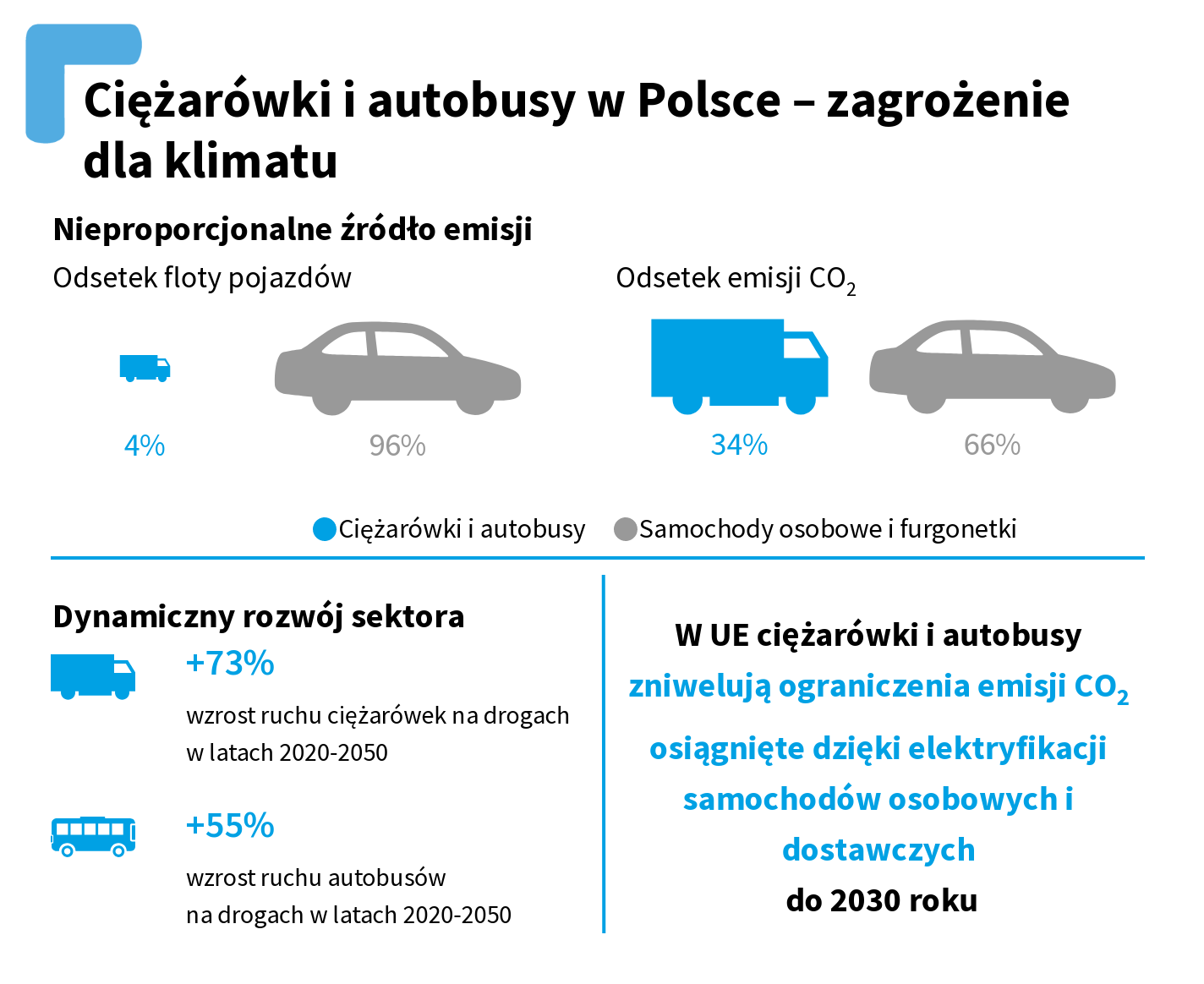
Trucks and buses account for only 4% of all vehicles, but are responsible for 34% of CO2 emitted by road transport in Poland. As the European Union prepares to present new emission standards for heavy-duty vehicles in November, a new analysis shows that if – in line with the net-zero emissions commitment – internal combustion vehicles are to disappear from the roads by 2050, the sale of diesel trucks must end by 2035.
A study conducted by the organization Transport & Environment (T&E) shows that even with the current CO2 emission targets for truck manufacturers, emissions from trucks and buses would completely negate the emission reductions from passenger cars and vans expected by 2030. This is due to the increased demand for road transport: between 1990 and 2019, the level of CO2 emissions from heavy-duty vehicles in Poland increased fourfold, and the European Commission estimates that between 2020 and 2050, truck traffic in the country will increase by 73%, and bus traffic by 55%.
Heavy-duty vehicles also consume huge amounts of diesel fuel. Currently, trucks and buses consume 53% of the diesel fuel used by Polish road transport.
– Transport is the biggest climate problem in Europe, and trucks are increasingly contributing to it. If the EU does not change the trend of their sales, polluting trucks will negate all the successes in emission reduction achieved through the electrification of vehicles started after 2020. – said Rafał Bajczuk, Senior Analyst at the Electric Vehicles Promotion Foundation.
Ending the sale of new internal combustion engine trucks by 2030 is the best solution from a climate protection perspective, but the required restrictions may prove too great to be implemented without disruption. Emission modeling performed by T&E shows that if we want to put road transport on the right path to zero emissions by the middle of the 21st century, 2035 is the last moment to achieve 100% sales of zero-emission vehicles. The “2035” scenario would mean that in 2050, only a small number of diesel-powered vehicles (older than their average “retirement age”) would be present on the roads. Currently, the average service life of trucks in Europe is 18 years.
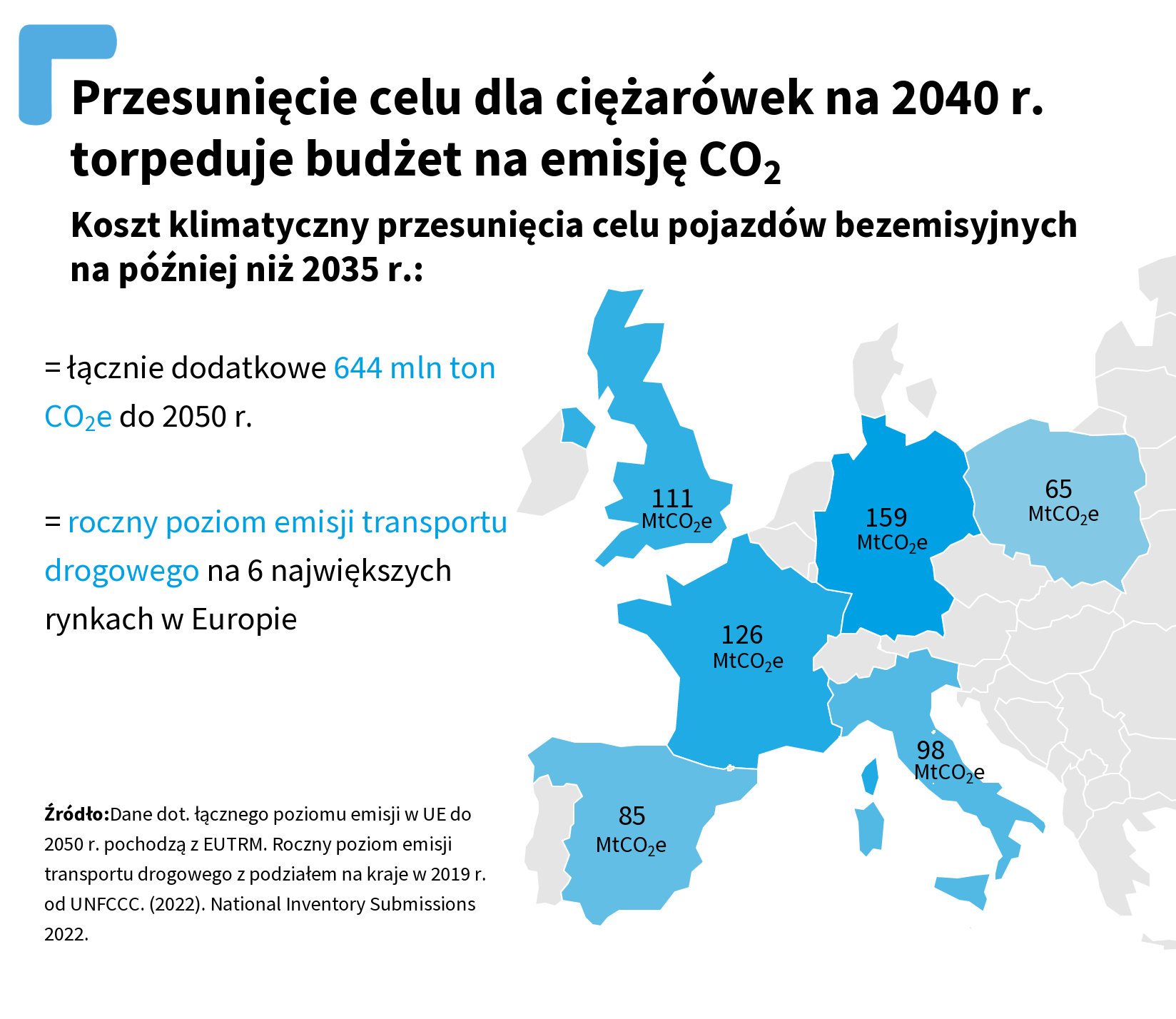
Therefore, a scenario assuming the aforementioned action by 2040 is too distant and would result in trucks emitting 644 million tons more CO2 by 2050 than in the 2035 scenario. This represents 4% of the EU’s total remaining carbon budget – equivalent to the current annual road transport emissions of Germany, France, the UK, Italy, Spain, and Poland combined. Postponing the end of sales for internal combustion engine vehicles to 2040 would also force lawmakers to take drastic and costly measures to remove 20% of the truck fleet that – in this scenario – would still be running on diesel in 2050.
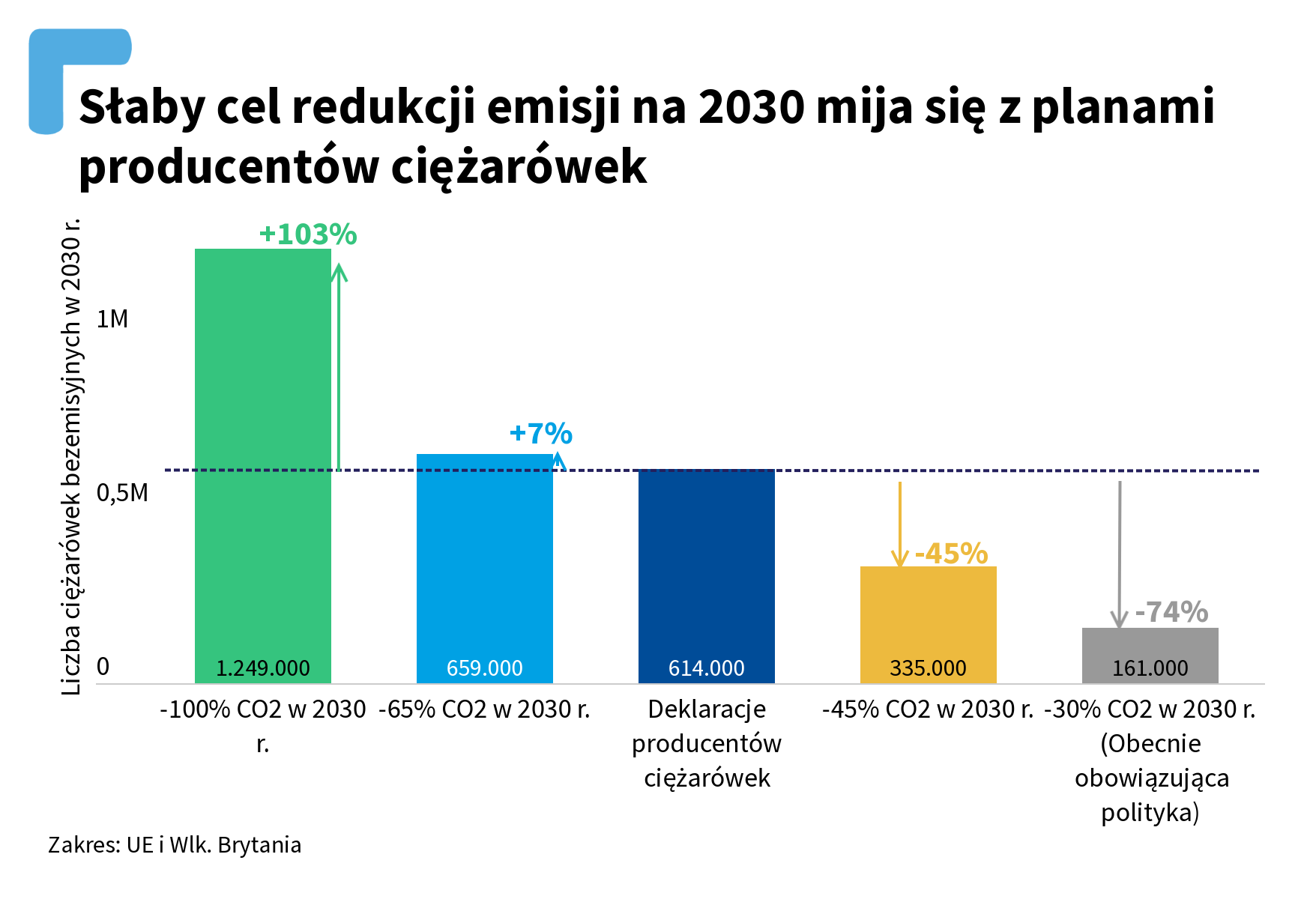
On the other hand, the study shows that ambitious EU CO2 emission targets for truck manufacturers for 2030, leading to the achievement of the zero-emission target in 2035, would mean manufacturers meeting their vehicle electrification commitments. The T&E “2035” scenario would lead to 659,000 zero-emission trucks on European roads in 2030, which is roughly in line with the announcements of these vehicle manufacturers. Consequently, diesel consumption by European trucks and buses would decrease by 9% by the end of the decade.
– The revision of emission standards for passenger cars and vans in June this year paved the way for trucks. Setting a target for total CO2 emission reduction by 2035 will help Europe and Poland get the last diesel vehicles off the roads and prevent a climate catastrophe. Any delay in this deadline will mean that a huge number of polluting trucks will still be driving on them in 2050. – adds Rafał Bajczuk.
Furthermore, the analysis shows that the current standards for truck manufacturers for 2025 and 2030 are not strict enough and would not allow for a reduction in CO2 emissions from heavy-duty vehicles. If current targets are maintained, they would emit 32% more CO2 in 2030 than in 1990, and there would be only 161,000 zero-emission trucks on European roads (including the UK), which is 74% less than their manufacturers predict.
- T&E therefore calls on the European Commission to propose the following targets during the November revision of CO2 emission standards for heavy-duty vehicles:
- Establish a 100% CO2 emission reduction target for medium and heavy trucks by 2035;
- Establish a target for the sale of only zero-emission city buses by 2027, for small trucks and coaches by 2035, and for specialized trucks by 2040;
- Announce a more ambitious CO2 emission reduction target by 2030, i.e., set it at -65% for medium and heavy trucks;
- Introduce intermediate targets in 2027 that will help accelerate the transformation process;
- Introduce energy efficiency standards for trailers.