








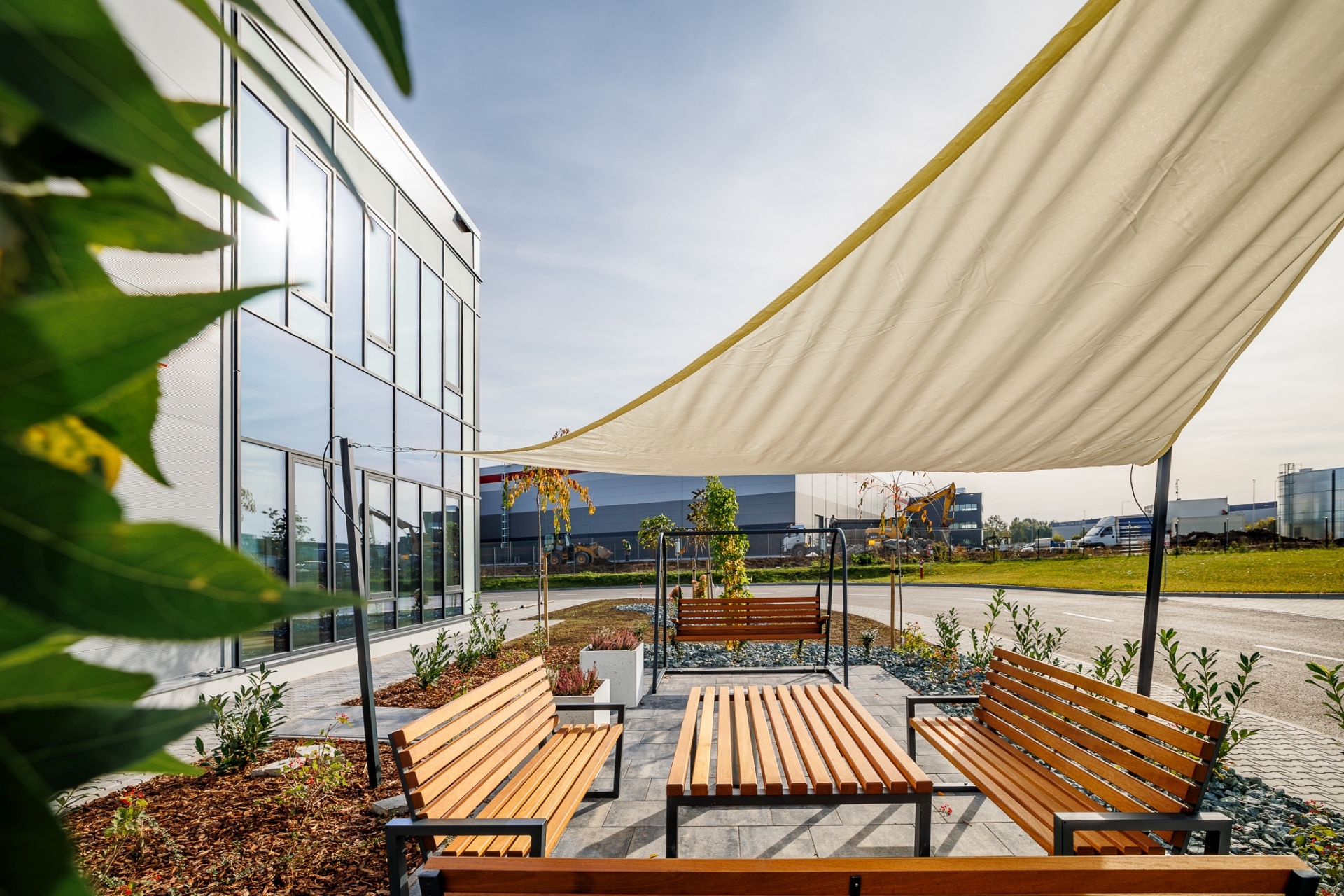
Companies that invest in the health and wellbeing of their employees see up to 30% lower staff turnover and higher operational efficiency. It is no surprise, then, that team wellbeing is one of the key factors shaping modern logistics parks. Warehouses, which until recently were associated mainly with storing goods, are transforming into friendly workplaces where caring for people is just as important as optimizing processes. Prologis has been supporting this trend for years, designing its investments to combine modern technologies with solutions that support employee wellbeing.
More and more organizations realize that their strength is no longer determined solely by technologies or processes, but by people—their health, motivation, engagement, and sense of security. This shift in focus is also a response to broader demographic and economic challenges. Poland is currently among the fastest-aging societies in Europe—according to forecasts, by 2050 the median age of Poles will reach 50, and the number of people of working age will fall by almost 30% compared to 2015. This means that companies must now create a work environment that fosters health, longer professional activity, and the maintenance of team productivity.
An investment with a “30 percent return”
As shown by the McKinsey Health Institute report “Thriving Workplaces: How Employers Can Improve Productivity and Change Lives,” prepared in collaboration with the World Economic Forum (Davos 2025), employee wellbeing is no longer a choice—it is becoming a necessity. Organizations that consistently invest in the health and wellbeing of their teams see up to 30% lower turnover and higher operational efficiency. This is proof that caring for people is today not just a matter of responsibility, but also a real factor of competitive advantage.
Prologis warehouse parks are much more to us than just halls and loading docks. We view them as small, vibrant communities where work naturally blends with relationships and daily life. A person spends an average of eight hours a day at work, five days a week—almost half of their active time. That is why we create places where it is simply good to work. Our approach is comprehensive: from ergonomic offices and modern halls, through green park surroundings, to health-promoting campaigns and sports events that integrate the employees of Prologis parks. Each of these elements builds a coherent space that is friendly to both people and the environment.
– said Marzena Tkaczuk, capital deployment director at Prologis.
In the light of comfort
Natural light and thermal comfort are just some of the important factors taken into account when designing modern warehouse facilities. Large glazing and roof skylights ensure access to daylight. This improves mood, supports concentration, and regulates the circadian rhythm. These are complemented by energy-efficient LED lighting controlled via the DALI system, which mimics the color of daylight and automatically adjusts its intensity to external conditions. Thanks to this, optimal, comfortable lighting is maintained in halls and offices with minimal energy consumption.
Stable and comfortable thermal conditions—regardless of the time of day or season—are ensured by a combination of simple technical solutions and advanced building automation technologies. The basis is above-standard wall and roof insulation, which limits heat loss in winter and protects against excessive heating in summer. Ensuring optimal conditions is also supported by air destratification systems, which equalize temperature differences between the ceiling and the floor, preventing the phenomenon of heat “escaping” upwards.
An integrated Building Management System (BMS) also takes care of the appropriate temperature and air humidity, monitoring temperature, humidity, and CO₂ concentration in real time. The BMS automatically regulates heating, cooling, and ventilation parameters, adjusting them to the number of people and the nature of the work being performed.
Moving away from traditional heat sources is of huge importance for user comfort and energy efficiency. In Prologis parks, gas boilers are increasingly being replaced by much more energy-efficient heat pumps, which reduce CO₂ emissions and automatically adjust heating power to current needs, ensuring constant thermal comfort inside buildings.
A good example of this approach is the 62,500 m² facility at Prologis Park Ujazd, built for the Schaeffler company. The building was designed with employee comfort in mind—it provides increased access to natural light, stable temperature, and fresh air, and its surroundings will be filled with greenery. The investment is devoid of a gas installation, and the heat energy used in the facility will come from air-source heat pumps. The roof is covered by a photovoltaic installation with 1,730 panels with a total capacity of 1 MW. Prologis’ goal is to obtain the BREEAM Outstanding certificate, which will confirm high energy efficiency and the highest standards of work environment quality.
The facility in Ujazd perfectly shows what wellbeing in practice means to us. At Prologis, we look at technology not as an end in itself, but as a tool meant to serve people. A team of specialists works on every building—engineers, architects, and experts in sustainability and work environment comfort. Together, we ensure that literally every detail is designed with purpose: efficiently, with care for the environment, and for the benefit of the person.
– lists Marzena Tkaczuk from Prologis.
A new standard in existing facilities
In the context of solutions aimed at improving the quality of work in warehouses, people most often talk about newly constructed facilities. However, it is worth remembering that there are currently about 36 million square meters of warehouse space in Poland, many of which were built years ago, before current technologies were widely available. Therefore, managing the existing portfolio responsibly and investing in the modernization of facilities so that they meet contemporary standards is just as important as developing new projects.
It is important to adapt existing warehouses to the needs of the specific client who is renting the given space. The process of preparing such implementations should each time include a detailed audit of client requirements, the selection of appropriate solutions and technologies, and supervision over their implementation.
– lists Michał Tasior from Prologis, who manages projects within the Essentials platform, which provides Prologis clients with the implementation of comprehensive projects in rented warehouse spaces. Both those related to employee wellbeing and, more broadly, those concerning daily operational activities.
Work and life
An integral part of Prologis parks is the PARKlife™ program, which makes logistics complexes places that are friendly to people. Relaxation zones, walking paths, sports fields, outdoor gyms, and flower meadows are being created on their premises. Prologis also supports sustainable mobility by installing electric vehicle charging stations and bicycle shelters with repair points. For four years, the company has been running a health prevention program for park employees across Poland, offering free check-ups in mobile diagnostic clinics. Initiatives that integrate the community, such as the Prologis Football Tournament for the Navika Cup in Łódź, in which teams of clients, partners, and company employees participate, are also part of PARKlife™.
Source: Prologis