









Following significant investments in fleet and network expansion, the establishment of new strategic partnerships, and the introduction of innovations over the past 12 months, Emirates SkyCargo is ending the year with a clear plan for 2026. As the cargo division of the world’s largest international airline, Emirates SkyCargo is on track to seamlessly connect the world, ensuring the fast, reliable, and efficient flow of goods.
A stronger fleet, a wider network, greater impact
At the beginning of the year, Emirates SkyCargo took delivery of its first Boeing 777Fs, followed by two more in the subsequent months. This allowed the airline to retire older aircraft and maintain one of the youngest fleets in the world. Currently, the fleet includes 11 Boeing 777Fs and 5 leased Boeing 747s. Last year, the first Emirates passenger aircraft was converted into a freighter and will begin operations in 2026. By the end of next year, Emirates SkyCargo plans to have at least 21 freighters, significantly increasing its current transport capacity.
Continuing its long-term plan to add new freighter destinations, the airline launched cargo services to eight new locations in 2025: Copenhagen, Narita, Bangkok, Mumbai, Beirut, Conakry, Phnom Penh (KTI), and Hanoi, while increasing flight frequencies for high-volume routes such as Guangzhou, Shanghai, and Johannesburg. The new connection to Hanoi was quickly increased to four flights per week to meet growing demand. By the end of the year, Emirates SkyCargo serves 42 global destinations across six continents as part of its freighter services.
In 2025, Emirates SkyCargo expanded its network by partnering with over 180 interline partners and signing new agreements to increase its global reach. In February, the airline signed an agreement with Africa’s Astral Aviation, and in April with Teleport from Southeast Asia, to provide seamless connections to major, secondary, and tertiary airports in both regions. The airline continues to strengthen existing strategic partnerships with global carriers such as Air Canada, United, and Virgin Atlantic to reach every corner of the globe.
Operations ready for the future
In parallel with plans to build a new facility at Al Maktoum Airport (DWC), Emirates SkyCargo has been investing in current operations to maintain peak efficiency. The airline renewed its vehicle fleet, taking delivery of 40 new Euro 6 trucks from MAN Trucks, equipped with the latest low-emission technologies. By the end of Q1 2026, the fleet will be bolstered by the delivery of five hydrogen-powered trucks, marking an important step in the gradual transition to alternative fuels.
Emirates SkyCargo, together with LODD Autonomous, will work on the development and testing of VTOL aircraft for first and last-mile deliveries in 2026.
Throughout the year, the number of online bookings grew, while manual bookings declined. By December 2025, nearly 80% of all Emirates SkyCargo shipments were booked digitally, primarily via eSkyCargo, followed by external digital platforms and through direct customer API integrations. By digitizing other key cargo processes, Emirates SkyCargo became the first carrier in the region to implement the PayCargo solution, introducing instant payments via credit card or direct debit instead of traditional cash transactions. In 2026, the airline plans further improvements to its digital tools, adding new features that will streamline the journey.
Solving transport challenges
Emirates SkyCargo remains the first choice for a variety of shipments – from transporting over 14,600 pets to carrying a Koenigsegg supercar prototype to the Mille Miglia in the UAE.
In 2025, the premiere of Emirates Courier Express took place – a door-to-door solution that sets new standards in cross-border deliveries. Within a few months, the service was implemented in Australia and Germany, with further rollouts planned for 2026. To date, over 50,000 packages have been delivered with an average network delivery time of 3 days, and an average of 1 day between the UK and the UAE.
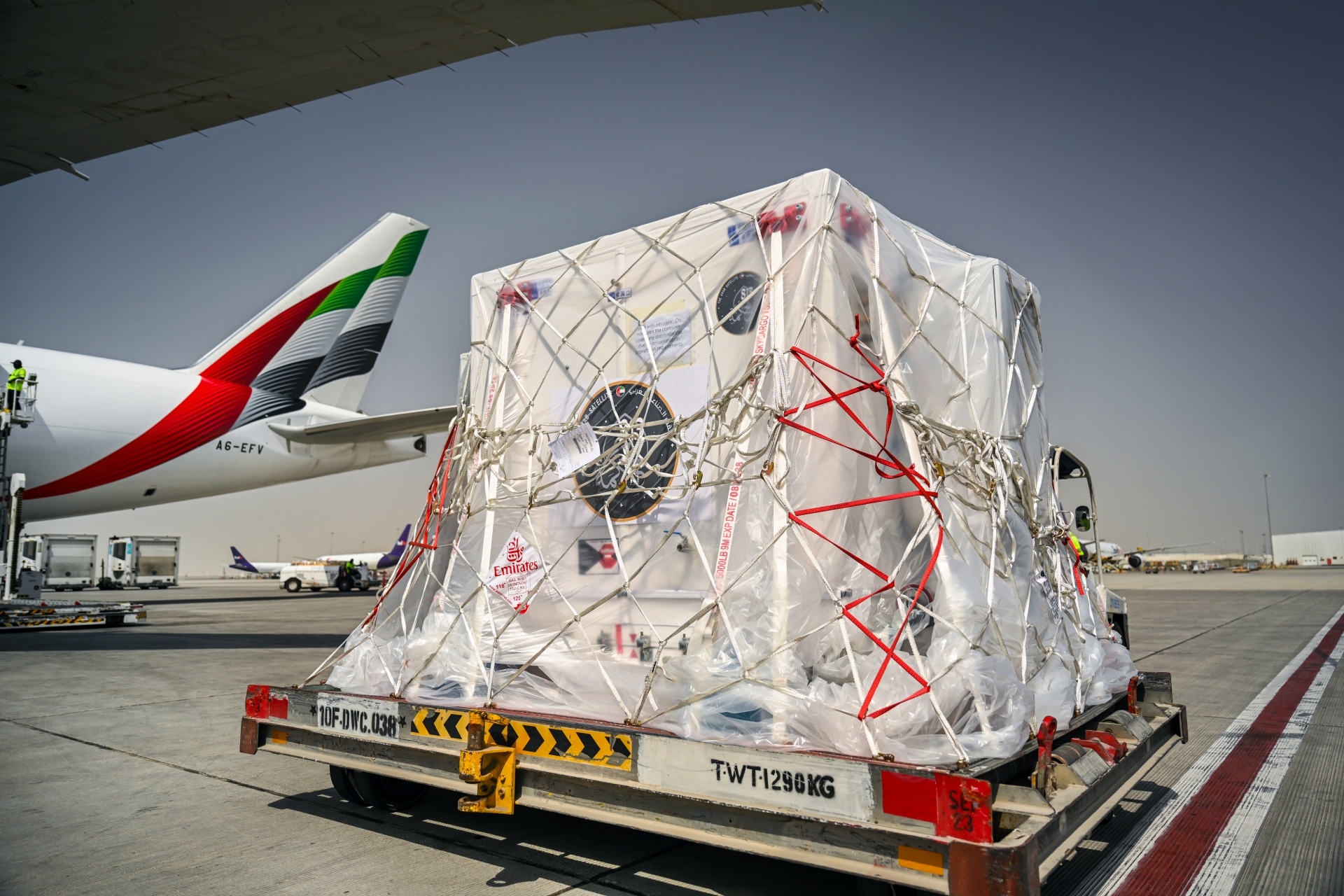
Leveraging the team’s technical expertise, Emirates SkyCargo launched the Aerospace and Engineering division, offering an optimized AOG service and a new aircraft engine transport offering. The airline recorded a 100% increase in single-engine transport compared to the same period last year, and demand continues to grow. Emirates SkyCargo also transported the Arab 813 satellite from Al Ain to Shanghai.
Fresh – dedicated to the transport of food, flowers, and other perishables – the airline’s largest division by tonnage, grew by 10%, carrying an additional 25,700 tons compared to 2024. This is equivalent to 275 million apples! As Comprehensive Economic Agreements (CEPA) are implemented in the UAE, the airline will continue to ensure farm-to-table deliveries in just 24 hours.
In response to the growing demand for specialized therapies, such as clinical trials or cell and gene therapies, Emirates SkyCargo recorded a 54% increase in shipments under the Vital service – a premium solution for the most sensitive pharmaceutical shipments. The airline continues to invest in infrastructure, technology, and processes, transporting 2,000 tons of pharmaceuticals per week.
The increase in mobile phone and other electronic device production in Vietnam and India led to a 30% rise in demand for the Secure service. Emirates SkyCargo met this demand by combining freighter and SEA-AIR services.
Emirates SkyCargo continues to set the standard in global logistics. In 2026, the company plans to double its capacity, add 20 new freighter routes, and advance the industry through smart, digital solutions.
Source: Emirates