








According to data from the end of November 2023, a total of 54,783 passenger and commercial battery electric vehicles (BEVs) were registered in Poland. Over the first eleven months of this year, their number increased by 21,369 units, i.e., 54% more than in the same period of 2022, according to the Electromobility Meter launched by PZPM and PSPA.
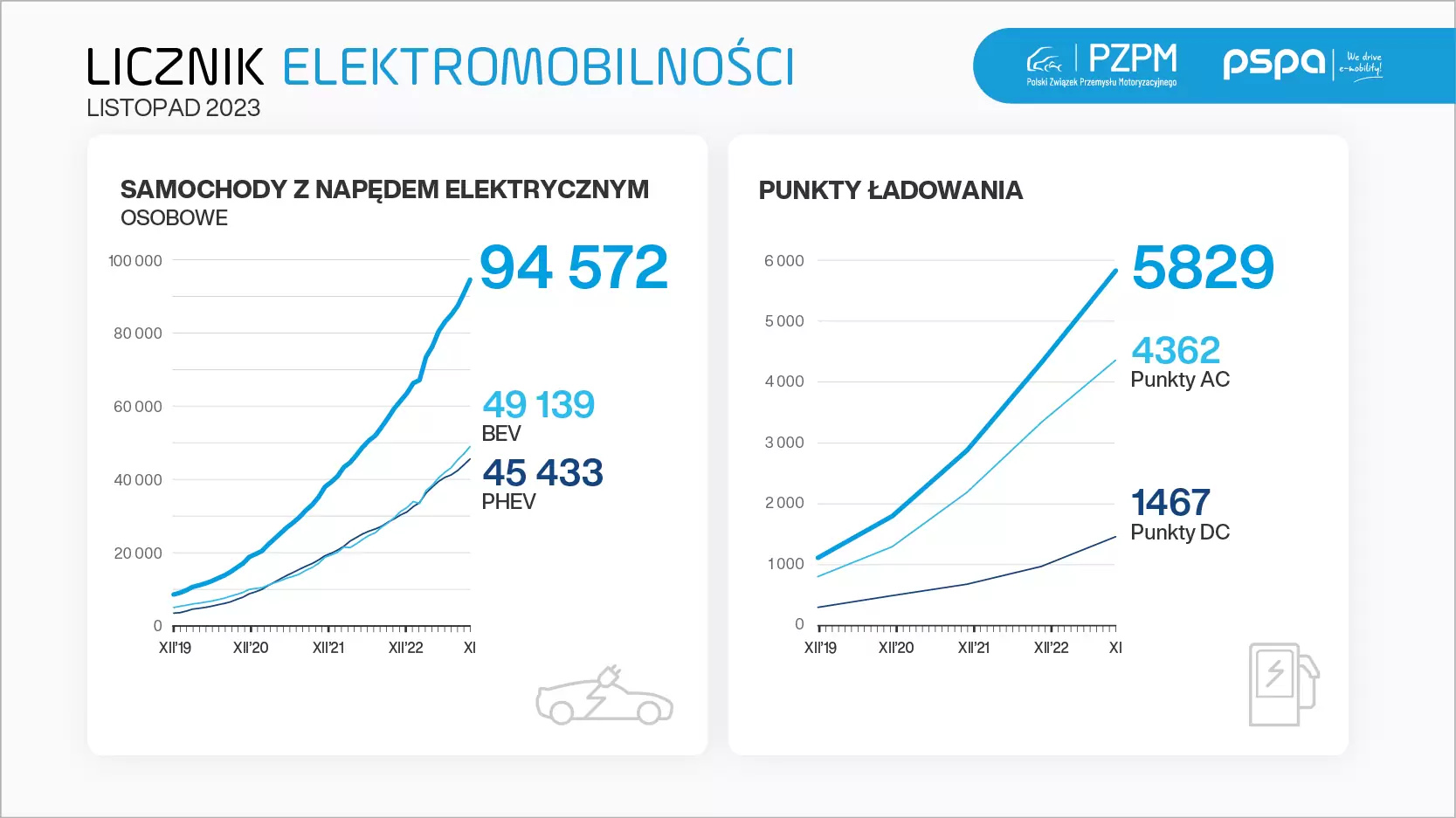
At the end of November 2023, there were 94,572 electric passenger cars on Polish roads. The fleet of fully electric passenger cars (BEVs) numbered 49,139 units, and the fleet of plug-in hybrids (PHEVs) amounted to 45,433 units. The number of electric delivery and heavy-duty vehicles stood at 5,669 units. The fleet of electric mopeds and motorcycles is also constantly growing, consisting of 19,411 units at the end of November, as is the number of hybrid passenger and delivery cars, which increased to 658,547 units. By the end of last month, the electric bus fleet in Poland had grown to 1,120 units.
Parallel to the fleet of electric vehicles, charging infrastructure is also developing. At the end of November 2023, there were 5,829 publicly accessible electric vehicle charging points (3,277 stations) operating in Poland. 25% of them were fast direct current (DC) charging points, and 75% were slow alternating current (AC) points with a power of 22 kW or less.
– This is the last edition of the “Electromobility Meter” this year, and although market data for the full 12 months is not yet available, we can present preliminary summaries. We already know that the number of newly installed charging points (70 more have been added so far than in the whole of 2022) and newly registered battery electric vehicles will be higher than last year. This is certainly pleasing. On the other hand, this year would have been significantly better for the electromobility market if the public administration had introduced several changes long advocated by the industry. Among the most urgent actions to be taken at the beginning of 2024 are shortening the connection procedures for charging stations, optimizing the “My Electrician” program, and introducing subsidies for zero-emission road heavy transport – says Maciej Mazur, Managing Director of PSPA.
– The results of the first eleven months of 2023 indicate that the growth in the number of registered battery-powered passenger cars has stabilized at around 50%. This applies to both new and used vehicles. Registrations of delivery and heavy-duty vehicles are growing almost twofold, as are electric buses. This year, we also registered twice as many hydrogen-powered passenger cars as last year. However, considering that Poland remains in the group of countries with the lowest number of electric vehicle registrations, it is necessary for the new government to immediately introduce solutions that will contribute to an increase in the volume of zero-emission vehicles on our roads. Also, if we want to maintain our status as a transport power in Europe, it is absolutely essential to include the heavy-duty vehicle segment in the subsidy program – says Jakub Faryś, President of PZPM.