








An interview with Zbigniew Wyszogrodzki, an expert in energy and urban mobility at the Business Centre Club.
Janusz Mincewicz: Polish municipal transport companies are buying electric buses, gas-powered vehicles, and recently hydrogen-powered ones. Are they doing this out of concern for our health, or because they have to?
Zbigniew Wyszogrodzki: Municipal companies are obliged to meet statutory requirements regarding the ownership and operation of low- and zero-emission vehicles. This is a good direction for development at the level of systemic solutions, however, under current conditions, it is burdened with at least two categories of limitations.
J.M.: What kind?
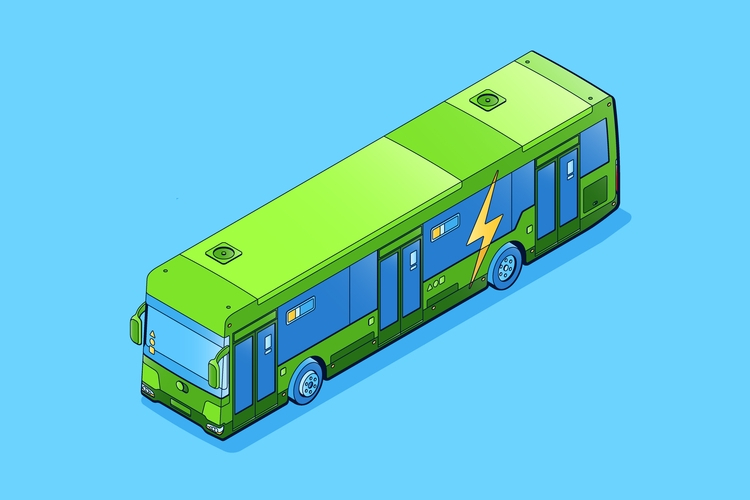
Z.W.: Firstly: economic risk, because zero-emission vehicles are still significantly more expensive than traditional ones; for example, an electric city bus costs about 2.5 times more than a modern, well-equipped diesel-powered bus that meets the highest exhaust emission standards.
 J.M.: And secondly?
Z.W.: These are energy problems, as the Polish power system is burdened with many years of investment and modernization neglect, therefore there may be a lack of capacity in the system, and above all, distribution capacity to connect vehicle charging stations. Consequently, systemic solutions are necessary, based largely on external subsidies, e.g., through EU funds or preferential debt instruments.
J.M.: But it is the European Union that imposes the obligation of zero-emission on us…
Z.W.: Yes, and therefore increasingly stringent environmental protection solutions are being imposed on top of this. And in Poland, as much as about 70% of electricity comes from old power plants fueled by hard coal or lignite. Most of them are characterized by low generation efficiency and high emissions.
J.M.: What does this mean in practice?
Z.W.: Among other things, it means that the so-called carbon footprint of an electric bus can be larger than that generated by a modern diesel-powered bus. This is somewhat related to the issue of the legitimacy of creating clean transport zones in cities. Opinions on this subject are divided.
J.M.: Why?
Z.W.: These zones are intended to ensure higher air quality in cities or parts thereof. However, it must be remembered that as long as boilers or stoves for solid fuels continue to operate, in which practically anything can be burned without any control of exhaust quality, we will have a problem with air purity. The best proof is the phenomenon of smog, which occurs in winter when houses are heated, while it is not observed in summer. Cars, on the other hand, drive regardless of the season.
J.M.: So what is best for zero-emission?
Z.W.: Hydrogen transport could be a solution, but in Poland, there is no infrastructure allowing for the production of hydrogen of appropriate quality – hydrogen vehicles require very high fuel purity, as much as 99.999%. Hydrogen produced in the country reaches at most 99.99% purity, which is a difference of an order of magnitude. Hydrogen producers assure of their interest in producing fuel of appropriate purity, but the time perspectives are unknown. It is worth adding that the nearest station where you can refuel a car with hydrogen is in… Berlin.
J.M.: So hydrogen fuel is just a fuel of the future.
Z.W.: Hydrogen is a very expensive fuel, because a kilogram costs about 8 – 10 euros. A vehicle powered by hydrogen is about 3.5 times more expensive than a diesel vehicle. Hydrogen, assuming it comes from water electrolysis performed using electricity from renewable sources, is a very clean, truly zero-emission fuel, which is why it is worth working on optimizing and significantly reducing the costs of its production and distribution, however, this may take many more years.
J.M.: What then?
Z.W.: In the transition period, we should focus on so-called electrofit solutions, i.e., converting used combustion vehicles into electric ones. Such a process can be applied in particular to city buses, where in place of the engine, gearbox, cooling system, and accompanying equipment, batteries with a control system can be installed, and the vehicle can be powered by a central electric motor or motors in the wheel hubs. Such solutions are already functioning, e.g., in Germany, and it would be worth developing the technology for such a conversion for the most common brands of city buses in Poland.
J.M.: Are all buses suitable for electrofit?
Z.W.: The vehicles that are best suited for electrofit are buses about 8 – 10 years old. The cost of this type of modernization fluctuates within 40% of the price of a new electric bus. Electrofit can therefore become a stimulus to accelerate the electrification of commercial vehicles, especially city buses in Poland, and thus bring local governments closer to meeting the requirements of the Act on Electromobility and Alternative Fuels.