








Poland is one of the leaders in road freight transport in the European Union. It was responsible for the transport of 380 billion tkm (tonne-kilometres) in 2021 – the most in the entire EU and 24 percent more than Germany, which ranked second. Poland’s truck fleet in 2021 numbered 1.15 million vehicles. This sector employed 486,000 people in 2020, which accounted for 15 percent of all those employed in this sector in the European Union. The TSL (transport, shipping, logistics) industry is currently facing changes resulting from EU CO2 emission standards for heavy-duty vehicles, which will force its electrification. The Polish Economic Institute (PIE), in the report “Electrification of the heavy road transport sector,” created in cooperation with the Polish Alternative Fuels Association (PSPA), analyzes scenarios for the electrification of this branch of the economy and points out possible economic consequences.
Poland as the EU leader in road transport
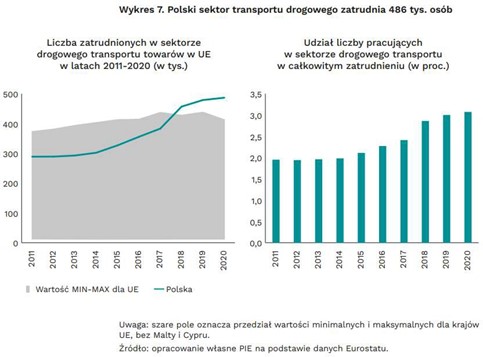
The road freight transport sector in Poland employs the largest number of workers among such industries in the entire EU. In 2020, more than 486,000 people worked in it, which was 74,000, or 18 percent, more than in Germany, which ranked second. Employees in Poland account for 15 percent of total employment in this sector in the EU. The importance of the freight transport industry within the Polish employment structure is also growing, as is the demand for employees. The share of people working in this branch of the economy increased from just under 2 percent in 2011 to over 3 percent in 2020. The growing number of employees is associated with a high demand for workers, including professional drivers. According to estimates by analysts and industry representatives, there may still be a shortage of 100,000-150,000 truck drivers in Poland.
Poland has the largest fleet of heavy-duty vehicles with a GVW (gross vehicle weight) of over 3.5 tonnes in the entire EU. In 2021, the fleet in Poland numbered nearly 1.15 million trucks, 33,000 more year-on-year. The average age of this type of vehicle in Poland is slightly lower than the EU average: 13.2 versus 13.9 years, but significantly higher than in the competitive markets of Germany (9.6 years) and France (9 years).
– The Polish heavy road transport sector dominates among European economies. For years, we have been observing a steady increase in employment and an ever-growing fleet of vehicles. However, it must be remembered that the value added of this sector in our country remains at a lower level than in more developed EU countries, and conventional vehicles dominate within the existing fleet. Today, the sector faces the challenge of replacing them with zero-emission vehicles as quickly as possible. Delays in the electrification of the vehicle fleet may weaken the competitiveness of the Polish TSL industry in the coming years – comments Maciej Miniszewski, senior advisor in the climate and energy team at PIE.
Insufficient infrastructure for electric vehicles
Although the heavy-duty vehicle (HDV) fleet is not relatively large, it generates a significant amount of emissions. Striving to implement the assumptions of the European Green Deal, the European Union supports the electrification of road transport. Under Regulation (EU) 2019/1242 of the European Parliament and of the Council of 20 June 2019, manufacturers are required to reduce the emission intensity of the fleet of newly registered heavy-duty vehicles by 15 percent in 2025 and by 30 percent in 2030 compared to the emissions of heavy-duty vehicles first registered in the period from 1 July 2019 to 30 June 2020. In turn, the AFIR project adopted by the European Parliament on 28 March 2023 imposes requirements on member states regarding the expansion of the charging station network. Exhaust emissions will also be regulated in light of the Euro 7 standard.
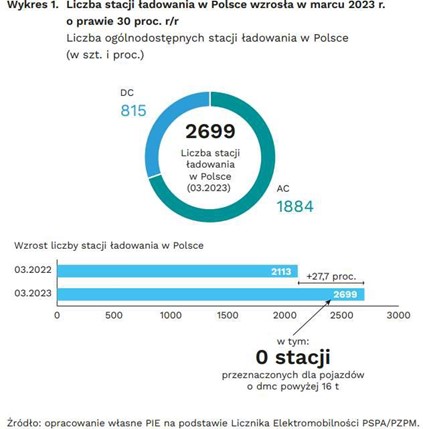
EU efforts to reduce CO2 emissions will force the electrification of road transport. The key to the development of electromobility in the eHDV segment is the expansion of charging infrastructure. Meanwhile, in Poland, not a single one of the approximately 2,700 publicly accessible stations is intended for vehicles with a GVW of over 16 tonnes. Their absence is accompanied by a small number of electric trucks, of which 11 were registered in Poland by 2022. From the perspective of TSL industry representatives in Poland, this is one of the biggest barriers delaying fleet electrification.
– One of the biggest barriers to the electrification of the transport sector, both heavy and passenger, is the lack of developed charging infrastructure. Appropriate infrastructure investments are needed, especially since the registration of electric trucks could increase the demand for electricity in Poland in the years 2030-2035 by approximately 2-4 percent. The charging profile or the use of fast chargers during peak hours will require investments in generation, storage, and network systems – points out Magdalena Maj, head of the climate and energy team at PIE.
Electrification of heavy road transport will be economically beneficial
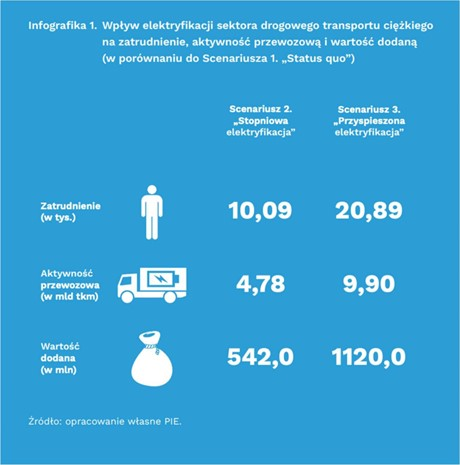
The report prepared by PIE shows that fleet electrification may allow Poland to increase its share in the heavy transport sector. Poland’s growing share in the EU transport market and the increasing number of trucks will increase the number of jobs in the sector. Gradual or accelerated electrification will lead to an increase in employment, at the expense of other countries, mainly Germany, by 10,100 or 20,900 respectively by 2035 compared to the scenario of maintaining the current pace of electrification.
The transformation may also accelerate the growth of transport activity of Polish TSL companies. Depending on the pace of electrification, transport activity by 2035 will be higher by 4.8 billion tkm or even 9.9 billion tkm compared to the status quo scenario. Furthermore, thanks to the accelerated electrification of the fleet, the Polish heavy road transport sector could grow by EUR 1.1 billion by 2035 compared to the scenario in which the current state of affairs is maintained.
– Poland remains the only one among the leading markets in the TSL area that has not yet offered a support system encouraging investment in zero-emission heavy-duty vehicles. Along with the development of electromobility in the heavy transport sector in other EU member states, maintaining the competitiveness of Polish carriers requires the introduction of a subsidy system for eHDVs and infrastructure, as well as the optimization of the law. It is necessary, among other things, to abolish road tolls for eHDVs, implement the possibility of entering restricted traffic zones for electric trucks, or provide tax breaks for entities investing in ecological means of transport. Such incentives will enable the realization of a positive scenario for the impact of progressive electrification on the heavy transport industry in Poland. PSPA sent recommendations in this regard in an open letter to Anna Moskwa, Minister of Climate and Environment – says Piotr Ziółkowski, New Mobility Expert at PSPA.
The full report is available at the link.
Source: Polish Economic Institute