








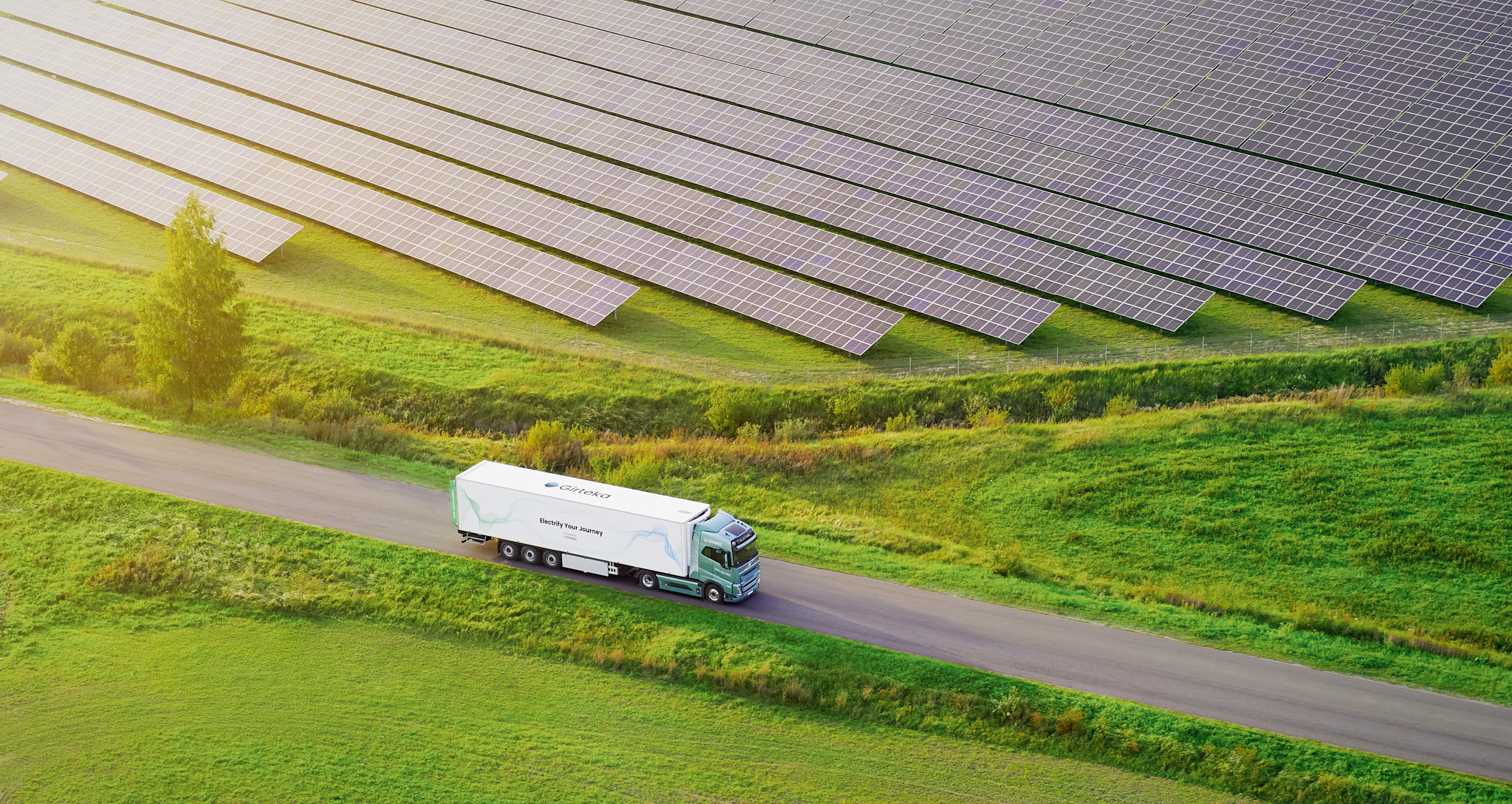
In the face of the global drive towards sustainable supply chains, transport services play a key role in reducing greenhouse gas (GHG) emissions. Road freight transport, which accounts for 77% of total transport emissions in the European Union, has become the main target of decarbonization policy. Sooner or later, every transport company will have to adapt to the new requirements. Girteka, the largest European road carrier based on the digitalization of services, has already found an interesting solution to maximize the decarbonization of its transport services by combining two branches of transport.
Scandinavia: the vanguard of sustainable development
Scandinavia is considered the bastion of sustainable development in Europe, where theories and debates have given way to real initiatives. The leader of the green transformation in transport is Norway, where nearly 80% of new passenger cars sold in 2022 were electric vehicles. The next step is obvious – the electrification of freight transport. And it is precisely in this area that the Girteka Group has prepared a new solution for one of its Scandinavian clients.
Girteka combines theory with practice
Girteka’s Scandinavian company will now provide freight transport services using battery electric vehicles (BEV) from Volvo Trucks. That is not all.
Girteka’s new solution is based on a thoughtful and innovative strategy of combining electric vehicles (BEV) with intermodal transport. Girteka will provide these services in the Trondheim region, Norway. Deliveries are to be carried out by electric trucks over a distance of 150 km, and then they will be transferred to rail in an intermodal connection system.
– Balancing customer needs with our focus on sustainable transport is a complex challenge, but we are ready to take it on. Finding practical solutions allows us to maintain operational excellence while making progress in decarbonization – emphasizes Jens Romer Sode, CEO of Girteka Nordic, part of the Girteka Group.
Intermodal and BEV: for a green future
The strategy of combining intermodal transport with BEV technology allows for a significant reduction in emissions compared to traditional logistics solutions based on diesel trucks. Its goal is to improve the quality of services offered to customers by leveraging the strengths of different branches and modes of transport while ensuring timely deliveries.
As a result, the strategy fosters an environment where companies can meet their logistics needs while actively reducing their carbon footprint. It also shows that efficiency and sustainability can effectively coexist in a modern logistics model.
Source: Girteka