









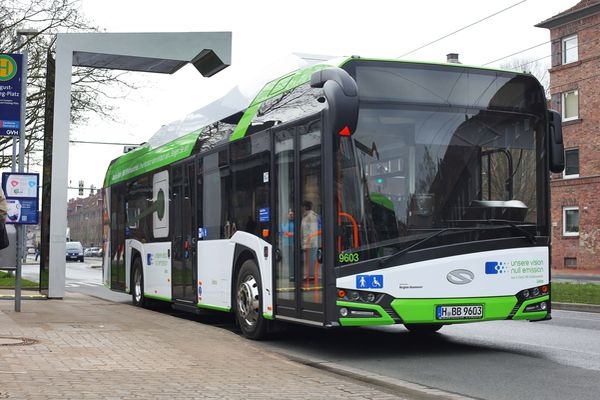
“Our vision: zero emissions” – this was the motto under which test drives of three new-generation Solaris Urbino 12 electric buses took place in Hanover. The official inauguration of the event was attended by representatives of the Hanover public transport operator üstra and the manufacturer Solaris Bus & Coach. Many invited guests were also present, led by Dr. Barbara Hendricks, Minister for the Environment of the Federal Republic of Germany.
Last year, Solaris won a pan-European tender for the supply of an emission-free transport system, i.e., both electric vehicles and their charging infrastructure. The üstra company, which chose the Polish offer, has been successfully cooperating with the manufacturer from Bolechowo for many years. Not only combustion-powered Solaris vehicles run on the streets of Hanover, but also hybrid buses, and since April, electric ones as well.
The new Solaris Urbino 12 electric buses for Hanover are equipped with a number of innovative solutions ensuring their efficient operation and low operating costs. The 12-meter buses are fitted with the innovative ZF AVE 130 axle, which has two independent electric motors built into its design. This solution allows for better use of passenger space and also reduces the vehicle’s weight. The electric buses use lithium-titanate batteries with a capacity of 125 kWh, which, combined with pantograph charging, provide virtually unlimited operational capabilities. An interesting fact is that during the ride, passengers can monitor the battery charge status on a screen. The modern vehicles are equipped with two ramps for disabled persons – one electric and one manual. Additionally, wireless Wi-Fi will be available in the vehicles.
The Urbino 12 electric buses for Hanover feature an innovative roof-mounted charging system that allows them to operate on the line all day without the need to return to the depot. This is possible thanks to the use of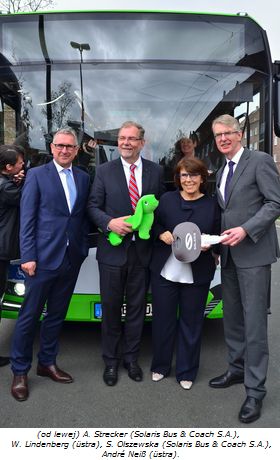 an external charger with a power of up to 450 kW located along the route. The vehicles draw electricity via a pantograph. The charging process takes only 4 to 6 minutes and enables all-day operation. At night in the depot, the batteries are charged using another pantograph charging mast and a traditional plug, using 32 kW chargers.
The new Solaris buses are scheduled to run on the representative lines 100 and 200, which connect the most important points of the city. The total length of the line is 16 km. There are 42 stops along the route, and the travel time is approximately 53 minutes. There is one junction point on both lines where pantograph charging takes place. This characteristic, and the fact that the lines run around the city center, create ideal conditions for test drives of Solaris buses.
Electricity taken from the municipal tram line is used to charge the electric buses on the line, which increases the energy efficiency of the entire project. Thanks to the use of energy from tram networks, üstra does not need its own power substations to supply the chargers with electricity. Additional energy savings are provided by the recuperation system installed in the buses. It works by returning energy to the traction batteries during braking.
The intention of the test drives was to thoroughly check the buses and the charging infrastructure during daily operations. They were also intended to identify any areas requiring optimization. The test results will be helpful when starting passenger service and when planning the introduction of electric buses on subsequent lines in the capital of Lower Saxony, which is a long-term goal of the Hanover carrier üstra. The project is co-financed by the Federal Ministry for the Environment, Nature Conservation and Nuclear Safety.
Electric Solaris buses have been present on the German market since March 2014. In addition to Hanover, these emission-free vehicles also run on the streets of Berlin, Braunschweig, Dresden, Düsseldorf, Hamburg, and Oberhausen.