








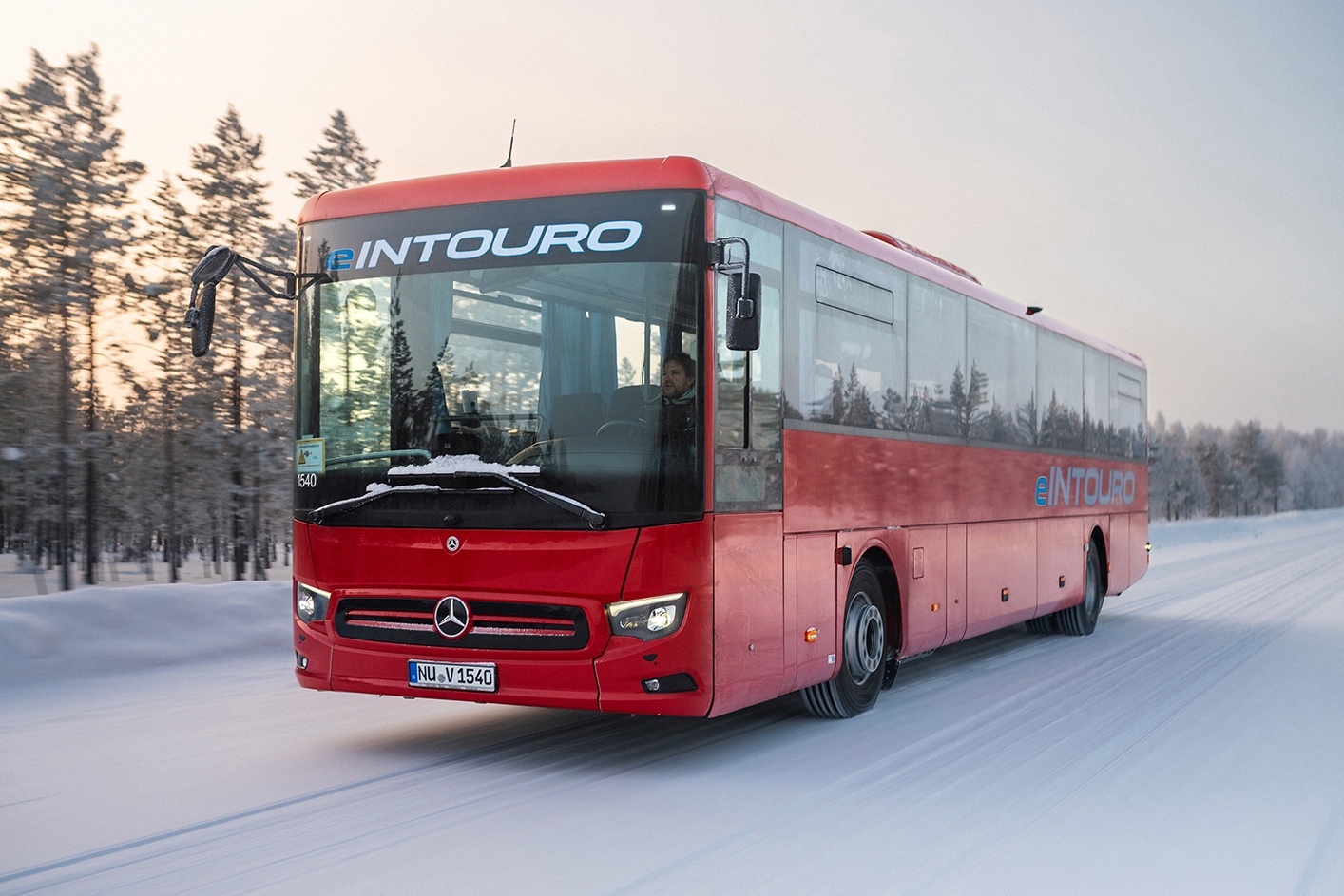
Leinfelden-Echterdingen – Bus operators place the same demands on electric-powered buses as they do on their conventional diesel-powered counterparts. Even in difficult weather conditions, when frost, ice, and snow come into play, the vehicles must simply operate reliably.
In this context, this year’s winter tests of two pre-production Mercedes-Benz eIntouro models in Rovaniemi, Finland, once again proved to be key endurance trials. The research and development team tested the first battery-powered intercity bus from Daimler Buses in extreme climatic conditions, such as snow-covered and icy surfaces, strong winds, and temperatures reaching as low as minus 30°C, in order to take action for further optimization based on the results obtained. All new Daimler Buses models undergo a comprehensive testing procedure before entering series production, which includes safety tests, endurance tests, and driving tests in extremely high and low temperatures.
During the test trip to Finland, engineers meticulously analyzed all functions and systems of both eIntouro units under real-world operating conditions. The team’s tasks included, for example, fine-tuning the drive control system and the central drive unit, as well as the three-speed transmission integrated into the central drive unit, and optimizing the brake management system, in which the electric motor’s recuperation plays a decisive role.
During the winter test drives, the eIntouro also had the opportunity to prove its capabilities over long distances: Daimler Buses engineers drove the eIntouro the entire 3,000-kilometer route from Neu-Ulm to Finland and back under its own power. They used only public charging infrastructure for charging. The ability to fast-charge the batteries allowed for short charging stops and a quick continuation of the journey.
Energy management in the spotlight
On-site in Rovaniemi, experts paid special attention to the performance of the eIntouro’s battery and electric powertrain in adverse weather conditions. To this end, cold start tests were conducted, the charging capacity of the high-voltage system at extremely low temperatures was checked, and the protection of drive components, software, and interfaces against low temperatures was tested. Furthermore, energy and thermal management systems were also subjected to intensive testing. The task of both these systems is to ensure that the batteries and the powertrain, as well as the passenger compartment and the driver’s workstation, are kept at the appropriate temperature while efficiently using the available energy, even in very low temperatures.
The winter tests also included numerous tests of driving and braking parameters on surfaces with varying grip. These tests were used, among other things, to fine-tune all safety-critical systems, such as ESP and ASR, as well as driver assistance systems.
Operational capability even in winter conditions
Martin Teigeler, Head of Product Engineering at Daimler Buses: “Our comprehensive tests regarding the operation of the battery and electric powertrain in extreme sub-zero temperatures and the behavior of the vehicles on icy surfaces or slush have provided us with not only valuable information for further optimization. They have also shown that the battery-powered eIntouro is fully ready for operation even in winter conditions.”
The first electric intercity bus from Daimler Buses
The Mercedes-Benz eIntouro is based on the already well-known high-floor Intouro model with a diesel engine, but differs from it with its battery-electric drive. Thus, Daimler Buses provides for the first time the opportunity to switch to electromobility in classic intercity transport, school transport, and shorter tourist routes.
In addition to the 12.18-meter-long eIntouro model, the 13.09-meter-long eIntouro M will also be available, which will allow for the implementation of variants with seat configurations ranging from 50 to a maximum of 63 seats. The eIntouro is the first European bus in which software updates can be installed wirelessly (Over-the-Air) without the need for a workshop visit.
Source: Daimler Buses Polska Sp. z o.o.