








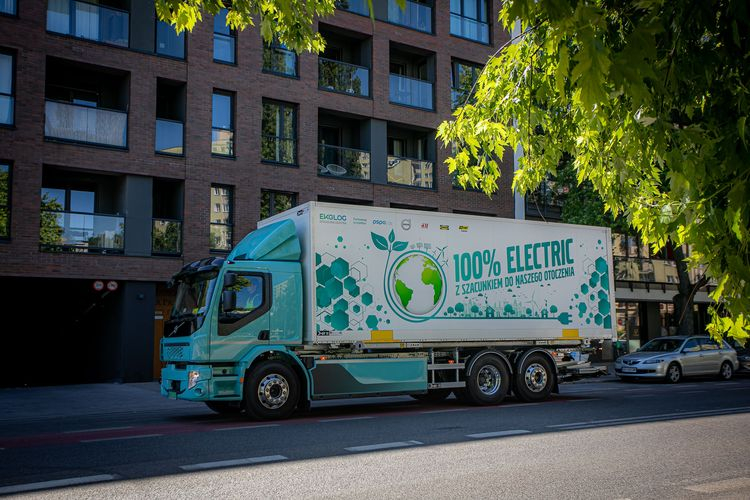
The data collection stage of the EKO-LOG project, carried out by the Polish Alternative Fuels Association (PSPA), has concluded. This is the first study in Poland of a mass-produced, 100% electric truck. The tests have shown that the electrification of heavy transport brings a number of environmental benefits.
As part of the first stage of the EKO-LOG project, an all-electric Volvo FE covered a total of 5,056 km. During the study, the electric truck reduced CO2 emissions by 2 tons compared to a combustion engine vehicle1. To produce the equivalent amount of saved carbon dioxide, an average passenger car would have to travel nearly 20,000 kilometers. PSPA evaluated the vehicle in 5 different aspects that are crucial from the perspective of TSL industry companies: efficiency, utility, socio-environmental impact, operating costs, and fleet management.
– Reducing greenhouse gas emissions generated by heavy transport is one of the key elements in the effort to improve air quality. Trucks are among the most invasive vehicles for the climate and the environment. They account for 5% of the total vehicle fleet moving across Europe, while being responsible for nearly 20% of the carbon dioxide emitted by the entire road transport sector – says Albert Kania from PSPA, coordinator of the EKO-LOG project.
The project was inaugurated on May 27 in Warsaw during a Volvo Trucks conference. The research stage, during which data was collected, lasted 2 months. As part of the pilot, the truck was integrated into the fleet of the company No Limit, which is responsible for logistics processes and delivery services for the other partners of the study – IKEA and H&M Logistics – on the route from warehouses located in Grodzisk Mazowiecki and Pruszków to collection points in Warsaw. The study also included testing the vehicle outside urban agglomerations during trips on the Grodzisk Maz. – Stryków – Grodzisk Maz. route. The goal was to determine the utility of electric trucks on longer non-urban routes.
– What has been achieved so far within the EKO-LOG project has confirmed our expectations regarding the use of Volvo Trucks electric vehicles in urban conditions. The first electric Volvo FE truck not only provides the expected range, but also guarantees the driver better working comfort, while also significantly influencing the time of deliveries. Our truck is meeting the hopes placed in it, and it is possible to complete all the partners’ tasks, and even take on additional orders – says Piotr Werner, Product Digital Marketing Manager at Volvo Trucks Poland.
– The EKO-LOG tests have come to an end, and it is time for summaries. During these two months, we checked the vehicle in various operational configurations, on short and longer routes. Over 5,000 kilometers traveled allowed us to gather interesting observations and conclusions, not only regarding the vehicle itself and its range, but also regarding charging infrastructure. More details will certainly appear in the summary report – says Maciej Rybak, Director of Service Line Home Delivery at No Limit.
During the test, the zero-emission Volvo’s powertrain consumed a total of 6,075 kWh of energy with an average consumption of 120.15 kWh/100 km. Regenerative braking technology allowed for the recovery of 1,024 kWh of energy, which enabled an additional 850+ km of travel. Nexity was responsible for monitoring and managing charging processes as well as providing technological support for the project. EKO-LOG allowed for the determination of a number of vehicle performance parameters in order to conduct a comparative analysis of operating costs. Three surveys were also conducted, as well as a comparison of noise emissions between the electric truck and a combustion truck on a public road, which showed that the electric vehicle can reduce noise emissions by nearly 10 times (by 9 dB) for the 0-30 km/h speed range. This is of particular importance during deliveries in urban areas. The surveys included, among other things, assessing public awareness of zero-emission trucks, determining their market potential, and gathering driver opinions on the utility aspects of zero-emission trucks.
The tests involved a fully electric Volvo FE Electric truck. The vehicle has a gross vehicle weight of 27 tons. The car was equipped with a three-axle chassis with a GT Trailers body and a box with a lift with a load capacity of approx. 13,000 kg, capable of holding up to 19 Euro-pallets. The Volvo has a battery with a capacity of 265 kWh, and on a single charge, it is able to travel about 200 km, depending on the configuration. Charging the vehicle with direct current (DC) takes approx. 2 hours, while replenishing energy with alternating current (AC) takes approx. 11 hours.
– Nexity Global actively participates in all initiatives contributing to the development of electromobility. This is the future not only for passenger vehicles but also for heavy transport, which is why we were happy to become a partner in the EKO-LOG project. We want to share our unique technology and knowledge in the field of monitoring and billing processes related to charging electric vehicles. According to research by the Polish Alternative Fuels Association, 73.1% of transport emissions in the European Union come from road transport. We believe that Nexity Global’s participation in the EKO-LOG project and the provision of appropriate technical knowledge will help contribute to real changes and reverse this trend – claims Jagoda Bugaj, Marketing Director at Nexity Global.
The research stage of the EKO-LOG project ended on July 31, 2021. Currently, the obtained data is being processed in detail and will be presented in the final report summarizing the results of the research. The official premiere of the report will take place on September 9, 2021, during the 4POLAND press conference organized by Volvo Trucks at the Jastrząb track near Radom.
– Reducing emissions related to heavy transport is a major challenge. The EKO-LOG project was a good opportunity to examine the possibilities of implementing electric trucks as an alternative to the conventional logistics fleet. We believe that progress can only be achieved through cooperation. Thanks to the partnership and participation in this project, we were able to share knowledge and experience and encourage the search for more sustainable solutions. Such initiatives are key for us and help us achieve our goals related to CO2 emission reduction. We are looking forward to the report summarizing the EKO-LOG project – concluded Michael Schulz, Logistics Regional Manager Region East Europe at H&M.
1 Average emission intensity for electricity in the EU based on: C. Redl, F. Hein, Dr. P. Graichen, D. Jones, The European Power Sector in 2020: Up-to-Date Analysis on the Electricity Transition, Berlin, Agora Energiewende, 2021, p. 5
Source: Polish Alternative Fuels Association