








In Europe, proper protection of a product ordered online is more important than whether the packaging is environmentally friendly. Conversely, in Poland, eco-friendly packaging is more significant than delivery by electric vehicle. Despite the often contradictory declarations of e-consumers, the sustainable direction chosen by logistics operators is being consistently implemented, although it is not easy to reconcile expectations, costs, environmental impact, and regulatory pressure. The latter element, in particular, poses a serious challenge.
The e-commerce packaging market has taken a sustainable direction
According to analyses by the international business intelligence firm Smithers, the global market for packaging used in e-commerce will reach a value of $73.3 billion by 2028, with an average annual growth rate of 7.5% between 2024 and 2028. In three years, the demand for eco-friendly versions of packaging could reach as much as $48.75 billion, which means a share of nearly 67% of the total e-commerce packaging market and an increase of 3 percentage points compared to 2023. As much as 80% of this share will belong to cartons, envelopes, and boxes made of cardboard, which in turn will translate into approximately 45 million tons of recyclable materials.
This is, of course, good news, but there will also be no shortage of challenges that not only e-commerce but also the logistics sector will have to face. According to Smithers, the most serious of these will be returns of products purchased online. As the firm’s analyses indicate, in 2022 alone, they cost the e-commerce industry $800 billion, which is almost twice as much as in 2020. The problem is already so serious that nearly 40% of online retailers worldwide charge for returns in some form. The very high costs of handling this process, including environmental ones, have become one of the main reasons for a change in retailers’ approaches, and it is precisely because of various types of burdens that increasing attention is being paid to the possibility of returning packaging along with the product. This is intended not only to facilitate activities on the part of consumers but also to streamline logistics while minimizing the amount of waste generated.
CleanHub also emphasizes in its 2024 report that online shopping requires up to 4.8 times more packaging than shopping in brick-and-mortar stores, and returned products contribute to generating additional pollution in the form of emissions and packaging waste, both plastic and paper.
E-consumers in Poland want eco-friendly and reusable packaging
The trend followed by the global market for packaging used in e-commerce is confirmed not only by demand forecasts but also by the actions of logistics operators serving e-commerce and research conducted among consumers who are making, or at least declaring, more responsible decisions in the area of delivery fulfillment.
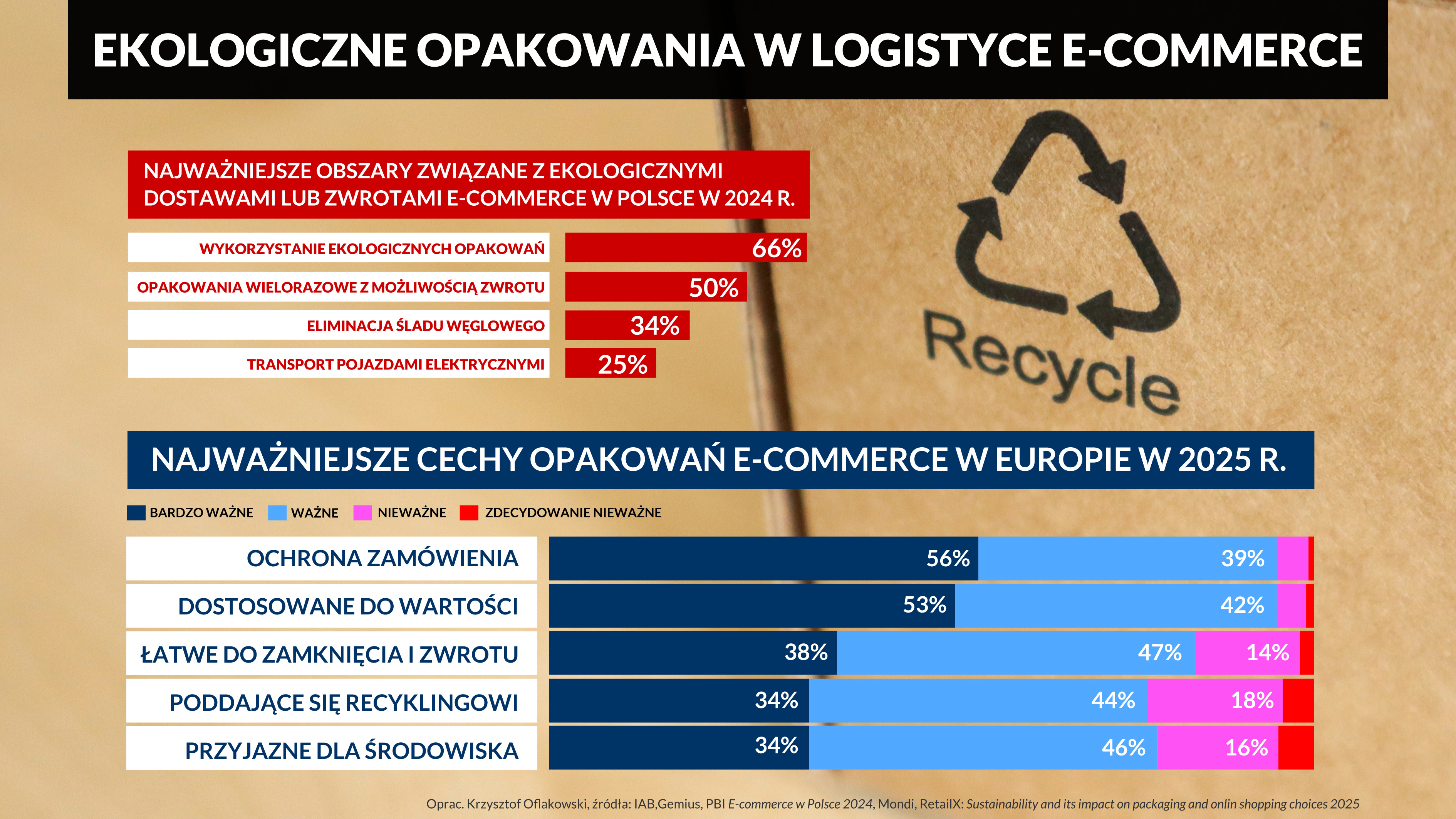
In Poland, such declarations are confirmed by, among other things, last year’s Gemius and PBI report on the e-commerce sector. It shows that despite a relatively low percentage of domestic e-consumers declaring that the impact of the delivery method on the environment is of significant importance to them (41%), for 66% of buyers, the most important issue related to eco-friendly deliveries and returns is the use of environmentally friendly packaging. Reusable packaging that allows for reuse for returning goods took second place in terms of importance (50% of responses). Eliminating the carbon footprint and deliveries by electric vehicles are clearly less important, chosen by 34% and 25% of respondents, respectively.
Europeans also have ambitious expectations, although only half believe in brands’ sustainable declarations
In February 2025, a number of interesting conclusions regarding packaging in e-commerce were also presented in a RetailX and Mondi study conducted on a sample of 6,000 European consumers placing online orders in Poland, the Czech Republic, France, Germany, Sweden, and Turkey. The analysis clearly shows that the importance of packaging as a factor influencing purchasing decisions is growing. Already in 2024, 76% of respondents considered this element a priority. In 2025, it is 80%. Furthermore, 87% of consumers claim that they prefer brands that use recycled materials for packaging.
In just one year, there has also been a 12% increase in e-consumers’ expectations that within the next 5 years, almost all their shipments will be delivered in biodegradable or recyclable packaging. Currently, 70% of online store customers want this. For retailers and the operators serving them, this is both an opportunity and a challenge to, on the one hand, fight for loyalty and new customer groups, and on the other, avoid traps in the area of greenwashing. The latter element is gaining importance, especially in the context of the fact that currently only 50% of online shoppers believe in sustainable declarations referring not only to packaging but also to brands’ pro-ecological declarations in general. However, the distance that customers show toward sustainable claims does not stop them from expecting that retailers should do more to minimize packaging-related waste. As many as 68% of respondents are of this opinion, and 76% want their orders to carry information that the packaging is 100% recyclable.
Logistics operators face a great opportunity, a major challenge, and a serious dilemma
On one hand, they must face EU regulatory requirements, the real needs of properly securing products, and cost rationalization; on the other, they must meet the expectations of their own contractors, and finally, skillfully seize the opportunity that arises from a pro-ecological change in approach to the entire order fulfillment cycle. Reconciling these factors is becoming particularly important in the face of the growing number of e-consumer demands referring directly to fulfillment operations, i.e., order fulfillment processes taking place in warehouses. The weight of the formulated demands is all the more significant because fulfillment accounts for almost half of the revenues of logistics operators providing services for e-commerce. According to last year’s calculations by Transport Intelligence, such operations accounted for 46.7% of the value (210 billion euros) of the entire e-commerce logistics market in 2023.
The problem, however, is that the e-consumer does not quite know what they want, and if they do, they do not want to pay for it
The RetailX study shows, for example, that despite ambitious demands regarding strict environmental standards, this is not the most desired or priority property of packaging declared by consumers. Absolutely the most important is the proper protection of the purchased goods. This factor is very important or important for a total of 95% of e-consumers (56% and 39% of responses, respectively). Next is packaging appropriately matched to the value of the product. This demand is also key for 95%, with the difference that slightly fewer, 53% of buyers, consider it very important, and 42% consider it important. The ability to reseal the packaging for returns is in third place (a total of 85% of responses), and recyclable packaging only placed fourth with a high importance priority at 34% and importance reaching 44% (78% total). The sustainable or environmentally friendly aspect is only in fifth place, followed closely by ease of disposal.
The discrepancy between declarations and real priorities is further reinforced by the fact that as many as 38% of e-commerce customers do not want to pay for packaging that meets their expectations at all. Only 27% of those ordering can pay an extra charge of no more than 1% of the packaging value, and 28% are able to cover an additional cost in the 1-5% range.
Does the logistics fulfillment market read expectations regarding e-commerce shipments well?
It seems that despite expectations that are not entirely consistent with each other, the logistics market and retailers are listening to European consumers. This is manifested, among other things, in declarations regarding the packaging in which their last online order was delivered. As many as 77% indicate that it was paper or cardboard, which is a share 10 percentage points higher than the global Smithers forecast for 2028. In Poland, the share of such packaging is 78%.
A significant percentage of customers also notice the efforts made toward sustainable packaging. Over the last 12 months, as many as 43% of Europeans have noticed an increase in the share of recycled materials, 41% have noticed an overall reduction in packaging materials, and 35% see that more and more products are being shipped in bulk. In Poland, these levels are 43%, 36%, and 38%, respectively.
The goal toward which the method of fulfilling online orders is heading in the context of packaging is established and clearly leads in the direction of sustainable development. In just the last 3 years, we have noticed a significant increase in the share of eco-friendly packaging on the market, which we currently estimate at about 70-80%. In the case of operations carried out for our contractors, the share of such packaging is already clearly over 80%. It is worth noting, however, that for some of our largest clients, who are also very large players on the Polish e-commerce market, we use exclusively eco-friendly packaging. By this, we mean both those that are recycled and recyclable, as well as reusable packaging that allows for returns. Selected brands already use only paper materials for shipping purposes, which is, of course, very pleasing. However, we also notice another very positive and interesting phenomenon, which we support and often recommend with the hope that such practices will become common practice in e-commerce logistics. Namely, we convince [clients] that packaging should not only fulfill protective and marketing functions but also be an educational platform, i.e., contain detailed information about the materials used and their potential for recycling. From an environmental point of view, a very important tip is also the method of disposal, e.g., indicating which bin to throw individual packaging elements into. An extremely practical and logistically justified solution is also a step-by-step instruction on how to reuse the packaging for returning a purchase. However, the packaging must be adapted for this, and from experience, we know that this form of climate responsibility enjoys great popularity among Poles shopping online
– says Agata Gąbińska, CSR Manager at ID Logistics Polska, which provides comprehensive logistics and transport solutions, e-commerce handling, and supply chain management in 18 countries.
Many functional solutions are also suggested by the digital world; for example, a QR code placed on the packaging can contain all kinds of instructions, information about emissions generated or saved, the location of shipment collection and drop-off points, and even the nearest addresses of the brand’s brick-and-mortar stores or locations where waste is collected. We also very much want e-commerce retailers to realize that eco-friendly behavior is in their best business interest. While it has been known for years that the environmental responsibility of brands builds loyalty and encourages consumers to make further purchases, much less understanding is attached to the fact that the lack of socially and environmentally responsible practices discourages crowds of customers from products with a specific logo. This also applies to the packaging in which these products are delivered
– adds Agata Gąbińska from ID Logistics.
Nothing discourages like waste
In the context of packaging and fulfillment processes, it is waste that has the greatest potential to discourage European customers from shopping at specific online retailers. The most negative impact concerns packaging that is too large in relation to its contents. 45% of buyers point this out. Not much less, 41%, will try to avoid a purchase if the packaging is difficult to recycle, and 40% if, after opening, it turns out that too much filler was used. It is worth noting, however, that the lack of sustainable packaging does not determine a definitive resignation from a purchase, as only 20% of respondents claim so. However, this is still one-fifth of all customers, which in a highly competitive environment is a very significant share that retailers cannot afford.
Some demands are very difficult to implement or are losing importance
Among the many expectations regarding packaging and the method of order fulfillment, there are also those that, from a purely operational or ecological point of view, are difficult to consider feasible today, even within the postulated time of the next 5 years. For example, 26% of e-customers want the retailer to organize waste collection and process it themselves as an incentive for using packaging recycling. On the other hand, the expectation that a courier will take the packaging in 5 years is losing popularity. Currently, 14% of consumers support such a solution. Last year, it was 20%. Fewer and fewer people, 10% of buyers, are also attached to the option of the order arriving without additional packaging. Last year, 15% of internet users wanted this.
A very interesting thread, however, concerns the fact that 21% of e-commerce consumers expect a refund for returning or delivering packaging to a collection point within 5 years. Compared to last year’s RetailX analysis, this demand lost 10 percentage points from the 31% level. The concept is interesting in that collecting packaging would require creating a system for its accumulation, rotation, and reuse, and the European Union has already looked into such solutions.
Regulation 2025/40 on packaging and packaging waste
According to EU assumptions, such a solution means organizational, technical, and financial arrangements, as well as incentives that enable the reuse of packaging in an open or closed system, e.g., through a deposit system ensuring the collection of packaging for reuse. This is just one of many paths intended to reduce the amount of packaging waste per inhabitant of the Community by 5% by 2030 compared to 2018. A threshold of 10% was set for 2035, and a reduction of 15% for 2040. According to EU officials, this should result in an overall absolute reduction of packaging waste by 19%, 29%, and 37%, respectively, for the entire Union. The regulation entered into force on February 11, 2025, but the start date for application was set for August 12, 2026, and in the case of many solutions, it was even postponed to 2030 or later.
Creating packaging rotation systems is only some of the decisions made
According to the adopted regulations, companies from the EU, and thus also logistics operators, will be obliged, among other things, to comply with the maximum percentage of empty space in collective, transport, and e-commerce packaging. It has been set at 50% and will enter into force on January 1, 2030. However, entrepreneurs who use commercial packaging as transport packaging in e-commerce, i.e., in practice, send products in factory packaging without additional layers, will be exempt from such an obligation. An alternative path to exemption will be the use of reusable systems. Either way, in both cases, entrepreneurs will be obliged to reduce the weight and volume of packaging to the necessary minimum ensuring functionality, both in terms of shape and material. From 2030, all packaging in the Union must also be recyclable, and the use of versions whose recyclability is less than 70% will be prohibited. Furthermore, recycling will have to be taken into account already at the design stage, both in terms of packaging construction and the materials used.
The e-commerce packaging rotation system will generate gigantic challenges for logistics
At the stage of work on EU regulations regarding packaging and packaging waste, analysts from McKinsey conducted a simulation of how such a system would affect, among other things, the costs and emissions resulting from e-commerce deliveries and what share of them logistics processes, and specifically transport, would account for. It turned out that this would cause far-reaching negative effects limiting the use of these solutions on a mass scale, especially in the context of logistics.
The non-food e-commerce sector in Germany was analyzed, i.e., categories such as fashion, electronics, and beauty. The simulation assumed a transition from paper courier bags with filler and paper boxes to protective plastic courier bags or PP boxes that are recyclable. The study assumed the collection of such reusable packaging from points located near consumers and their full redistribution to the next cycle of use, excluding the cleaning stage. It turned out that such a mechanism would result in, among other things, a radical increase in transport costs necessary to deliver packaging to operators, logistics centers, and distribution centers. In the case of reaching the profitability threshold, i.e., the level of 20 cycles, transport alone would be responsible for 70-80% of the costs associated with this process and 55-65% of carbon dioxide emissions per rotation. While the environmental benefit of such a solution is visible above 20 rotations, the need to clean reusable packaging will generate additional pollution, which will trigger the need to implement further rotations and lead to a greater number of transports.
The projected cost increase is as much as 205%
McKinsey also compared the financial and environmental effects for each type of packaging. It turned out that the cost of a single use of packaging with a minimum lifespan of 20 rotations, compared to a single use of paper packaging with a 90% recycling rate, increases by 50-60% in the case of courier bags and by 195-205% in the case of boxes. As mentioned earlier, transport would be responsible for 70-80% of this cost. It is also worth keeping in mind that even introducing reusable packaging to every tenth package would mean an increase in the costs of handling the e-commerce market in our western neighbor by about 30 million euros. Increasing the volume of reusable packaging in the system also creates additional challenges for logistics infrastructure, including storage, washing, and disposal after the assumed number of rotations is exhausted.
Emissions up by an additional 65%
Large changes following the implementation of a reusable packaging system are also visible in the area of emissions. In the case of replacing single-use bags with reusable ones intended for at least 20 rotations, emissions increase in the range of 30-40% for each cycle of use. The scenario of replacing boxes is a jump in pollution of 10-20% each time. The share of emissions coming from transport alone in this case is at the level of 55-65%. A completely separate consequence is also that the reusable system will require standardized packaging sizes, which in turn creates a risk of wasting loading and storage space, as not every packaging will correspond to the dimensions of the distributed product. The distance over which the container must be transported will also play a role, as it must ultimately return to the system and be used in the next rotation. According to McKinsey, successful operators of systems serving e-commerce will have to go through more than 20 rotation cycles before it is possible to achieve an emission reduction. In the case of food packaging, this can be as many as 200 rotations.
The European Union is also thinking about the need to establish a minimum number of cycles of use, and although a decision has already been made on the need to create packaging circulation systems, provisions regarding the scope of rotation are to be made by February 12, 2027. By that time, the necessary packaging formats are also to be established, which will take into account, among other things, requirements regarding logistics.