








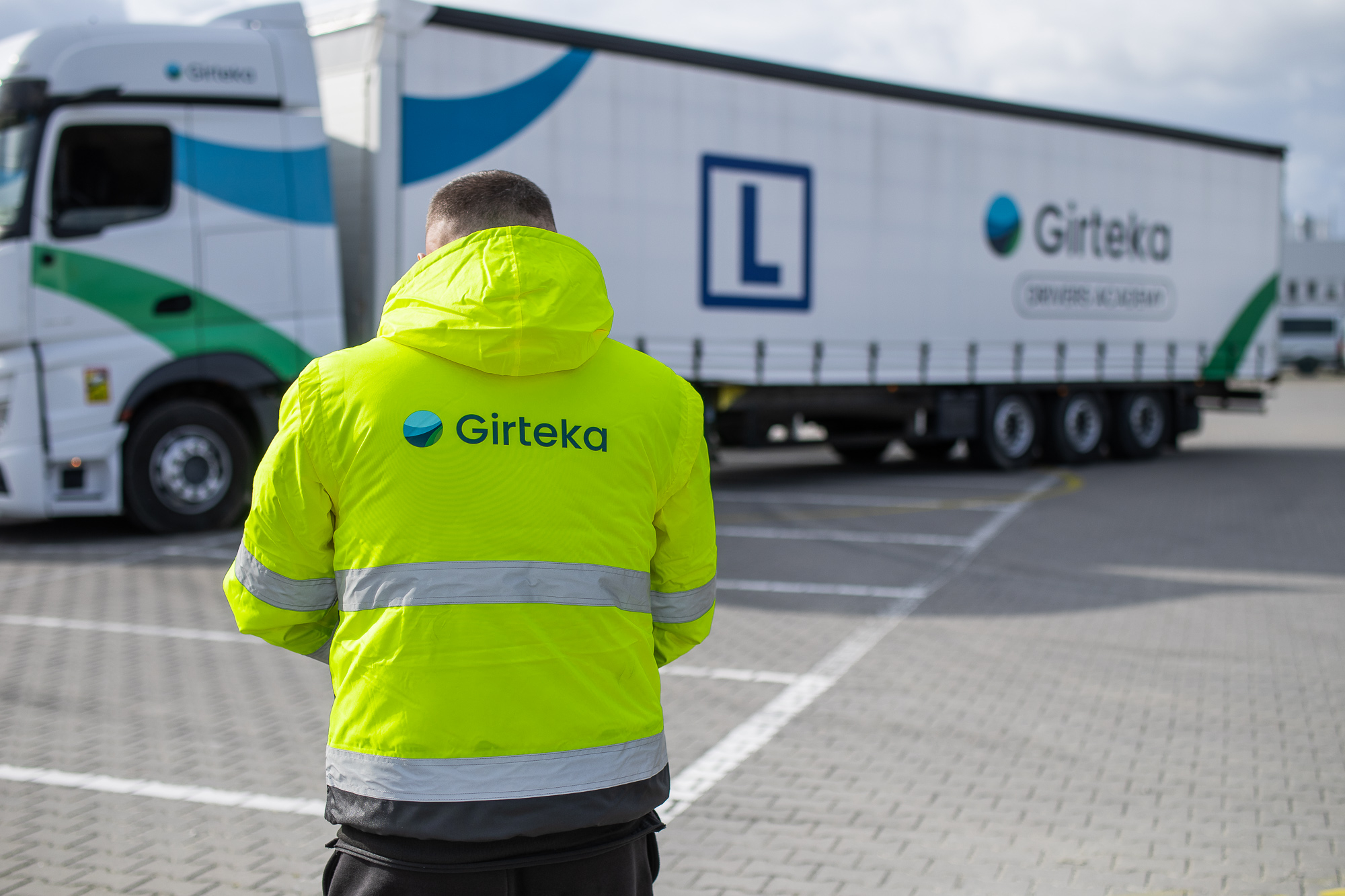
The pursuit of decarbonization is presenting the logistics industry with new challenges today. The lack of infrastructure, limited network capacity, the range of electric vehicles, and the costs of implementing alternative methods are the subject of many discussions and the search for optimal solutions. In this context, a simple and effective, yet often underestimated, method of reducing CO2 emissions in road transport is eco-driving. And here, the skills of drivers and support from transport companies are key. How do drivers themselves assess eco-driving and the benefits it brings? Uladzislau Piatrychyts, winner of the 11th edition of the ECO League program, organized by Girteka, a leading European road carrier based on the digitalization of services, shared his insights.
Eco-driving is a potential that can and must be utilized
Every day, goods are delivered on European roads by over 6 million trucks, with an average age of 14 years. Replacing them with zero-emission vehicles is either expensive or even impossible, given today’s manufacturer capabilities and the demand for emission-free logistics services. At the same time, the emission levels generated by older truck models significantly exceed the values specified in the currently discussed EURO 7 standards, as well as EURO 6, introduced to the market a few years ago. The logistics services sector, where heavy goods vehicles (HGVs) account for approximately 20 percent of all road transport emissions in Europe, is therefore facing a huge challenge in the pursuit of sustainable development.
Incentive programs, such as Girteka’s ECO League, which focus on driver behavior, are an opportunity for rapid change. Why is this a good solution?
Thanks to eco-driving skills, drivers can influence fuel consumption levels and, consequently, exhaust emission levels. Primarily because it can be used immediately, without the need for major investments. Moreover, it also brings additional benefits to drivers.
– In my experience, eco-driving directly affects road safety. It requires calm driving, with smooth maneuvers planned well in advance. This also affects the driver’s feelings. When you drive this way, you feel calmer – says Uladzislau Piatrychyts, a professional Girteka driver and winner of the ECO League.
Programs like ECO League increase driver motivation
Drive smart and safe! – this is the main premise and goal of the ECO League program, which Girteka has been developing for several years. Integrating a culture of economical driving, which uses advanced technologies and simultaneously improves road safety, does not just develop driver skills. In the ECO League, their driving is analyzed based on 8 different parameters, from engine idling, use of brakes and braking in extreme conditions, stopping, coasting, and cruise control usage, to its effectiveness and engine load. Combining this data allows the driver to obtain an eco-score, with a maximum rating of 100 points.
– One of the most important aspects of eco-driving is anticipation… And you cannot influence that. But you can influence your skills and move effectively through busy, difficult, or dangerous road sections – explains Uladzislau Piatrychyts, emphasizing that the program focuses on improving skills and safety. And such an approach affects the well-being of drivers. Piatrychyts also points out that eco-driving requires constant commitment, which may explain why some drivers are still hesitant to adopt it. – Eco-driving requires patience and work over a longer period – he notes, emphasizing that while results are not always visible immediately, in the long run, their impact is already significant.
Digital support is also important
New technologies and digitalization provide support in delivering fast and accurate information about driving performance. Drivers can easily use them and thus improve their skills.
– Thanks to the new fleet and telematics, eco-driving is simple and convenient. Some parameters have changed, and now driving has become easier and safer, and the results are better. Daily monitoring is also convenient because all information is always available online – explains Uladzislau Piatrychyts.
The experience and insights of Uladzislau Piatrychyts align with the goals and achievements of the ECO League program. Through education, the use of technology in providing real-time feedback, and daily support, Girteka’s actions contribute not only to the reduction of greenhouse gas emissions. They also allow for the building of a community of drivers specialized in eco-driving and thus promoting sustainable development.
Greater driver engagement, greater environmental benefits
The results of the ECO League program confirm that driver engagement, supported by education and modern technologies, enables the achievement of significant environmental benefits. Currently, the average distance covered by one truck is over 160,000 km. If emissions can be reduced for every 100 km traveled, the scale of the impact can be significant. And what’s more, this is already possible with financial outlays representing less than 1% of the investments required for solutions based on electric or hydrogen-powered vehicles.
It is also worth emphasizing that incentive programs, such as the ECO League, as well as other training or practical exercises, always bring benefits to drivers. As Uladzislau Piatrychyts says: “I wanted to be more than just a driver, I wanted to be a professional driver. The ECO League is based on many parameters that allow me to control and improve my skills in driving a truck”.
The ECO League program is an example of Girteka’s growing commitment to transport decarbonization efforts, which strengthens the company’s position as a responsible leader in the logistics services market. It also brings benefits to local communities, which is associated with the reduction of greenhouse gases, and to drivers, for whom it provides opportunities to improve skills and greater safety on the road.
Source: Girteka Group