









Forecasts for 2024 and the next few years point to the growing value of the logistics services market for e-commerce. A battle for the global podium is currently underway, but it is happening at the expense of Europe, even though the regional e-shopping sector is growing. Global estimates for e-commerce remain optimistic, yet it is clear that the growth momentum is weakening. Meanwhile, in Poland, we are observing the expansion of Asian platforms that are catching up with domestic players.
The global value of logistics services for e-commerce will grow by 10.5% this year. According to the British analytical center Transport Intelligence (Ti), an average annual growth rate of 10% will be maintained until 2028. This means that e-commerce logistics will develop almost three times faster than the entire contract market, for which this year’s growth forecast was estimated at 3.7% year-on-year, and at 3.8% for the years 2022-27. Such a large disparity could already be observed in 2023, when contract logistics increased revenue by 2.4%, while e-shopping support grew by 7.5%. In both cases, these were increases below the initial assumptions from the beginning of 2023, i.e., 3.8% for the contract market and 7.9% for e-commerce logistics, although the estimation for e-commerce support was clearly more accurate. If the forecasts prove correct this time, it will mean that in 2024, logistics operators handling e-orders will share as much as 496,515 million euros among themselves. Almost half of this amount will go to fulfillment, i.e., operations carried out in warehouses.
Current balance of power in e-commerce logistics
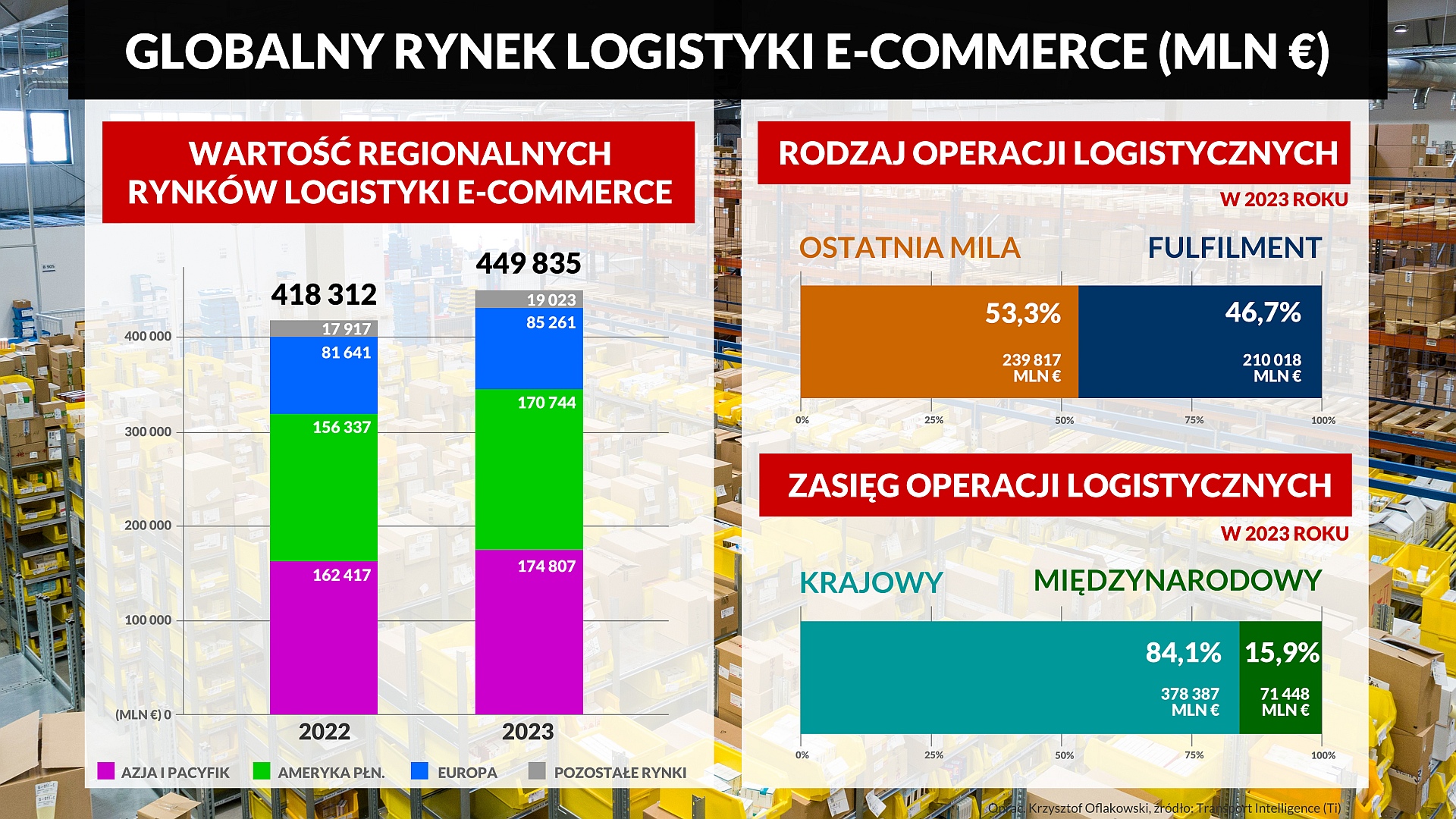
According to Ti, global revenues from logistics operations provided for e-commerce amounted to exactly 449,335 million euros in 2023. Data published in February this year shows that the biggest winners, as in 2022, were operators serving the North American market. They currently hold 38.86% of the logistics pie. This translates into services worth over 174.8 billion euros and an annual increase in global market share of 0.03 percentage points. This may be a small expansion, but combined with the size and still-growing potential of the local e-commerce sector (mainly thanks to the USA), North America has maintained the top spot on the podium for the second year in a row. In 2021, it still belonged to the Asia-Pacific region.
Far East leading in growth rate
The situation looks slightly different when looking at revenue dynamics, which in the case of North American companies reached 7.63% year-on-year in 2023, while for operators from the Far East, it was 9.22%. Asian logistics companies are growing significantly faster and are currently the runners-up in the ranking in terms of the value of services provided (170.7 billion euros). The difference, however, is marginal and amounts to only 4.1 billion euros. Second place currently gives a global market share of 37.96% and means only a slight expansion from 37.37% in 2022. However, considering the condition of the local economies, the size of internal markets, the growth rate, and the importance of the e-commerce sector, it is only a matter of time before operators from this part of the world regain the leader position in the global revenue ranking.
The world is running away from Europe
Unfortunately, the improvement in results in both North America and Asian markets is happening at the expense of the Old Continent. The European e-commerce logistics market is currently worth almost 85.3 billion euros and, in terms of revenues achieved in 2023, it grew by 4.43% year-on-year, which is below the global average. As for the share in the global market, it shrank by 0.57 percentage points (from 19.52% to 18.95%). Europe is losing out, even though indicators for the regional e-shopping sector are improving, especially in selected categories.
Who in the EU shops online?
According to the latest Eurostat data, as many as 92.35% of the EU population aged 16-74 used the internet in 2023, and 69.39%, or about 311.42 million people, made a purchase online for private use. This means an increase in the share of the population shopping online from 67.95% in 2022. In other words, 75.14% of internet users in the Union are already shopping there. At the Community level, three age groups deserve special attention. These are people aged 16-24, 25-34, and 35-44. Respectively, 82%, 87%, and 84% of them made purchases online last year, and it is thanks to them that growth at this level was achieved.
As for the data for Poland, we are performing slightly worse than the EU average. 88.11% of Poles used the internet last year, which is slightly less than the year before (88.43%). According to Eurostat, the total population aged 16-74 shopping online also fell to 64.32%. In 2022, it was 64.58%. Ultimately, this means that in 2023, exactly 73% of active Polish internet users made virtual purchases. Unfortunately, there was also a slight decrease here from 73.03% in 2022.
In a slightly broader view, among internet users shopping online on the Old Continent during the 12 months of 2023, the record holders are: the Dutch (93.09%), Norwegians (90.88%), and Swedes (90.5%). These are the only countries where this indicator exceeds 90%.
What do Europeans order most often and what does it mean for logistics?
An absolutely unrivaled product category in terms of the share of individual orders, and thus also generating the most individual logistics operations, is fashion, i.e., clothing, footwear, and accessories. In 2023, 43.61% of EU residents using the internet chose it. This is an increase of nearly 2 percentage points compared to 2022. Far behind fashion (18.54%) are orders from restaurants and catering services. The third favorite assortment is cosmetics and care products, i.e., the beauty segment. 17.63% of internet users placed orders in this category last year.
It is similar in Poland and many European countries. In 2023, 42.53% of Polish internet users ordered fashion products; 62.36% of the Dutch, 57.98% of the Danes, and 56.74% of the Swedes did the same. Bulgarians order the least clothing, footwear, and accessories, but it is still 25.05% of network users.
– Another year has confirmed that the fashion assortment, both in Polish and EU e-commerce, is secure. Even in the weaker 2023 for trade, fashion sold online achieved good results, both in terms of revenue and the volume of orders placed. The broken record of share is good news not only for us, as an operator specialized in serving the fashion industry, but also for the wider logistics market and the entire e-commerce industry in Poland. Improving conditions, even in individual segments of EU e-commerce, and even more so in the largest category, is most often a signal of upcoming investments in Poland, a harbinger of more modern warehouse space and new job offers at operators serving both domestic and regional markets. It is in Poland that distribution centers are increasingly being located, from which EU cross-border operations are conducted. Thanks to this, we are becoming a stronger regional player, which is confirmed by the latest CBRE data. It shows that the Polish online retail market already accounts for over 46% of e-purchases made in the CEE and SEE area. Also, in the GUS data, it can be seen that Polish e-commerce is doing quite well and is returning to form after declines in 2023. In January this year, total online sales in Poland increased by 11%, and the share of e-commerce in total retail was 0.5 percentage points higher than a year ago and amounted to 8.8%. As much as 27.2% of all textiles, clothing, and footwear in retail trade in Poland were sold online at that time. This is the largest share among the product categories monitored by GUS. The year began according to assumptions, and we expect further revival in Polish and EU e-commerce, also in cross-border orders – says Michał Wochna, Chief Operating Officer at ID Logistics Polska, which provides comprehensive logistics and transport solutions, e-commerce support, and supply chain management in 18 countries.
Where do EU e-commerce orders come from?
According to Eurostat, 52.01% of EU e-commerce consists of orders placed with domestic sellers, which means that most logistics operations are also carried out within the borders of individual countries. In the Netherlands, this indicator is 78.03%, in Sweden 73.86%, in Denmark 71.86%, while in Poland it is 53.13%. The data collected by the European Statistical Office concerns EU residents who used the internet during the 12 months of 2023 and made purchases in the 3-month period of the survey.
Apart from domestic e-shops, purchases made from foreign sellers, but still located within the Community, are also very popular. Intra-EU cross-border accounts for 20.32% of the order market, while in Poland it is only 7.15%. In turn, classic cross-border, i.e., all foreign purchases, regardless of whether they come from a country in the Union or outside it, account for 9.11% in Poland. At the EU level, it is 24.94%, and this share increased by 2.04 percentage points over the year, thus surpassing the pandemic year 2020 (24.3%).
Cross-border accounts for almost 16% of the value of global e-commerce logistics
Ti analysts also looked at cross-border orders, not because of their share, but from the perspective of the value of logistics services needed to handle them. According to their calculations, global cross-border e-commerce handling generated just over 71.4 billion euros in revenue in 2023 and currently accounts for 15.9% of the value of the entire sector. Similarly, the finalization of domestic orders accounts for 84.1% of the 449,835 million euro value of the entire market, i.e., it reached 378,387 million euros.
The proportion is much more balanced when it comes to e-commerce logistics revenues divided by the type of operations performed. The basic division includes fulfillment services and last-mile distribution. The latter operations currently account for 53.3% of the market, which gives 239,817 million euros, while fulfillment processes, i.e., the remaining stages of order fulfillment, account for 46.7%. This translates into a value of services reaching 210,018 million euros. Similar proportions in this field have been maintained for years, but Ti believes that automated order fulfillment processes in warehouses will be crucial in the future for efficient management of multi-channel sales, i.e., in the increasingly popular omnichannel model, understood as joint management of operations in the traditional and online channels. Consequently, services performed in warehouses will open up the possibility for operators to offer value-added services to operations already being performed. Everything, of course, depends on how quickly retail trade will develop, both in the stationary and online versions.
What are the prospects for online sales?
According to January analyses by Insider Intelligence eMarketer, global retail sales of goods and services via the internet (B2C) will reach 6.334 trillion dollars this year and will account for 20.1% of retail sales in general. This will be an increase of 8.8% compared to 2023. Data up to 2027 indicate two very clear trends. On the one hand, both e-commerce sales and their share in total retail trade will grow (in 2027 it will be 7.956 trillion dollars and 22.6% share). On the other hand, year by year, the dynamics of online sales will lose momentum, which will be a sign of market saturation. While global e-commerce sales grew by 10% in 2023 according to eMarketer, in 2027 the year-on-year growth will be 7.4%.
Sales of goods are more important for logistics
A different look at the e-commerce market, more responsive to the needs of logistics operators, was proposed by Statista Market Insights analysts. Forecasts from March this year for the B2C model, but concerning only physical goods sold to individual customers, speak of this year’s sector value of 3.226 trillion dollars and an average annual growth until 2029 at the level of 9.79% (to 5.145 trillion). This year alone, the market for physical goods sold online will grow by 15.6%, and as in the case of eMarketer forecasts, global dynamics will lose potential to reach 4.5% in 2029.
As for the EU market, revenue estimates for this year indicate 344 billion dollars and 11% growth. In the years 2024 – 2029, the market will grow by an average of 8.86% annually, and at the end of the forecast, it will reach 525.8 billion dollars. The value of the Polish sector was estimated this year at 13 billion dollars (an increase of 10.8%), and in 2029 at 20.45 billion. In the years 2024 – 2029, the market will grow by an average of 9.48% annually.
Expansion of Asian platforms on the Polish market
Poland still lacks a lot to reach the leading European e-commerce markets, hence the revenues generated by logistics operators still oscillate around the 8th place on the Old Continent. However, we are in an excellent situation in terms of growth potential, and there is still a long way to go before the domestic e-commerce market is saturated. Especially since the expansion of foreign platforms in Poland is gaining momentum. A very interesting situation in this context could be observed at the beginning of the year in the ranking of the largest e-commerce platforms operating in our country.
According to the Mediapanel study conducted by Gemius and PBI, after the December shopping peak, most large sales websites recorded a decline, but the number of users of Shein, the Chinese-Singaporean clothing giant, and Temu, the Chinese platform operating in the marketplace model, increased significantly. January data show that the latter service is only 3.7 million users away from the largest e-commerce service in Poland, i.e., Allegro. In January, Temu was visited by 14.92 million people, which in practice means that 50.21% of Polish internet users were on the platform. At the same time, 6.05 million users, or 20.38% of those using the network, visited the Shein e-shop in search of clothing, footwear, and accessories. This is not much less than visits to Amazon, which attracted almost 6.26 million people (21.09% of internet users) in January. The difference, however, is that the Asian fashion service gained 477.6 thousand users in a month, while Amazon lost 471.9 thousand. It is worth noting that in January, Aliexpress (59.8 thousand) and Temu, which recorded an impressive increase in visits of 1.287 million, also gained users.