









Electronic commerce already plays a significant role in our lives. Increasingly efficient, and above all, more convenient technology allows us to make purchases with literally just a few clicks. We are taking advantage of it! However, e-commerce is not just about digital technologies. Let us not forget the complex logistics infrastructure that delivers products to customers’ doors. And logistics is currently undergoing major development and significant turbulence. What kind? The Polish Institute of Road Transport has just presented a report that sheds light on the key aspects of logistics in e-commerce.
Online shopping has become the norm. Gemius reports that in 2023, as many as 79% of regular internet users declared that shopping online is standard for them. Consumers have increasingly high demands and expect fast and trouble-free delivery. Sellers, wanting to meet these expectations, must take care of deliveries. That is why logistics is a key element of business strategy today. Technology and innovations such as artificial intelligence, eco-awareness, or the ease and accessibility of purchasing in mobile applications drive progress, but they also pose new challenges. And it is the skillful adaptation to these that will be most important in maintaining competitiveness in the e-commerce market.
The situation in the courier market
The report “E-commerce Logistics. Where are we, and where do we want to be?” begins with an analysis of the situation in the CEP (Courier-Express-Parcel) market. In 2022, this sector handled nearly 922 million shipments and postal parcels. However, the PITD report estimates that in 2023, this figure reached 1,300 million courier shipments. In Europe, Poland leads the way in out-of-home (OOH) deliveries. In 2022 alone, our country had 29,000 parcel lockers. It is worth keeping in mind that this number is constantly growing, which reflects the growth in online trade. The question is whether we will be able to handle the increasing volume of orders placed.
Are returns a costly part of logistics?
Forecasts indicate that by 2027, the value of global online sales will increase to over 5.5 trillion dollars. This huge number suggests that sellers have reason to be happy, but not everyone will benefit to the same extent. Because, despite the dynamic growth in sales and the associated revenue, one must remember the distribution costs.
We also cannot overlook product returns. Their percentage is growing because stores compete not only on price but also on convenience and the promise of an easy cancellation of a purchase. A pro-customer return policy is an important element of business strategy, influencing customer satisfaction. However, it also affects the company’s cost-efficiency. Returns are a significant problem, especially in the fashion sector. It is worth noting that according to data from “Logistyka RP” dated September 18, 2023, forecasts for 2027 predict that the fashion industry will contribute to global revenues of over 1 trillion dollars, of which 259 billion dollars will come from Europe and 5.36 billion dollars from Poland. However, the percentage of returned orders here will be a staggering 17%!
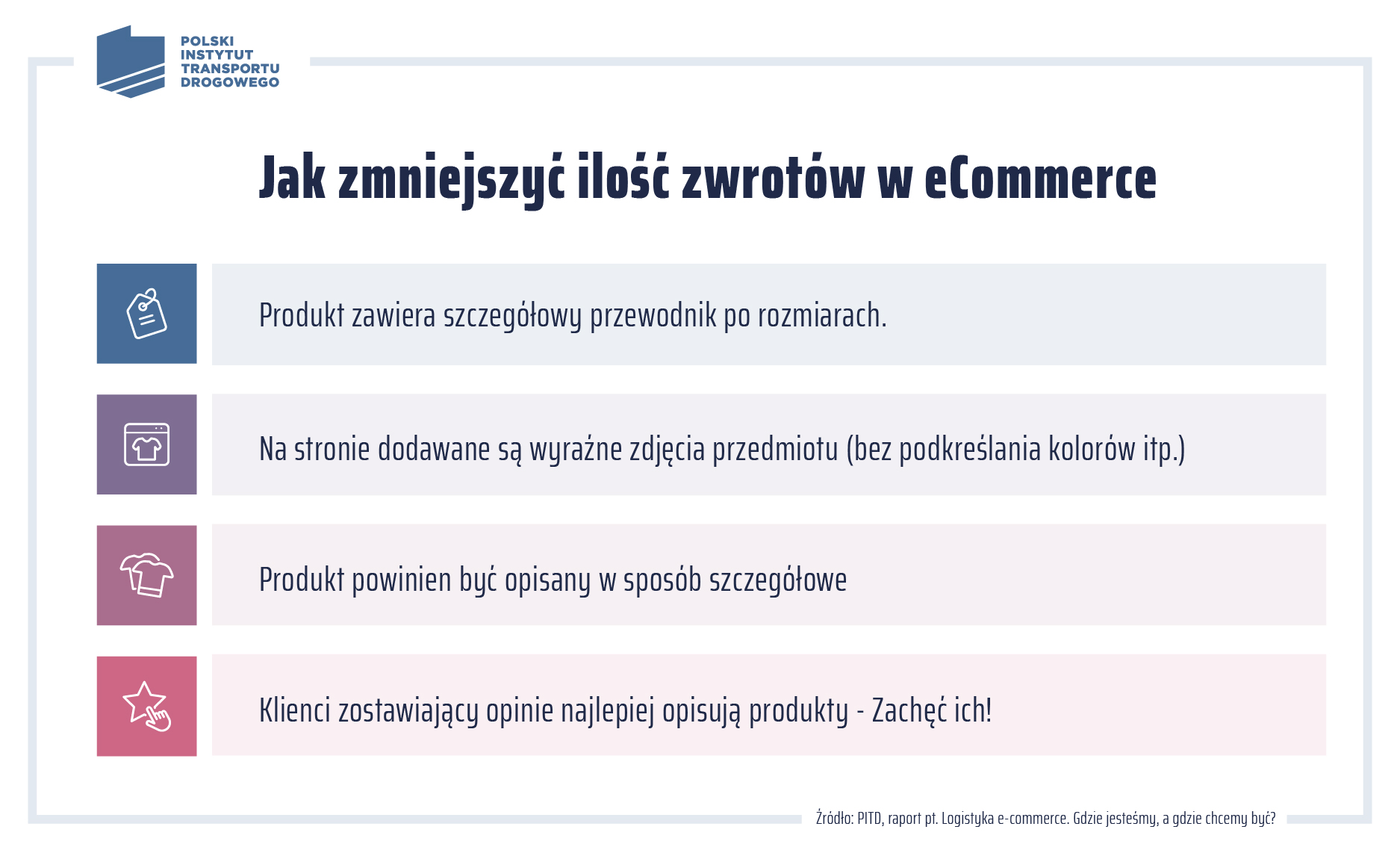
Returns pose a challenge for sellers and e-commerce-related logistics. The market value and the share of returns are key indicators requiring attention and a balanced approach from e-commerce owners in Poland. So, how much do e-commerce returns really cost, and how can they be addressed?
Optimization algorithms in logistics?
Nowadays, growing consumer expectations require the use of advanced optimization algorithms. Fast delivery and ecological transport methods are becoming the standard, which is why the use of advanced algorithms is becoming indispensable.
They are useful, for example, in order picking in the warehouse, where accuracy and timeliness are crucial for customer satisfaction. Methods such as single order picking, batch picking, or zone picking are analyzed for efficiency and optimization.
They are also important in optimizing transport routes and last-mile delivery, where they can be used to minimize costs and empty runs, as well as to adapt routes to specific constraints, such as time windows or capacity limitations, or to analyze routes and courier occupancy.
– There is, of course, no single recipe here, and much depends on the specifics of the market, e.g., the level of infrastructure development, population density structure, or legal regulations – points out Krzysztof Chaładyn, Vice President of the Management Board of Otimo Sp. z o.o.
Ecological stores and green logistics?
In the face of increasing environmental awareness in society, more and more suppliers are focusing on issues related to ecology in e-commerce. 42% of respondents declare that the impact of the delivery method on the environment is of great importance to them. Environmentally friendly delivery motivates nearly half of online shoppers. Analysts point to the great potential of new solutions in the area of sustainable e-commerce, especially in order logistics.
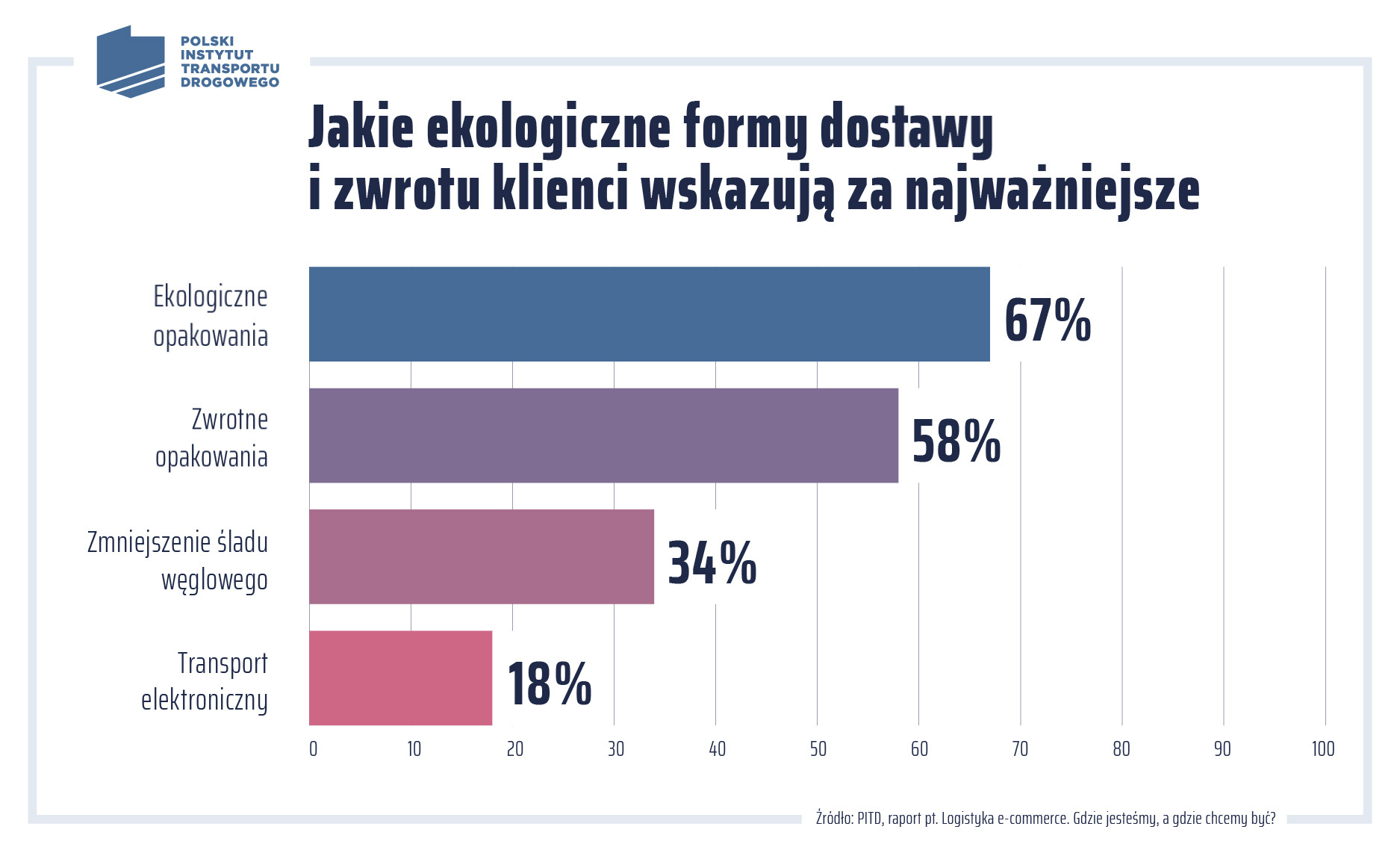
Implementing these solutions is becoming increasingly important due to the growing environmental awareness of consumers and entrepreneurs. For example, the introduction of transshipment hubs and cargo bikes can increase their availability and lower prices. The sharing economy, including the collective use of vehicles and shared parcel machines, also plays an important role in reducing environmental impact. Continuing the development of these initiatives can support the sustainable development of e-commerce. Experts also draw attention to issues such as the problem of greenwashing or clean courier transport.
Warehouse automation: the future of e-commerce warehouse logistics
Warehouse automation, in turn, is a direction that is gaining more and more importance in the context of warehouse logistics for e-businesses, in order to improve warehouse processes through the use of modern technologies, starting from receiving through picking and shipping of goods, as well as managing returns and complaints. Among the solutions already used in modern warehouses for the needs of intensive e-commerce order fulfillment, one can point to both warehouse management systems (WMS), thanks to which we are able to efficiently manage orders, and integrated MFC (material flow control) class systems supporting the supervision of warehouse automation systems.
– The e-commerce industry, in particular, needs these types of solutions to effectively face market challenges. Electronic commerce has broken the existing pattern of traditional logistics and is increasingly forcing logistics operators to implement automated solutions. Automation is one of the key factors in cost control, increasing efficiency and flexibility, and building a sustainable development strategy – emphasizes Piotr Streker, Fulfillment Director at 3LP SA.
Logistics development is not slowing down!
Understanding and optimizing logistics in e-commerce is a milestone for the further development of this industry in Poland. Many questions were raised in the text, but the answers to them can be found in the discussed report. At the end of the document, there are case studies that present the use of local return channels in the MODIVO Group, or the Four pillars of re-commerce at Expondo. We invite you to read it!
Report partners: Otimo, LODZistics – Logistics Business Network of Central Poland, 3LP, Alsendo.
Link to download the report: https://pitd.org.pl/logistyka-e-commerce-pobierz-darmowy-raport/