









Both the global e-commerce market and the logistics sector serving it have favorable long-term forecasts. Operators active in domestic markets, especially those offering omnichannel services, will earn the most. However, the unstable economic situation will bring price increases, which does not please e-consumers who, looking for savings, expect free service from sellers. A significant portion of them also have interesting demands regarding ecology, although few want to pay for climate protection.
Retail trade is stabilizing and slowing down
It has been predicted for months that the current year would be a period of significant slowdown in global commodity trade. Therefore, the latest forecast from the International Monetary Fund (IMF), according to which the global import-export volume will grow by only 1.5% in 2023, should not be a surprise. In 2024, it will be 3.2%. The World Trade Organization (WTO) also predicts that global commodity trade will grow by 1.7% this year, compared to 2.7% in 2022. The WTO, like the IMF, assumes that growth will reach 3.2% in 2024.
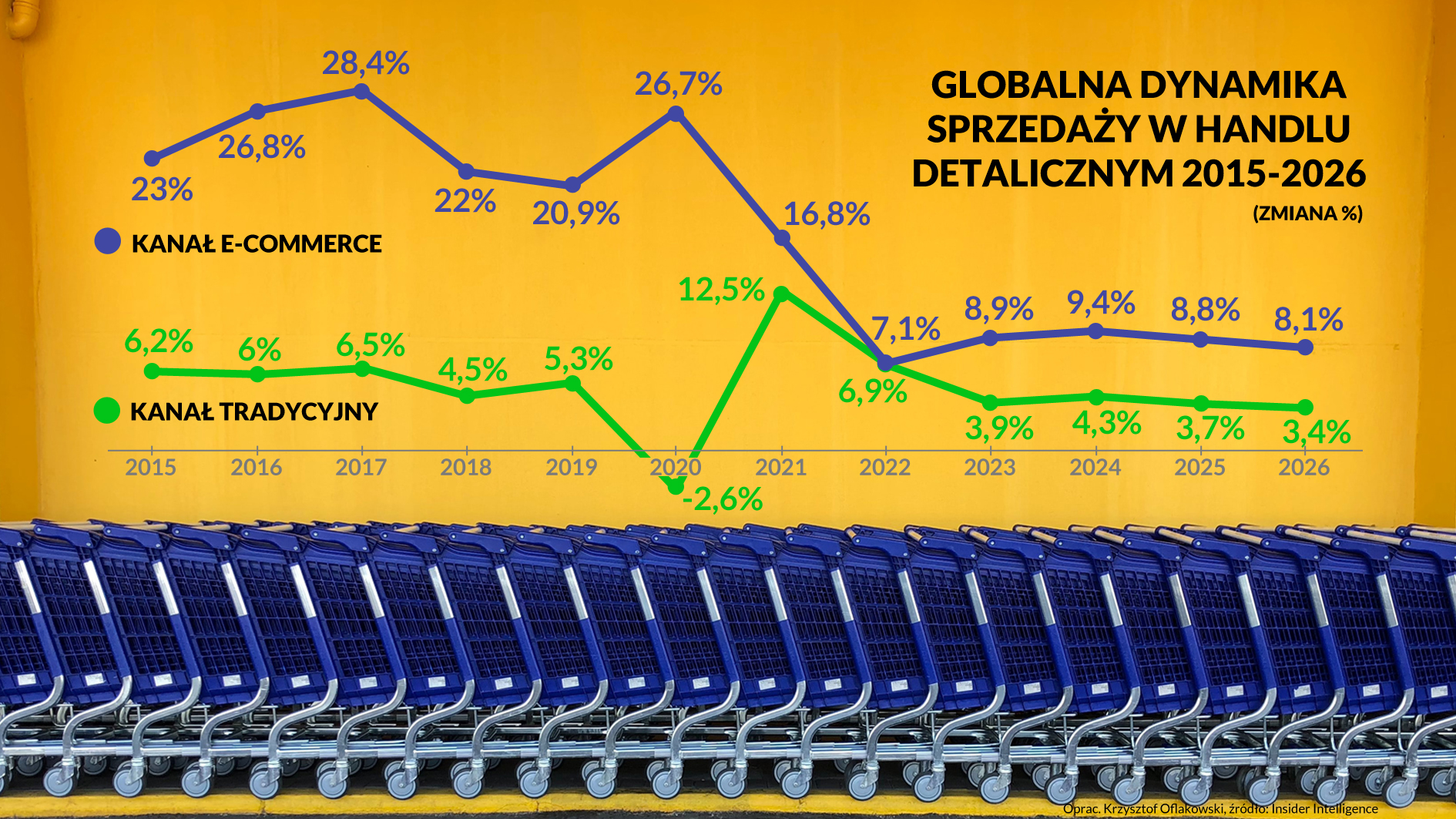
Consequently, retail sales, both in the traditional channel and e-commerce, will be slowed down for the longest time. The dynamics in both cases will flatten, and significantly so. According to Insider Intelligence analyses, the previous growth rate of global e-commerce, which has been fluctuating above 20% since at least 2015, and even 28.4% and 26.7% in 2017 and 2020, will fall below 10% per year and remain at this level until 2026. A significant dip was already observed in this market in 2021, from 26.7% to 16.8% and then to 7.1% in 2022. This year, the market is expected to grow by 8.9%, and in subsequent years by 9.4%, 8.8%, and 8.1% in 2026, respectively. Although the decline in dynamics is significant, online retail still performs better than the projected results for traditional retail sales. After a collapse and a negative value of -2.6% in 2020, it recorded a sharp rebound to 12.5% in 2021 and a weakening to 6.9% in 2022. Starting from this year, growth will hover in the range of 3.9%, 4.4%, 3.7%, to 3.4% in 2026.
A weak start to the year in global e-commerce, but a stable outlook
Considering the economic and geopolitical situation in the world, e-commerce still has a favorable growth outlook, although the beginning of the year was not very kind to the market. According to the Salesforce shopping index, in Q1 2023, global web traffic did increase by 6%, but digital commerce reached a negative value of -2% (compared to Q4 2022, 0%). The digital consumer growth indicator (-7%) and the average spending per visit to a virtual store (from 2.85 USD in Q4 22 to 2.3 USD in Q1 23) also reached negative values. Clear declines are also visible in the second-largest e-commerce market in Europe, namely Germany. According to the Federal Association of E-commerce (BEVH), the local market shrank by 5% in 2022, while in Q1 2023, sales fell by 15% year-on-year. The category that recorded the largest decline in the first quarter was fashion, including footwear and accessories (-20.8%). BEVH notes that despite the natural decline in shopping after the holiday period, the reductions in this case are also a result of a long list of geopolitical uncertainties, which is still growing. This causes consumers to postpone purchases that go beyond the strictly necessary, such as fashion, jewelry, or entertainment.
Fluctuations since the beginning of the year are also reported by the Polish Central Statistical Office (GUS). In January, the value of online retail sales fell in current prices by 32.7% compared to December, and e-commerce in “total” sales shrank from 9.5% to 8.3%. In February, a slight rebound in price terms (by 1.7%) and an increase in share to 8.7% were recorded. In turn, in March, there was a jump in terms of prices (by 14.7%), but the share of e-purchases in total sales fell to 8.6%.
However, long-term forecasts for online retail published by various organizations are optimistic. For example, according to Statista analyses, the average annual growth of global online retail (B2C) in 2023-2027 will be 11.3%. This year alone, revenues in the three largest markets will reach 2.055 trillion dollars in Asia, 1.137 trillion in the Americas (with the dominant role of the USA), and 722.4 billion dollars in Europe. As for the European market, starting from this year until 2027, it is expected to grow at an average annual rate of 9.97% and reach approximately 1.1 trillion dollars in four years. Taking into account the condition of the European economy, it can be said that this is a quite decent result, especially since the number of Europeans shopping online is constantly growing. This is confirmed by recent Eurostat data, which shows that in 2022, as many as 68% of the EU population aged 16-74 made purchases online. This is 1% more than a year earlier. Interestingly, as many as 51% of digital consumers in the EU made transactions with a seller from the same country, and this is reflected in the logistics market.
Stable e-commerce development is good news for logistics operators
Operators involved in this market will benefit from the sustained positive economic situation in online retail. This is indicated by the latest data from Transport Intelligence (Ti), which shows that the global market for e-commerce logistics services is expected to grow by 7.9% in 2023, reaching a value of over 451.2 billion euros. The entire sector will improve its results from 2022, when it shrank by 5% due to limited demand, which was a derivative of, among other things, the war in Ukraine, inflation, supply chain disruptions, and limited consumer spending. However, growth of nearly 8% can be considered quite modest if we take into account the dynamics of 2020 and 2021, when the sector grew by 28% and 19.9%, respectively.
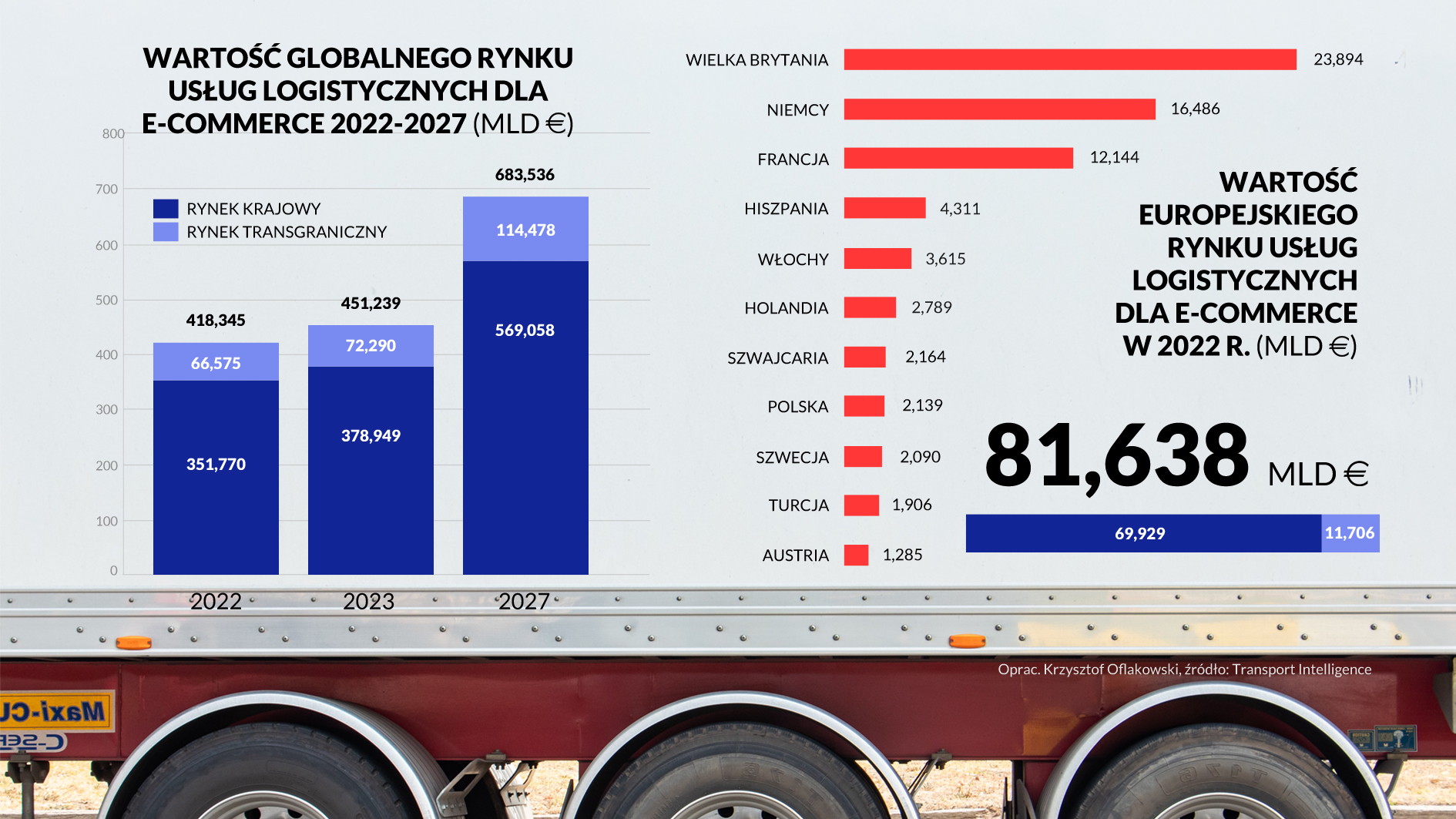
Transport Intelligence calculates that by 2027, the global market for e-commerce logistics services will grow at an average annual rate of 10.3%, and in all major markets, the largest revenues, reaching 84%, will be generated by domestic services. In 2022, a market worth over 418.3 billion euros was built primarily by such services. They generated nearly 351.8 billion euros. The remaining part, i.e., almost 66.6 billion, was due to cross-border services. This year, these proportions are expected to be over 378.9 billion to almost 72.3 billion euros (84% to 16%), and in 2027, over 569 billion to nearly 114.5 billion euros (83.2% to 16.8%). Analogous to the current relationship, domestic services will gain a significant advantage. In four years, the entire global market serving e-commerce is expected to reach a value of over 683.5 billion euros.
Good prospects for European companies
At the end of 2022, the European logistics services market working for online retail was worth over 81.6 billion euros, of which domestic services are valued at over 69.9 billion euros, which accounts for 85.6% of the sector’s value. The rest, i.e., 11.7 billion, was accounted for by cross-border services. In a more balanced proportion, approx. 43 billion euros to approx. 38.6 billion euros (52.7% to 47.3%), remain last-mile transport services versus warehousing services (fulfillment). However, the value of individual markets in Europe differs significantly. Great Britain (23.9 billion) clearly stood out from the rest of the countries, followed by Germany (16.5 billion), France (12.1 billion), Spain (4.3 billion), Italy (3.6 billion), the Netherlands (2.8 billion), and Switzerland (2.1 billion). In 8th place in Europe is the Polish market with a value of 2.139 billion euros. Behind us are Sweden (2 billion), Turkey (1.9 billion), and in 11th place, Austria with a logistics sector worth nearly 1.3 billion euros.
Logisticians, both in Europe and beyond, are convinced that despite the temporary slowdown in global trade, there will certainly be no shortage of work in the coming years. This is confirmed by a Ti study conducted in 2023 among over 70 professionals in the logistics industry serving the e-commerce market. The results of the analysis indicate that as many as 56.6% of them are convinced that within the next 5 years, online sellers will outsource more logistics operations outside their organizations. An additional 22.6% also believe that the current trend will at least be maintained, and only 18.9% claim that the outsourcing of logistics services will decrease. Only 1.9% are not convinced in which direction the market will develop. According to the respondents, outsourcing operations will be noticeable especially among stores conducting omnichannel sales, where the complexity of resource management is more complicated and requires greater investment outlays. On the other hand, not all online sellers are ready for additional expenses, especially since most TI respondents forecast an increase in logistics costs over the next 5 years.
– In the coming years, e-commerce service will become increasingly difficult. Not only will the volume of online orders caused by the growth of e-stores and their customers increase, but also the pressure on the speed and quality of service, both sales and after-sales. With the increase in efficiency and complexity, logistics costs will also grow, and we saw this clearly in recent years when the market was growing very dynamically. Price increases were additionally generated by external factors – completely independent of sellers, including, among others, fluctuations in the fuel market. Some of these factors are still visible, new ones have also appeared, and the large and still persisting unpredictability of the economic environment is a huge barrier to the development of enterprises. Hence the increasingly frequent decisions to outsource logistics operations outside the organization and turn to a sector accustomed to operating in changing macroeconomic conditions. Logistics outsourcing today is nothing more than the optimization of risk resulting from the nature of the business conducted. Trade wants to focus on sales, not on organizing deliveries and returns, especially in conditions of variable demand. In the coming years, e-commerce service will also be more difficult due to the still-maturing omnichannel sales model. During the pandemic, sellers had to give up traditional contact with the customer and moved to the web. Today, shopping malls have returned to favor, as a result, the share of e-purchases has fallen slightly, and this can be seen in the GUS data. At the beginning of last year, it exceeded 11%, now it does not exceed 9%. However, sellers want to remain on the internet, be online and offline at the same time, always close to the consumer, and provide services on many levels. For many of them, this is a completely new experience, hence the decisions to entrust operations to the outside – says Krzysztof Wawrzyniak, Director of Controlling and Process Optimization at Spedimex, a Polish logistics operator serving retail chains, shopping malls, online trade, and LTL and FTL transport in Poland and Europe.
The economic situation in the world is changing consumer behavior
Although there will be no shortage of work related to e-commerce service, both sellers and operators will have to face other challenges, namely, rapid fluctuations in the behavioral patterns of digital consumers and sometimes disturbing demands regarding deliveries. However, sudden deviations do not favor building long-term market and investment strategies.
How large these fluctuations are is well shown by an extensive study by Retail Economics and Auctane conducted in the UK, USA, Canada, Australia, Germany, France, Italy, and Spain. The results of the analysis prove that in the face of inflation, high interest rates, rising costs of living and maintenance, consumers have changed their behavior both in terms of shopping and delivery. According to the authors, consumers have re-evaluated their shopping priorities, becoming more focused on the price of goods, and this is an effect of fear for both the state of personal finances and broader economic prospects. Anxiety related to this prevails among 84% of respondents. Additionally, 73% plan to introduce changes in their shopping habits, and even in the group of wealthy customers, this percentage reaches 61%.
Evolution is also visible in terms of logistics service costs for purchases. This year, only 24% of consumers are willing to pay for the return of goods purchased online, which is a 4% drop compared to 2022. The focus on overall shopping costs is also well shown by another indicator, concerning 32% of e-consumers who pay more attention to the delivery price this year than to its speed. Price has become the most important factor in the entire order delivery process, and this percentage increased by 5% from 27% in 2022. On the other hand, delivery speed, which is currently important for 22% of online shoppers, has lost importance. Last year, this value reached 27%. Delivery convenience, including the choice of location or time window, is also ceasing to count (a drop from 23% to 18%), but more customers expect flexible returns (an increase to 10% from 9% in 2022), as well as the ability to track the shipment (an increase to 7% to 9%) and environmentally friendly deliveries (an increase from 7% to 9%). Incidentally, it turned out that customers increasingly value the ability to choose a sustainable delivery option (a jump from 74% to 79%), but immediately afterwards it turned out that only 7% of them declare that they are able to pay more for the possibility of compensating for the greenhouse gas emissions generated. Much more, because 38% prefer to extend the waiting time for the shipment to reduce emissions, and 34% to give up home delivery. Such results suggest that consumers who are considering making their own orders more sustainable are not currently ready to bear additional costs for this purpose. This percentage has not changed since last year, where it also amounted to 7%.
Sellers have slightly different views when it comes to the environment and service prices
For only 18% of online retailers, sustainable deliveries and reducing their impact on the environment are very important and constitute a key element of running a business. 21% of sellers consider these same factors important, but other sustainable actions are more important than green deliveries. In turn, 36% claim that environmental aspects are important, but current strategic priorities lie elsewhere. An additional 12% also say that these factors are not very important and they focus on other strategic priorities. For 13%, environmental aspects have no significance.
Unfortunately, different expectations are also visible in the area of prices. Not all sellers are able to meet the demands of customers sensitive to this aspect of deliveries, and as many as 28% of them plan to raise the related burdens. An additional 10% of sellers also want to raise return costs this year, and 43% product prices. Only 18% do not plan changes in any of these areas. An unfavorable cost balance makes all free options less common – especially in terms of returns.
– The last year was a period of a real revolution in terms of free delivery and return policies. The organizational and cost burdens turned out to be too large for many, even the largest online sellers. First of all, the scale of this phenomenon was surprising. Platforms all over the world have revised their regulations and either introduced fees or raised purchase thresholds guaranteeing additional benefits in the area of logistics service. This, in turn, created challenges in relations with customers who, accustomed to free services, do not want to accept additional burdens. Return logistics turned out to be particularly expensive, which involves assessing the condition of the returned goods, regeneration, and the procedure of reintegrating the product into the sales cycle – adds Krzysztof Wawrzyniak.
Retail Economics estimates that returns can reach as much as 30% of orders, while for the traditional channel it is less than 10%. According to analysts, the average cost of handling returned goods is approx. 20% of the value of the purchased goods, which in turn lowers the margin. However, customers are pulling the rope in their direction, and the percentage of those who want free returns is constantly growing. In 2022, it was 73%, currently, it is 76%.
E-consumer demands are becoming less and less realistic
Other studies also show that current customer expectations do not take into account the capabilities of sellers and operators. For example, the Shopify Commerce Trends 2023 report indicates that 66% of 900 global e-commerce brands believe that supply chain problems, which began with the pandemic and were then exacerbated by the war in Europe, will deepen this year. This, in turn, makes 68% of sellers negatively assess their own ability to meet customer expectations.
In turn, in the Sendcloud Consumer Research 2023 study, as many as 66% of e-consumers expect that there will be delivery price increases in 2023, yet as many as 62% of orders completed in the basket are abandoned because it turns out that the delivery price is too high. By the way, it also turns out in this analysis that despite the widely expressed concern for the environment, it is not the highest factor taken into account when choosing a delivery option. Shoppers still bet on service convenience, because the most preferred, and at the same time the least ecological, option is the standard home delivery option (50%). Next, the option of the next day (34%) or a specific day (31%) is indicated. CO2-neutral delivery is preferred by 19% of shoppers, but it only takes 7th place on the list of priorities. Earlier are, among others, weekend deliveries and deliveries at collection points (21% each) and same-day deliveries (23%).
An exceptionally interesting British market
The marginal importance of environmentally friendly deliveries is also visible in a study published at the end of March this year by the Statista service. An analysis conducted in the largest European e-commerce market, i.e., in Great Britain, shows that for local e-consumers, free delivery of goods ordered online is much more important than the issue of environmental protection. This is the most important criterion for 69% of those shopping online. For 54%, free returns and delivery speed (53%) are also important, as well as the ability to track (47%) and ratings given by other buyers (44%). Among the key criteria taken into account during e-shopping, issues related to climate protection are only in 6th and 7th place. For 38% of customers, minimizing the amount of packaging waste is important, and for 32%, the use of ecological materials for packaging. Only 12% pay attention to whether the delivery has a neutral impact on the environment in terms of CO2 emissions.
By the way, the British e-commerce sector is an exceptionally grateful and interesting market when it comes to environmental issues in e-commerce logistics. For example, according to the Retail Technology Show, as many as 76% of Britons believe that sellers could do more to be more sustainable in environmental issues. Interestingly, 50% even support the demand to impose an additional sanction tax on online sellers, which would neutralize the carbon footprint created during the delivery of their own orders. This demand is especially popular among Generation Z. As in other analyses, local consumers commonly declare the need to choose a green delivery option, but ultimately this is not what is most important to them. The priority is for the shipment to arrive quickly (68%) and not to be too expensive (53%), ideally if it is free (51%). Such results go hand in hand with analyses conducted by Asendia, which show that 48% of the inhabitants of the Islands would pay more for a faster delivery process, but only 23% would pay extra for fully carbon-neutral deliveries. In contrast, the voice of reason is undoubtedly the demand of 71% of buyers that sellers offer a repair service for purchased goods, which in turn fully fits into the philosophy of creating a green and sustainable economy.