









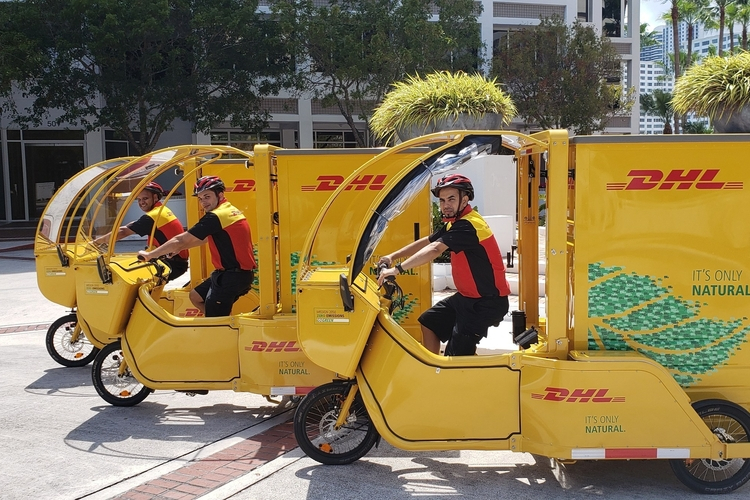
DHL Express, an international express service provider, in cooperation with REEF Technology, a company providing mobility and logistics services in North America, has been deploying three-wheeled electric cargo bikes for deliveries in Miami since 2020. The bikes, powered by an electric motor, are equipped with a special cargo container that allows couriers to carry loads of up to 180 kg. Annual use of an electric bike for last-mile delivery reduces CO2 emissions by 100,000 kg!
The project implemented by both companies was aimed at realizing the DHL GoGreen strategy, which assumes minimizing the carbon footprint associated with last-mile deliveries. DHL plans to implement green solutions for this delivery segment in 70% of its operations by 2025. Each e-cargo bike deployed by the company allows it to remove one conventional van from the streets, thereby contributing to reduced traffic, noise, and pollution, while ensuring fast and efficient deliveries for customers.
E-commerce, which has been growing rapidly in recent years (and has accelerated even further since the coronavirus pandemic), has significantly increased the demand for last-mile deliveries. Delivery companies are increasingly looking for solutions that not only allow them to efficiently handle the growing number of parcels but also remain in line with the concept of sustainable urban development. Electric cargo bikes are one such solution that is gaining popularity, especially in cities with higher air pollution, noise, parking problems, and traffic flow issues, particularly if their goals include, for example, reducing greenhouse gas emissions.
– Densely populated urban areas are the places where we have had the most success deploying e-cargo bikes to replace delivery van routes – 1 to 1 – says Greg Hewitt, CEO of DHL Express.
Many companies are setting ambitious goals for reducing greenhouse gas emissions, and electric cargo bikes fit perfectly into this trend, characterized by zero exhaust emissions. Research results from the consulting firm Salford indicate that a company can reduce CO2 emissions by up to 75% by switching deliveries from vans to e-cargo bikes whenever possible. In addition to environmental and health issues, e-cargo bikes alleviate problems related to parking, traffic, and congestion in cities. Depending on municipal regulations, e-cargo bikes can travel on streets or use bike lanes and cyclist-friendly zones, such as parks, to bypass areas with the heaviest traffic. Some cities treat couriers using e-cargo bikes leniently, allowing, for example, free parking in commercial parking zones previously reserved for delivery vans. This means that couriers can pull up to the delivery location, park right in front of the building, drop off packages, and head on their way, while at the same time traditional delivery vans would be wasting time sitting in traffic jams and looking for an available parking space. In this case, it often ends with parking in inappropriate places or blocking bus and car traffic.
In Poland, too, cargo bikes are gaining popularity and are increasingly used in large cities by companies such as Dachser, GLS, DHL Parcel, and DPD.
Based on: www.freightwaves.com