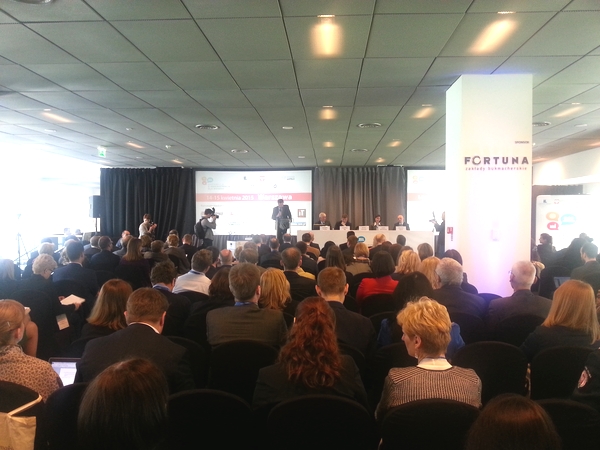
Over 400 participants took part in the second edition of the e-Administration for Business (EAB 2015) conference, which was held in Warsaw on April 14-15 this year. The conference was organized by three entities involved in the development of e-administration: the Ministry of Administration and Digitization, the Ministry of Economy, and the Institute of Logistics and Warehousing. The main theme of this year’s meeting was electronic services provided to entrepreneurs by public institutions. The organizers intended the conference to be a platform for information exchange for entrepreneurs, while also serving as an opportunity to present the development directions of e-administration.
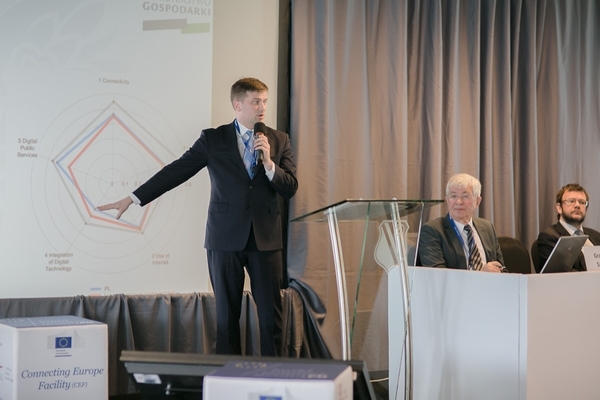
The conference was opened by Grzegorz Szyszka – Director of the Institute of Logistics and Warehousing, who in his speech referred to the memorandum developed by the organizers after the first edition of the EAB conference in 2013. Subsequently, Arkadiusz Bąk – Undersecretary of State at the Ministry of Economy – presented, among other things, indicators of the digital economy and digital society. It turns out that in these indicators, Poland reached a level of 0.38 in 2015, which placed it 23rd among the 28 European Union member states. It is optimistic that as many as 81 out of 100 people in Poland choose mobile broadband services. In this area, our country ranks 5th in the EU. Unfortunately, in terms of fixed broadband availability, we occupy only the 26th position.
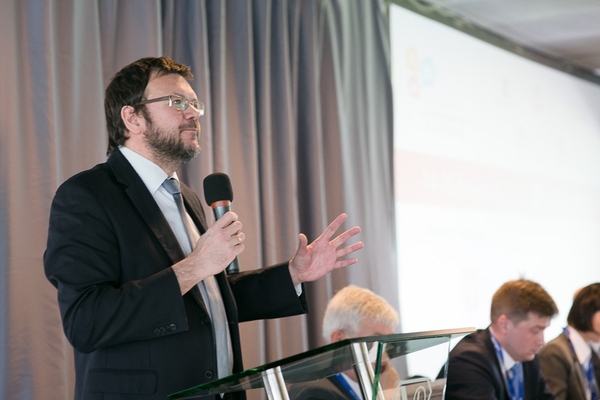
Roman Dmowski – Undersecretary of State at the Ministry of Administration and Digitization (MAiC) – drew attention to the issue of the so-called “public administration cloud” in small local government units. In this area, the development and pilot implementation of basic services in a dozen or so offices is planned. In his speech, Minister Dmowski also emphasized that the goal of the MAiC is not only to build digital infrastructure but also to take legislative and organizational actions.
A diagnosis of the state of electronic invoicing in Poland was the subject of a speech by Bogusław Bieda – Director of the Department of Electronic Economy at the Ministry of Economy – during the “E-invoice in public procurement” session. Our country ranks among the last in Europe in terms of e-invoicing. Over 1.5 billion invoices are issued annually in Poland, but only 10% of them are transmitted electronically. Significantly more companies receive e-invoices (25.35%) than issue them (5.5%). In the opinion of Tadeusz Rudnicki from the Institute of Logistics and Warehousing, a factor stimulating electronic invoicing in EU countries is the introduction of an obligation for public administration to accept invoices in electronic form, motivated by reducing state budget costs. As part of the thematic sessions, conference participants – representatives of public institutions and companies – were able to learn about, among other things, new e-services provided on the ePUAP 2 platform, solutions in digital customs service, administrative procedures at Single Points of Contact, and legal solutions enabling the further development of e-administration in Poland.
The topics of the second day of the conference concerned cross-border digital services. The proceedings were opened by Jean Francois Junger – a representative of the European Commission (DG CONNECT), who presented the directions for the development of e-administration in Europe. Thanks to the involvement of the e-SENS and e-CODEX projects, which co-financed the event, conference participants were able to learn about examples of good practices from abroad. The possibilities and benefits resulting from building efficient e-administration across national borders were emphasized. The aforementioned projects were presented by, among others, Carsten Schmidt – project coordinator from the Ministry of Justice of North Rhine-Westphalia, as well as Grzegorz Szyszka – Director of the Institute of Logistics and Warehousing, who presented their real impact on the development of cross-border e-public services. The current actions of the administration and judiciary in Poland, aimed at integrating national IT systems with those of other EU countries, were also presented.
On the second day of the conference, April 15, 2015, a partnership agreement regarding the implementation of the e-CODEX project was signed between the Ministry of Justice and the Institute of Logistics and Warehousing. On behalf of the Ministry of Justice, the agreement was signed by Eliza Wójcik – Director General of the Ministry of Justice. The agreement on behalf of the Institute of Logistics and Warehousing was signed by Grzegorz Szyszka. In the agreement, both parties declared joint actions aimed at implementing cross-border electronic judicial proceedings. The culmination of both the first and second day of the conference was a discussion with the participation of representatives of government administration, the judiciary, and business circles on the assessment and expectations of the business world regarding e-services. The conference organizers, listening to the opinions of the participants, are convinced that the event will contribute to the increase in the availability and quality of digital public services in Poland and invite you today to the next edition of the event in 2017.
You can read about the details of this two-day conference on its website.