









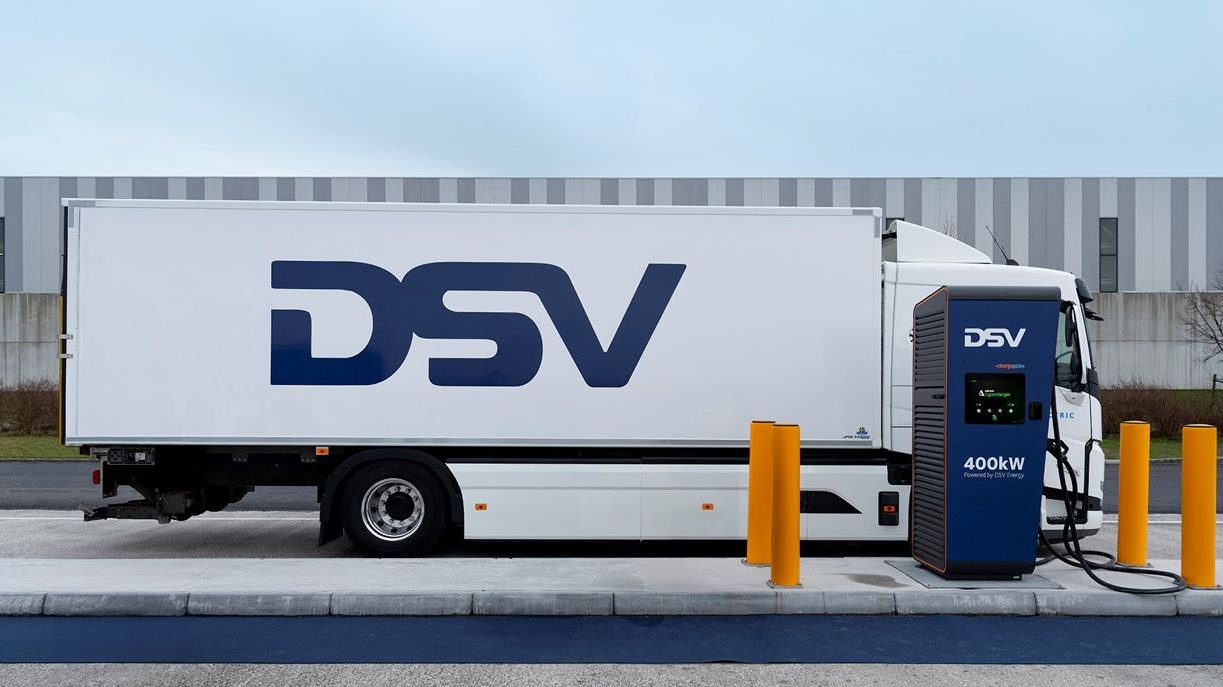
At the beginning of the year, DSV added two electric Volvo Trucks vehicles to its fleet, carrying out last-mile deliveries in the Łódź metropolitan area. After the first quarter, the operator is summarizing the initial findings from their operation. The latest study conducted for DSV shows that sustainability issues have a real impact on the purchasing decisions of 49% of Poles, and for 56% of respondents, supply chain transparency is an important or very important issue – in light of these data, actions for the decarbonization of road transport are gaining particular significance.
Road transport is the foundation of the product and goods distribution system in Poland and the European Union, without which it would be impossible to conduct daily business operations. At the same time, the wide range of heavy-duty vehicle usage in distribution means that the sector is responsible for 20% of all CO2 emissions in the EU. This means it is particularly sensitive to regulatory changes regarding permissible emission levels, as well as to changing consumer attitudes, who expect active measures to be taken for reduction.
As the survey conducted for DSV on a representative group of Poles shows, 49% of respondents take sustainability efforts into account when making purchasing decisions. An even larger group, as much as 56%, declared that it is important or very important to them that companies inform about the environmental impact of the transport and logistics operations of the products sold. This makes the issue of decarbonization an element of competitiveness for all sectors of the economy.
Increasingly, in inquiries from potential clients, one of the mandatory elements is to present information about the offer of solutions in the area of sustainable logistics. At DSV, we see this change both at the global and local levels. That is why the development of solutions in the area of sustainability is one of the priorities of our business strategy. One of the key elements of these actions is the development of our fleet of electric heavy-duty vehicles (BEV). DSV already has the most vehicles of this type in Europe.
– says Kinga Daniszenko, Sustainability Coordinator at DSV.
As part of implementing this strategy, at the beginning of the year, two VOLVO FL Electric trucks with refrigerated bodies joined the DSV branch in Łódź. The purchase was made as part of an international partnership between the Swedish manufacturer Volvo Trucks and the operator. The vehicles with a gross vehicle weight of 16 tons are used for last-mile deliveries for clients in the metropolitan area. What do the first experiences show? The success of the energy transition depends as much on battery capacity as it does on overcoming psychological barriers and driver skills.
The magic of planning
As the data collected during operations carried out from February to April 2026 show, the average daily distance covered by the cars grew month by month:
- February – average 130 km per day
- March – 166 km per day
- April – 200 km per day
On a record day, the distance covered per vehicle reached 266 kilometers. The operator’s experts attribute this progress to overcoming the psychological barriers of dispatchers who are responsible for planning routes.
In the first weeks of operation, dispatchers were very cautious about planning longer trips for fear of battery depletion and lack of energy to return to the base. Currently, after verifying the capabilities of the new vehicles in practice, these concerns are much smaller, and the distances are getting longer.
– says Piotr Czajkowski, Fleet Manager at DSV.
Driving without the brake
The primary factor affecting the operating costs associated with the use of electric trucks is driver skill.
The way they drive the vehicles has a direct impact on energy efficiency. The key is the recuperation of electrical energy during braking. This requires drivers, accustomed to working with internal combustion units, to reprogram deeply ingrained habits and use the brake less frequently.
Power deficit on Polish roads
Expanding charging capabilities – both on public roads and in logistics centers – is a key aspect for the further development of the use of electric heavy-duty vehicles.
While urban logistics are supported by investments from operators who are increasingly deciding to build their own charging infrastructure, e.g., in logistics centers, the electrification of long-haul transport is limited by an “energy ceiling.” Polish infrastructure, although growing (12,543 charging points in March 2026), remains extremely asymmetric. According to GDDKiA data, there are 487 charging points for passenger cars and only 5 for trucks available at motorway service areas (MOPs) on expressways.
For the needs of the operation in Łódź, we installed mobile charging points at our logistics center, enabling us to provide energy for vehicles while maintaining high flexibility, thanks to the possibility of moving the stations to another location. Thanks to our own infrastructure, our cars are perfect for “last mile” operations. However, for them to be able to go on longer routes, we cannot risk the battery running out on an expressway, where the vehicle’s driving characteristics are different. A steady driving pace drains the batteries faster, and the lack of traffic lights makes it impossible to use the recuperation system as it does in urban areas.
– points out Piotr Czajkowski, Fleet Manager at DSV.
Source: DSV – Global Transport and Logistics