








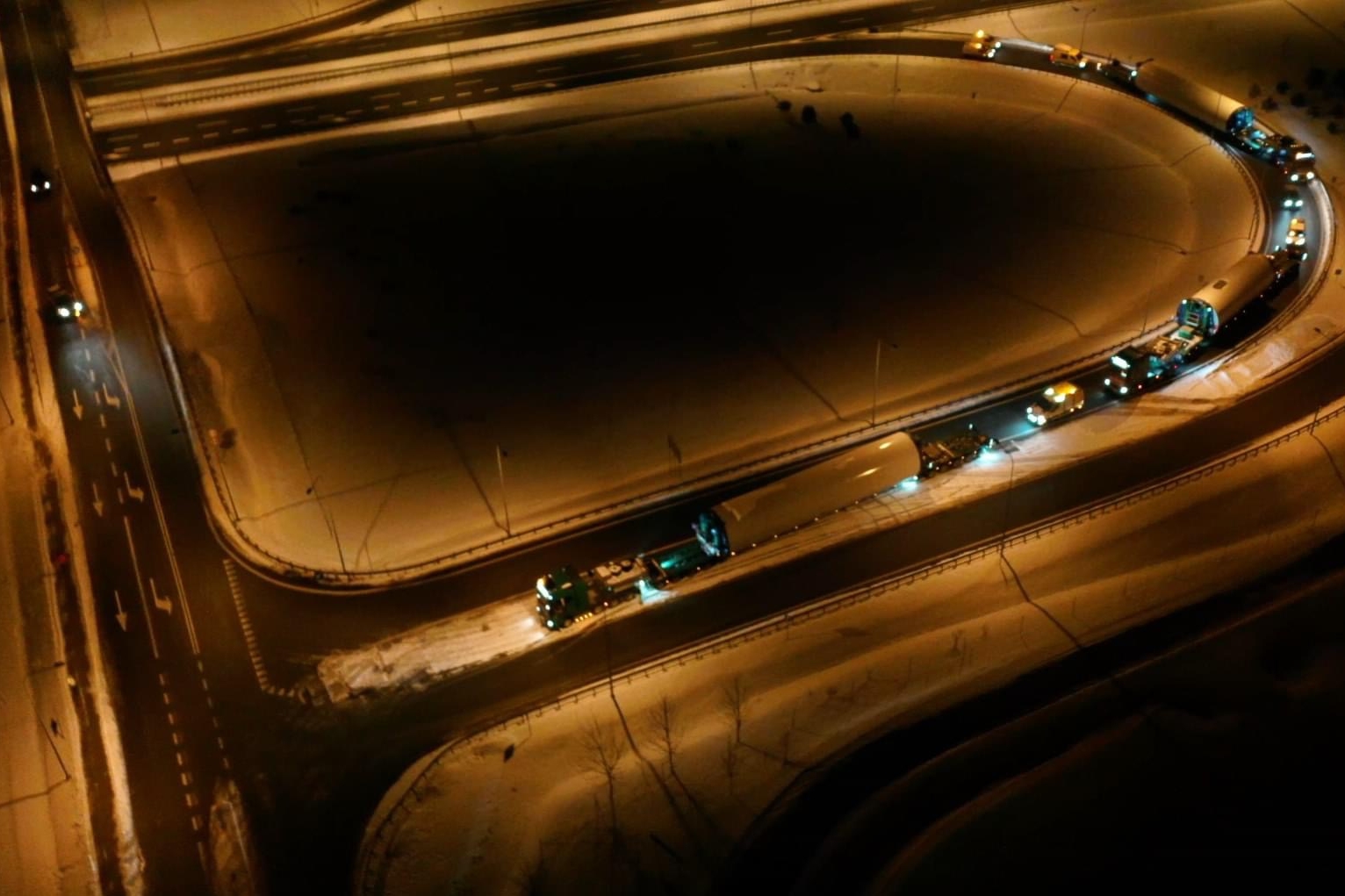
The energy transition in Poland is progressing, as evidenced by the increasing number of investments in renewable energy sources, including wind turbines. This is why a growing number of oversized transports can be observed on Polish roads. How are these types of transports prepared to ensure full safety and compliance with strict regulations?
Keys to success: physics, engineering, and geometry
Transporting wind turbine components requires detailed planning and precise route determination. Rotor blades can measure over 100 meters in length. For comparison, the maximum length of a standard transport set is 16.5 m. At this scale, every turn becomes a challenge, and every logistics plan is “tailor-made”.
In the DSV project logistics team, we follow one principle: everything can be delivered. It is only a matter of physics and good preparation. Executing projects in the wind energy sector requires specialized competencies in engineering, construction, and… geometry. This is essential to guarantee the safety of road users, the cargo, the infrastructure, and local communities.
– emphasizes Grzegorz Samoć, Director of the Project Logistics Department at DSV – Global Transport and Logistics.
DSV specialists are responsible for preparing the route plan. The first stage of this process is comparing the descriptions provided by maps with actual conditions during so-called site visits. Thanks to the data obtained, it is possible to create a digital model simulating the potential impact of the transport on the infrastructure. This allows for the identification of road infrastructure elements that will need to be rebuilt or reinforced to enable the transport. In this regard, DSV also cooperates with experts in geodesy or civil engineering, among others.
Transport supervision
The General Directorate for National Roads and Motorways plays a key role in the process of transporting wind turbines. This institution is responsible for evaluating the project documentation prepared by the operator, coordinating with road managers at the provincial, district, and municipal levels, as well as issuing comprehensive permits for the transport.
My experience indicates that at the route planning stage, direct dialogue with local communities, institutions, and local governments is very important. We conduct multilateral consultations with officials, the Police, or the Municipal Guard. We answer concerns and look for compromises together. For example, it is often necessary to rebuild roundabouts to flatten the surface for the duration of the passage. This theoretically small change can affect pedestrians and drivers. Therefore, we must demonstrate to local partners that our solution is not only necessary but also does not jeopardize the safety of road users.
– points out Grzegorz Samoć.
Benefits for local communities
Polish law imposes an obligation on entities transporting oversized loads, such as wind turbines, to restore infrastructure to its original state.
In many cases, however, the infrastructure must be changed to make transport possible – for example, by reinforcing the surface. Therefore, officials often agree with transport operators to carry out repairs using advanced materials that permanently improve the quality of the infrastructure.
Managers and participants very often oblige us to carry out repairs, including, for example, widening the road or even building sections of it from scratch. I believe that proper preparation and dialogue are the best guarantee of the local community’s interests, as well as a contribution to positive changes whose effects are visible for a long time. As an example, I will cite the transport of an 850-ton element for a petrochemical investment, which we carried out in Płock. After its completion, we carried out repairs to local roads, for which we used modern technologies. From the residents’ point of view, the only result of our passage is modern roads that provide them with higher quality and travel safety.
– says the project logistics expert.
In the context of wind turbine transport, a myth often appears regarding the harmful impact of the cargo weight on public roads.
For the transport of wind turbines, we use specially designed trailers consisting of a series of smaller modules connected to each other – the structure can be compared to a locomotive with carriages,” explains Grzegorz Samoć. – “Because we increase the total number of axles and wheels, it is possible to distribute the weight more effectively. Therefore, the force exerted per square meter of the surface is the same, and in many cases even less, than for a traditional 40-ton tractor-trailer set.”
Source: DSV – Global Transport and Logistics