









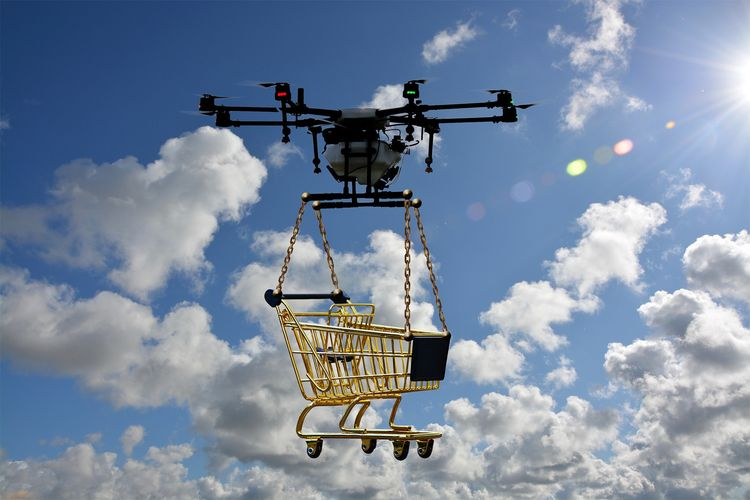
Stock shortages, improper product placement, and incorrect pricing are the cause of huge losses for retail chains. In the US alone, revenue losses are greater than in the case of theft, reaching a staggering amount of approx. 1.75 trillion dollars. Chains have been using robots equipped with artificial intelligence for years, and soon drones will be flying over our heads to count goods on shelves.
Robots scanning shelves in large stores are nothing surprising. Especially in the American market. There, machines assist people and—by driving from shelf to shelf—point out shortages or analyze when a given product might run out. The employee receives information and can quickly replenish the stock without wasting time walking aimlessly through store aisles.
On first-name terms with a robot
One of the first retail chains to start using machines to count inventory was Walmart. The American company has nearly 12,000 stores worldwide and employs nearly 2.5 million people.
– Robots were supposed to make employees closer to customers. A significant part of their working time is spent on activities related to stocking goods, checking if prices are correct, and ensuring that the assortment on the shelves is not mixed up by customers. These are simple, repetitive, and tedious tasks, but very time-consuming, and it is in such situations that robots best replace humans – describes Paweł Rytelewski, Vice President of the Management Board of SI-Consulting. – Interestingly, most employees of the American chain very quickly accepted this form of help. We simply like it when our work is made easier. Robots became part of the team, and it even happened that the machines were given name tags – adds Rytelewski.
At the beginning of 2020, about 600 robots were driving through the aisles of Walmart stores. The company wanted to double the number of devices, but suddenly resigned from signing a new contract with the existing supplier. The reason was not that the robots turned out to be non-functional or failed to perform their basic task.
– However, it turned out that the employees did not stop wandering between the shelves at all. They did not spend more time with customers, but instead focused on fulfilling online orders and… continued to wander between the store aisles – describes Rytelewski. Additionally, the coronavirus epidemic increased the number of online orders, because there were fewer “stationary” customers, so employees were more involved in checking stock shortages.
Will drones replace ground machines?
This does not mean, however, that further work on the development of autonomous technologies to support humans has been stopped. Moreover, another step, or rather a flight forward, has been taken. In the US, some stores, including the Circle K, General Mills, and Johnson & Johnson chains, will be equipped with drones that, like ground robots, will scan shelves in grocery stores. Drones will use image recognition technology (Smart Vision), and thanks to mobile phones, a quick analysis based on machine learning by artificial intelligence will be performed.
One of the advantages of drones is that their adaptation and implementation is much cheaper than developing an autonomous mobile robot from scratch. The manufacturer also ensures that drone technology is less invasive for customers who felt psychological discomfort when robots were driving through the aisles. Additionally, the drone propellers are to be secured with special cages so that they do not pose a threat to customers.
According to Pensa Systems – the drone manufacturer – introducing machines equipped with artificial intelligence into stores is not only a desire to equip employees with additional tools to facilitate work, but also an attempt to resolve a major financial problem for retail chains. Lack of adequate stock, inaccurate price implementation, and improper optimization of product locations in aisles cause huge losses. Lack of efficiency in this area costs American chains about 1.75 trillion dollars annually!
Source: Lightbe