










Proper accounting of a driver’s working time is not only a matter of regulatory compliance but also a factor that directly impacts road safety and the optimization of transport business costs. In the following article, we will present the general principles of driver working time accounting, the most common mistakes made during settlements, and the penalties for non-compliance with regulations in this area.
Why is proper driver working time accounting important?
Driver working time accounting plays a key role in several aspects:
- Regulatory compliance – Adhering to regulations governing driver working time is mandatory and aims to ensure compliance with labor law and avoid penalties. Driver working time is regulated by national and EU legislation, such as Regulation (EC) No 561/2006. These regulations define maximum daily and weekly driving limits, breaks, and rest periods. Compliance with these regulations is verified during roadside inspections.
- Road safety – Proper working time accounting minimizes the risk of accidents resulting from driver fatigue. Driver fatigue is one of the main causes of road accidents; according to studies by the AAA Foundation for Traffic Safety, it is responsible for up to 20% of all road accidents. Ensuring an appropriate number of breaks and rest periods in the drivers’ work schedule allows them to maintain good physical and mental condition, which directly affects safety while driving.
- Transport cost optimization – Effective management of breaks and rest periods affects driver productivity and, consequently, the company’s operating costs. Breaks planned at strategic points along the route allow for maximum utilization of driving time and minimization of downtime.
- Driver comfort – Proper working time accounting, including ensuring a sufficient number of breaks and rest periods, positively influences the relationship between employees and the employer. Satisfied drivers are more engaged and willing to cooperate for longer.
How is a driver’s working time calculated?
Definition of driver working time: A driver’s working time is not only the period spent behind the wheel but also other duties, such as loading, unloading, vehicle technical inspection, and periods of availability or other work related to transport.
Rules for calculating driving time:
- Daily limit – A driver may drive for a maximum of 9 hours per day. This limit can be extended to 10 hours, but no more than twice a week.
- Weekly limit – The maximum driving time per week is 56 hours, and the two-week limit cannot exceed 90 hours.
- Breaks and daily rest periods – After 4.5 hours of driving, a driver must take a break of at least 45 minutes. It can be divided into two parts: the first lasting at least 15 minutes and the second at least 30 minutes. The daily rest period is at least 11 hours (it can, however, be reduced to 9 hours three times between two weekly rest periods).
- Weekly rest periods – Regulations also govern the driver’s rest periods falling within a work week. A regular weekly rest period for a driver should last at least 45 hours. A driver has the right to reduce it, but to no less than 24 hours. Furthermore, every reduced weekly rest period must be compensated by an equivalent period of rest, which must be taken in full before the end of the third week following the week in question.
Registration of driving time, breaks, and rest periods is performed using tachographs, which are mandatory equipment for vehicles with a permissible total weight (GVW) exceeding 3.5 tons. Data from these devices must be regularly analyzed and archived. Tachographs play a key role in monitoring and complying with driver working time. Thanks to tachographs, both drivers themselves and their employers have accurate records of working time, which allows for ongoing control of compliance with applicable regulations. Digital tachographs, introduced as mandatory in new vehicles since 2006, record data in electronic form, which facilitates their analysis and archiving. Regular reading and analysis of tachograph data allow for the identification of potential driving time violations or failure to comply with mandatory breaks and rest periods. Thus, tachographs contribute to increasing road safety by minimizing the risk of accidents caused by fatigue. Furthermore, tachographs are an essential tool during inspections carried out by labor inspectorates and transport services. According to regulations in force since the end of 2024, tachograph data must be stored for a minimum of 56 days.
Are you performing express transport and looking for loads for vans? Check here: https://www.timocom.pl/serwis/gielda-transportowa/busy
Who can account for a driver’s working time?
According to the regulations, the employer is obliged to keep records of each driver’s working time. The employer bears responsibility for the compliance of the settlements with the regulations. The company owner may also delegate the keeping of records to a qualified employee. It is also possible to use the services of an external company specializing in driver working time accounting (outsourcing).
How to account for a driver’s working time?
Accounting for driver working time requires knowledge of regulations in the field of labor law, road transport, and tax regulations.
An important aspect is the changes resulting from the Mobility Package, and in particular the amendment of May 2022, which changed the rules regarding the accounting of work in the context of international transport. These changes eliminated the treatment of international transport as a business trip, which significantly affects the way costs associated with this mode of work are settled. Furthermore, the possibility of paying per diems in international transport, which was previously a common practice, has been abolished.
To properly account for a driver’s working time, a detailed analysis of working time and the inclusion of all activities performed by drivers is necessary. This process requires detailed recording of start and end times of work, the number of hours worked (including night hours from 9:00 PM to 7:00 AM), as well as recording the number of overtime hours exceeding the standard 40 hours per week. It is also important to keep documentation regarding days off, on-call hours, and any leave from work.
Importantly, according to Art. 6 of the Act on Driver Working Time, a driver’s working time includes not only driving the vehicle itself but also a number of other activities, such as:
- loading and unloading of goods,
- supervision of loading and unloading,
- assisting passengers boarding and alighting from the vehicle,
- forwarding activities,
- daily maintenance of vehicles and trailers,
- performing official tasks or ensuring the safety of persons, the vehicle, and goods,
- administrative activities,
- cleaning and performing activities related to vehicle operation.
The period of availability for work, including waiting time for loading or unloading, is also included in the driver’s working time.
More information on accounting for driver working time in accordance with the Mobility Package can be found here: https://www.timocom.pl/newsroom/seria-deep-dive-czas-pracy-kierowcy-w-pakiecie-mobilnosci-cz-1-391896
What mistakes to avoid when accounting for driver working time?
The most common mistakes include:
- Lack of regular reading of tachograph data.
- Incorrect documentation of breaks and rest periods.
- Ignoring maximum driving time limits.
- Improper calculation of daily and weekly rest periods.
- Incorrect recording of availability periods.
- Storing tachograph data for too long.
- Lack of appropriate training for drivers.
- Non-compliance of settlements with applicable regulations.
- Lack of monitoring of changes in regulations.
- Not conducting regular audits of settlements.
Penalties for exceeding driver working time
Financial penalties are provided for violating regulations regarding driver working time, which can be imposed on drivers and entrepreneurs. It is worth familiarizing yourself with the tariff contained in legal acts to be aware of the risks and properly manage driver working time.
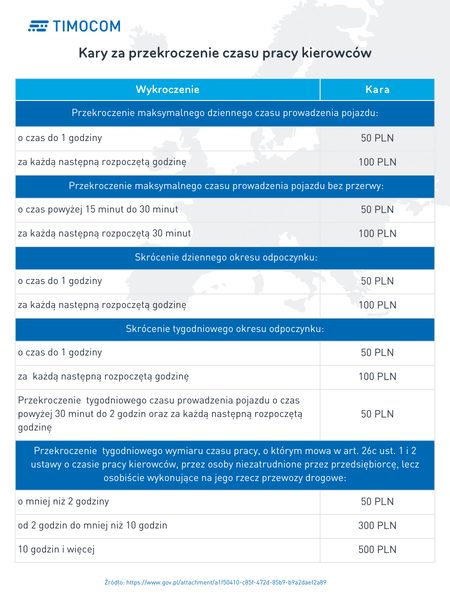
Regular audits and systematic monitoring of regulations can help in avoiding these penalties.