








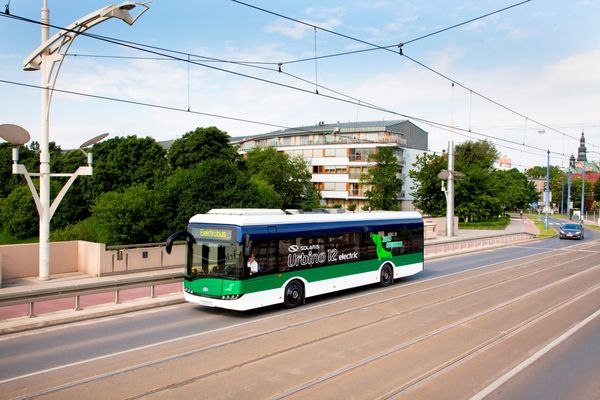
Solaris has signed another contract for the delivery of an electric bus to the German market. The twelve-meter vehicle will be delivered to the municipal transport operator in Dresden as part of the “Elektro-Buslinie 79” project, which is part of a special program implemented by the states of Bavaria and Saxony called “ELEKTROMOBILITÄT VERBINDET” (transl. “Electromobility connects”).
The Solaris Urbino 12 electric will be delivered to Dresdner Verkehrsbetriebe AG (DVB), the municipal transport operator in Dresden, in the first half of next year. It will be another vehicle with an innovative drive in this client’s fleet. Dresden was the first city in Europe to purchase a hybrid, eighteen-meter Solaris in 2006.
– We are particularly pleased that the first bus with a pantograph charging system will appear in Dresden in daily line service – said Reiner Zieschank, CEO of Dresdner Verkehrsbetriebe.
The experience gained from the operation of Solaris buses so far is a good starting point for the implementation of the new project. Scientific supervision of the venture is provided by the Dresden University of Technology. Data obtained from the use of the electric Urbino, in particular related to charging and energy storage, will allow DVB to plan further actions aimed at replacing traditional drives with electric ones.
– I am very pleased that Dresden, by investing in modern technologies, has chosen our electric bus. It is all the more encouraging that our first hybrid bus is running in Dresden. The city is once again thinking boldly about the future of its transport and is opting for the best and most ecological technologies – emphasized Solange Olszewska, CEO of Solaris Bus & Coach S.A.
The electric Solaris Urbino produced for DVB will be twelve meters long. It is an extremely quiet, zero-emission bus distinguished by innovative technical solutions and modern styling. The vehicle will be equipped with a 160 kW motor and batteries with a capacity of 200 kWh, allowing it to cover all planned routes without restrictions. The batteries will also power the vehicle’s components, including heating, air conditioning, steering, and doors. They will be charged via a plug-in connector and a fast energy replenishment system in the form of a pantograph mounted on the roof of the vehicle.
The Solaris Urbino electric will run on line number 79, which connects the Mickten and Übigau districts. During the runs, the energy in the batteries will be replenished at one of the loops using a pantograph. Charging will take 3 to 4 minutes. At night, at the depot, power will be supplied via a plug-in connector.
The “Elektrobus-Linie 79” project is one of forty implemented as part of the “ELEKTROMOBILITÄT VERBINDET” program by the states of Bavaria and Saxony. It received funding of approximately 1.1 million euros from the German Ministry of Transport and Digital Infrastructure.
Polish buses are very well known to the residents of Dresden. In addition to the aforementioned Solaris Urbino 18 Hybrid, there are 51 of them in the DVB fleet on a daily basis. The first ones arrived in the capital of Saxony as early as 2003.