








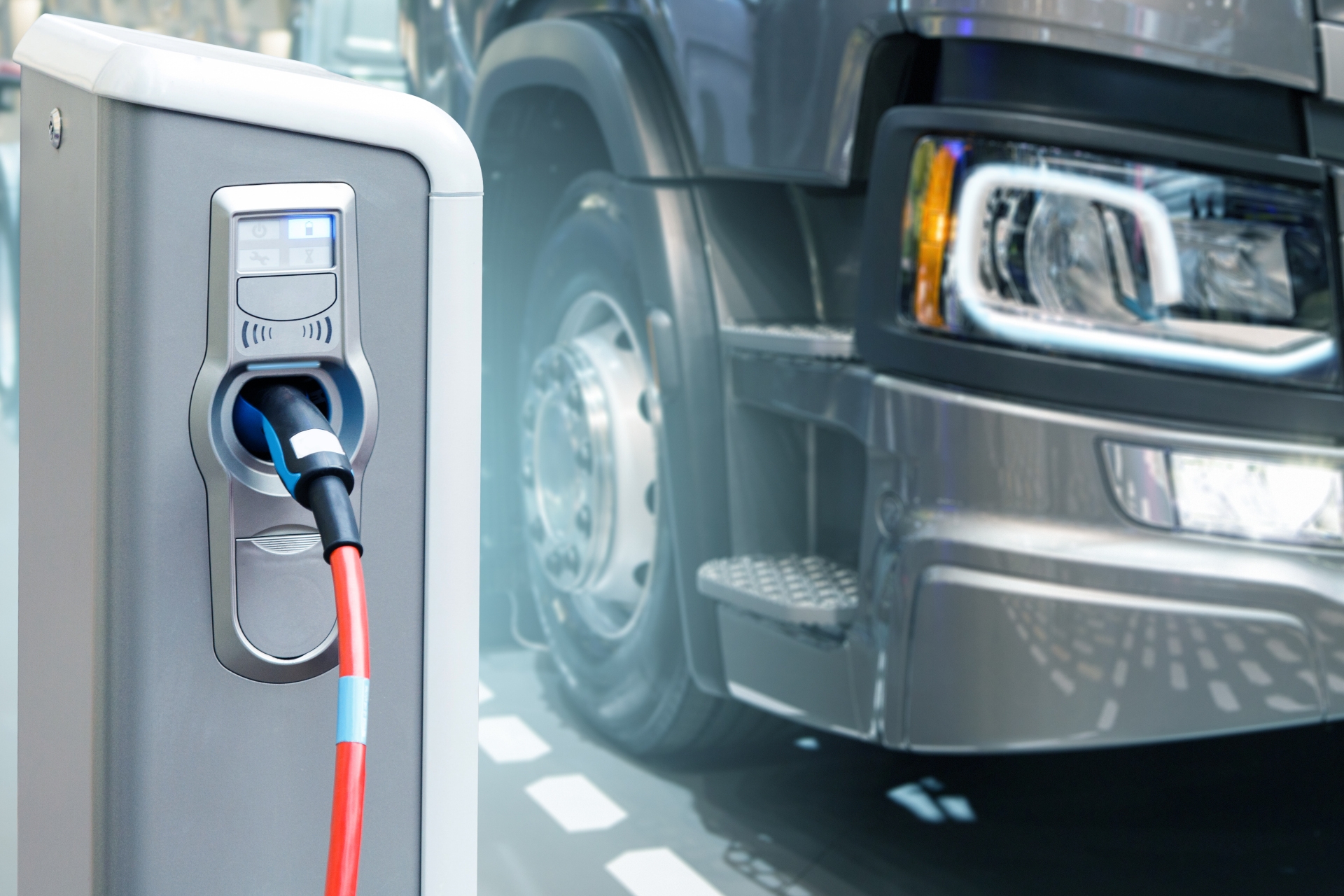
Polish carriers are facing a strategic dilemma – should they invest in zero-emission trucks now, or perhaps wait a little longer? In the first quarter, the National Fund for Environmental Protection and Water Management launched a call for applications for subsidies for the purchase or leasing of electric trucks. The program has sparked mixed feelings in the TSL industry. Carriers are wondering whether electromobility in heavy transport is already a necessity or still a prospect for the distant future?
E-trucks in Poland – hard to hear, but also hard to see
According to data from the Polish Institute of Road Transport, the zero-emission status of heavy transport in Poland is currently negligible. The share of electric trucks in the entire fleet in our country is only… 0.01%. At the end of 2023, only 105 low-emission trucks were registered in Poland. By the end of December 2024, the number of electric delivery vans and trucks had indeed reached 8,143 units (data from the PSNM electromobility counter). However, we do not have an exact breakdown by tonnage of the registered vehicles, and the majority of these registrations consist of smaller machines used, for example, by courier companies.
This could be changed by the government program “Support for the purchase or leasing of zero-emission vehicles of categories N2 and N3”
The amount allocated by the government for this purpose is 1 billion PLN. This is even more than what was allocated for support for the purchase of passenger cars under the previous “My Electrician” program (in the new “OurE-car” program, the amount is already higher). The maximum subsidy for the purchase of an e-truck can be as much as 750,000 PLN for a category N3 vehicle (over 12 tons GVW) and 400,000 PLN for a category N2 vehicle (from 3.5 to 12 tons GVW).
More and more carriers are considering at least partial electrification of their fleet, and the subsidy program may accelerate their decisions. After all, there are significant funds available that are worth reaching for. Government subsidies may turn out to be hard to ignore for many companies. However, transporters cannot forget about the need to come up with their own contribution, which is a lot of money – from 40% of eligible costs for small companies to as much as 70% for large enterprises. It is therefore an opportunity to replace the fleet with modern vehicles, but only for companies that have free funds, maintain liquidity, and use tools that increase it
– notes Jerzy Dąbrowski, Member of the Management Board of Finea, which specializes in financing the TSL industry.
Benefits and question marks
The benefits of using electric trucks are tempting when considering their purchase. These include lower operating costs, access to low-emission zones, or exemption from road tolls in some countries, such as Germany or the Czech Republic. However, the European Commission plans to extend the possibility of applying road toll exemptions for electric trucks beyond 2025, which may encourage other countries to implement such relief. All of this can provide a competitive advantage. Additionally, more and more companies commissioning transport expect their logistics partners to reduce their carbon footprint.
Thanks to the rapid development of technology, the battery capacity in low-emission vehicles is increasing. According to data from the company SPIE, modern electric trucks offer a range of 300 to 500 km on a single charge. The typical battery capacity of a truck is 500–1000 kWh. Fast charging (DC) is optimal: 350–2000 kW. The full charging time is 1–2 hours at 500 kW power. Assuming an electricity price of 1.50 PLN/kWh, the cost of charging one truck (800 kWh) in the 20-80% SoC range is 720 PLN (SPIE calculations).
This is significantly less than in the case of a vehicle with a conventional drive. Additionally, electricity prices are generally more stable than diesel prices. Transporters remember well the last few years, when the cost of fuel changed from month to month. Carriers borrowed money or accelerated invoice payments to stock up on diesel. Those who did not do so drove at a loss. The price of energy seems to be more stable
– says Jerzy Dąbrowski from Finea.
Charging infrastructure is lacking, but it will grow quickly
The development of infrastructure is a result of, among other things, the AFIR (Alternative Fuels Infrastructure Regulation), which aims to accelerate the construction of a network for charging and refueling vehicles powered by alternative fuels, such as electricity or hydrogen, throughout the EU.
The regulation provides that by the end of 2025, fast-charging stations with a minimum power of 150 kW for passenger cars and delivery vans will be installed along the main EU transport corridors (TEN-T network), spaced every 60 km.
Another NFOŚiGW program supporting the development of charging infrastructure for heavy transport is intended to help with investments in charging infrastructure. A total budget of 4 billion PLN for the construction and expansion of a high-power charging network is intended to be the answer to the fundamental barrier to electrification.
Investing in a zero-emission fleet requires meticulous business analysis. On one hand, we are dealing with an increasingly restrictive EU climate policy and a progressive move away from internal combustion engines, and on the other, we are accompanied by the economic reality of transport companies often operating on low margins. Additionally, in the TSL industry, there is a very long wait for payments for completed transport services. According to faktura.pl data, it is an average of 22.2 days. The longest of all industries in 2024. We see the benefits that the purchase of an electric truck brings, but the costs associated with it are still very high
– summarizes the Finea expert.
The disadvantages are still limited range, problematic charging on international routes, and uncertainty regarding the final profits from such an investment. The question also arises whether current geopolitical changes will not reduce the trend toward vehicle electrification.
Summary
- The share of electric trucks in heavy transport in Poland today is a fraction of the market – little more than 0.01 percent.
- This could change quickly – the government intends to spend 1 billion PLN on subsidies for electric trucks. Additionally, 4 billion PLN is on the table for the expansion of the high-power charging network.
- Electric machines are cheaper to operate, allow access to low-emission zones, and in some countries, they are also exempt from road tolls.
- However, the brake on the mass electrification of heavy transport is the insufficiently developed supporting infrastructure and high purchase costs.
Source: Brandscope