









At every major airport, hundreds of buses make thousands of trips, transporting passengers to and from hotels, parking lots, or car rental companies. Traffic around an airport is heavy, and the larger the airport, the more the nuisance of transport increases proportionally. More and more airports are deciding to opt for zero-emission transport and purchase e-buses.
United States
Kansas City Airport has been using this type of transport since 2017 and was the first airport to introduce fully electric shuttle buses to serve passengers. Indianapolis International Airport uses six new electric buses manufactured by Complete Coach and is planning further purchases. Later this year, nearly 20 electric buses from Proterra are planned to be put into service at airports. 10 40-foot buses with 30 seats will go to San Jose International Airport (SJC); 5 will operate in Sacramento, and 4 at Raleigh-Durham Airport. In Sacramento, the new electric vehicles will supplement the fleet of buses powered by compressed natural gas.
San Francisco International Airport announced in April the purchase of six new electric buses. One of the fastest-growing airports in the USA has ambitious plans to significantly reduce carbon emissions. This includes, among other things, a 50% reduction in greenhouse gas emissions compared to 1990 levels.
Other major American airports, as well as smaller local ones, are announcing tenders or are already purchasing new rolling stock to serve passengers. The model for airport managers’ policy is California, where by 2035, passengers using the state’s 13 largest airports will be transported exclusively by zero-emission vehicles.
Europe
The largest fleet of electric buses in Europe operates around Amsterdam’s Schiphol Airport. The airport achieved its leading position thanks to the introduction of 100 electric buses. The fleet is growing and will increase to 258 vehicles by 2021.
Since March 1, passengers at Brussels Airport have been able to use new electric buses, which are used to transport passengers between the boarding gate and the aircraft. Also thanks to the new buses, Brussels Airport achieved carbon neutrality in 2018. However, it continues to increase its efforts to reduce its environmental impact1.
In the British Isles, Volvo Buses received a contract to supply six fully electric buses to Birmingham Airport. The buses are scheduled to enter service in November 2019. Due to the requirement for 24/7 operation, each of the Volvo 7900 electric buses will be charged using a pantograph system. Charging takes up to six minutes, providing flexibility and enabling continuous operation. Birmingham Airport CEO Nick Barton recalled that since 2012, the airport has reduced its CO2 emissions per passenger by 20%.
– The implementation of 6 electric buses will contribute to a further reduction in our CO2 per passenger, which is simply fantastic – stated Barton2.
Poland
3,500 new buses running on alternative fuels are expected to hit the streets of Polish cities over the next 10 years. Currently, there are fewer than 200 electric buses in operation in the country. There are also about 350 CNG-powered buses, and about 180 vehicles with alternative propulsion have been ordered – according to the report “Alternative fuels in public transport,” presented during the Polish Alternative Fuels Congress held in Warsaw.
However, at the moment, only one Polish airport is served by a zero-emission fleet. In May of this year, the first electric bus appeared at Gdańsk Airport. A Solaris Urbino 12 electric transports passengers across the airport apron. Compared to the needs, this is a drop in the ocean. Especially since passenger transport concerns not only the airport apron itself but also, among other things, commutes from city centers to the airport.
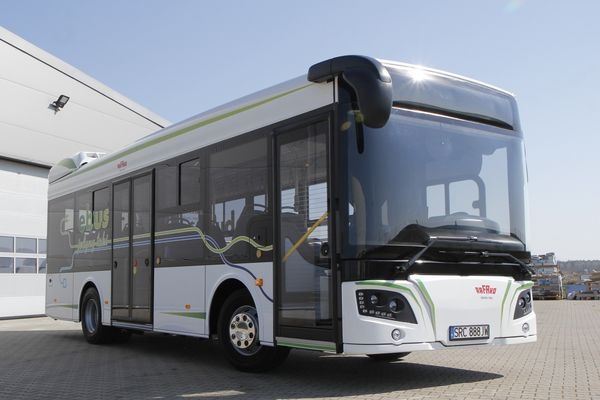
Here, a proposal from the company RAFAKO appears with the first completely Polish e-bus project. It is equipped, for example, with an innovative LTO fast-charging battery, which allows reaching up to 90% capacity in 15 minutes. The vehicle is adapted for the transport of disabled persons, which certainly makes it an interesting proposal for airport managers and will allow them to catch up with global and European airports.
1 https://aviationbenefits.org/newswire/2019/03/brussels-airport-introduces-electric-buses-to-serve-passengers/
2 https://www.volvobuses.com/en-en/news/2019/mar/volvo-receives-order-for-six-electric-buses-to-birmingham-airport.html