









The consignment note is of key importance in the carriage of goods and should contain all relevant details related to the transport. Because the transport document indicates the carrier’s obligations, the scope of their liability, specifies who the sender and recipient are, and contains instructions on the conditions under which the goods should be transported, it is in practice the most important document in transport. Unfortunately, in the era of widespread digitization, it is still filled out in paper form. Research by the Polish Institute of Road Transport shows that the note is most often filled out by hand[1], and since it should be issued in three or four copies (for the sender, recipient, carrier, and freight forwarder – if applicable), the number of paper documents used in transport is significant.
The electronization of the consignment note has long been a topic in discussions about road transport, but since 2020, due to various restrictions resulting from the COVID-19 pandemic, work on the digitization of documents has accelerated. Due to the need to adapt to the new reality, including the introduction of restrictions on physical contact between drivers and warehouse workers, a significant number of entities in the supply chain have switched to sending transport documents in electronic form via e-mail or other dedicated platforms, and even more advanced solutions. An example is ROHLIG SUUS Logistics, which, in order to limit direct contact, replaced the method of written documentation of delivery and receipt of shipments in the consignment note with confirmation of delivery via SMS code[2]. This solution simultaneously ensures the safety of shipments and the ability to maintain distance, i.e., the safety of individual people. The solution implemented during the pandemic proved to be excellent and proved that digital solutions can successfully replace paper. At the same time, the use of digital confirmations provides broader possibilities, allowing for the recording of additional information, such as GPS position, further authenticating the service performance. Digital solutions are acceptable and increasingly expected by principals, but due to the lack of appropriate regulations, paper is still used to ensure that drivers have a complete set of required documents in the event of a road inspection.
Electronic consignment note in the light of international regulations
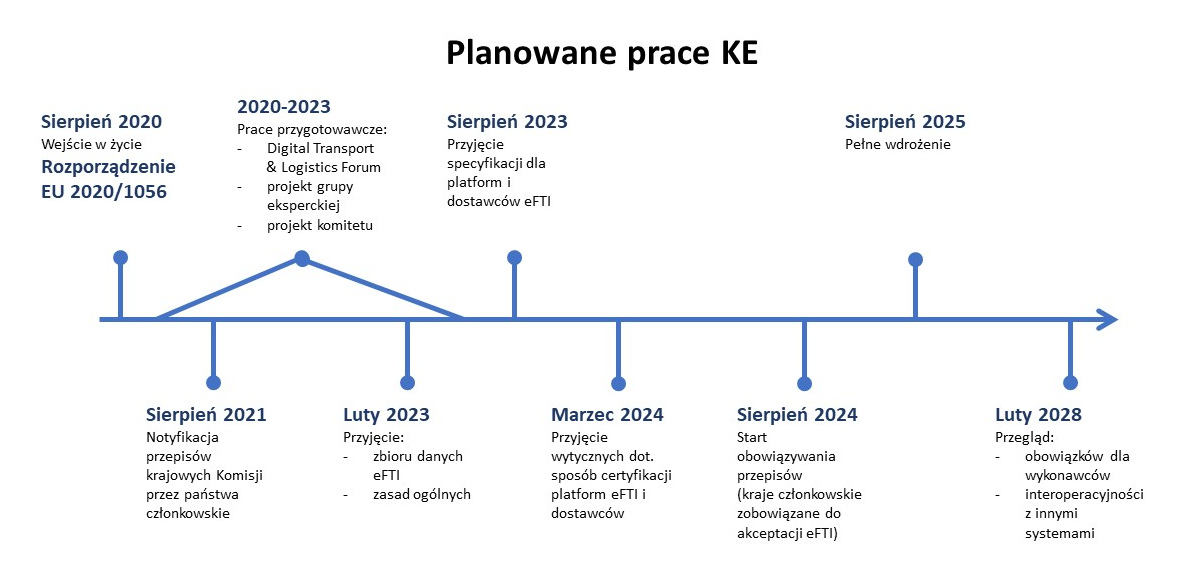
The possibility of using an electronic consignment note appeared on the international stage when the first five countries (Bulgaria, Finland, Lithuania, Latvia, Switzerland) ratified the additional protocol to the CMR Convention[3] regarding the electronic consignment note. Originally, the CMR Convention did not contain a formal basis for the use of documents in electronic form (unlike, for example, the RU/CIM Convention), but the additional protocol changed that. According to it, Art. 2 para. 1 of the 2008 protocol, a consignment note within the meaning of the CMR Convention may be issued in electronic form. All requests, declarations, instructions, reservations, or other statements related to the performance of the contract of carriage provided for by the CMR Convention may be submitted in the same form. A consignment note issued in electronic form is treated on an equal footing with a consignment note issued in written form and has the same evidentiary power[4]. Poland acceded to the CMR additional protocol on September 11, 2019. Changes are also taking place at the European Union level. The EU regulation on electronic freight transport information[5] defined the general principles and directions for processing information in eFTI (Electronic Freight Transport Information) platforms, the appointment of certification bodies in member states, and introduced a schedule of changes. The European Commission is tasked with adopting implementing acts, ensuring the interoperability of technological solutions by August 21, 2023. The regulation itself is to enter into force on August 21, 2024, and by August 2025, full implementation of technological solutions is to take place. Changes at the European level will allow for the unification of technological solutions throughout the European Union. This is necessary due to the need to increase the efficiency of processes in the supply chain, the need to minimize compliance costs for both interested business entities and competent authorities, and to ensure the safety of shipments. Polish law and electronic consignment notes Unfortunately, in light of the Polish Road Transport Act (utd), the interpretation of Polish regulations[6] indicates that for the purposes of monitoring compliance with the provisions of the Road Transport Act, there is a need to use paper documentation.
 Source: Adrian Mirowski, SNARTO, presentation e-CMR – what it is and what is the current situation on the domestic market
According to Art. 87 para. 1 point 3 of the utd, when performing road transport of goods, the driver is obliged to have with them and present upon request of the authorized inspection body documents related to the transported cargo. The provision does not explicitly mention consignment notes, but in practice, it is most often transport documents that are documents related to the transported cargo. Although the utd does not define the concept of a document, the act clearly distinguishes the concept of a document from other information carriers. It can therefore be argued that the act recognizes only documents in paper form as documents, and electronic documents could be considered as other information carriers. In the case of such an interpretation, the driver would always have to have paper documentation confirming compliance with the conditions resulting from the regulations. The second limitation, in light of Polish law, is Art. 38 para. 2 point 1 of the Transport Law Act, which provides that an obligatory element of a consignment note is, among others, the sender’s signature. This means that only an electronic transmission that contains the sender’s signature can be considered a consignment note, which in practice means a document in electronic form with a qualified electronic signature or an electronic signature within the meaning of the eIDAS regulation[7], which excludes the use of this solution in practice on a large scale.
Benefits of digitizing consignment notes
The consignment note is a document whose validity in the transport process cannot be questioned. Issuing transport documents manually creates many risks, which is why the electronization of industry documents should be a priority.
Digitization of transport documents:
- Will reduce the company’s operating costs. The need to handle documents in traditional form causes an excessive burden on support departments, as well as unnecessary costs (printing thousands of pages, sending by mail, storage, the obligation to store for 5 years). For example, at ROHLIG SUUS Logistics S.A., it was calculated that due to the need to have paper documents, about 3.5 million sheets are printed annually in this one company. Another aspect of operational facilitation would be the lack of need for additional contact with supply chain participants, because documents would be visible online by all interested parties;
- Will reduce the risk of error. In manually filled documents, errors appear resulting from the lack of knowledge of drivers on how to correctly fill out a consignment note, as well as due to language problems of foreign drivers. Moreover, it would be possible to eliminate the risk of losing documents;
- Will reduce abuses in the sphere of payment for the performed transport service. Contractual penalties for late delivery of documentation will lose their reason for existence. Some transport contracts contain clauses according to which even a larger part of the carrier’s remuneration is due for the delivery of documents, and only a small part for the transport itself. Although this is contrary to the essence of the contract of carriage, it occurs quite commonly in practice, and the electronization of documents would definitively put an end to such practices;
- Will shorten payment terms for the performed transport service. Very often, the payment of remuneration for forwarding or transport services is dependent on the delivery of paper documents. In practice, it happens that one has to wait several weeks for paper documentation if the driver is on a long route. The introduction of electronic notes would allow for immediate verification of whether the transport has been completed and would prevent such conditions from being set in contracts;
- Will increase the safety of shipments. The need to authenticate with electronic data would eliminate situations in which entities appear in the supply chain that do not have such data, but only try to impersonate the carrier or recipient based on forged documents;
- Will enable unambiguous identification of persons signing documents. It happens that during a dispute it is difficult to determine who and when made entries in the content of the consignment note. Electronization will allow for unambiguous determination of who made the entry, on what date and time, and even where – thanks to geolocation. Digitization will therefore make the electronic note an even better means of evidence than a paper document;
- Will allow for the automation of other processes in organizations, for example, document approval and invoicing.
Paperless Project
GS1 Poland has initiated a project aimed at developing and implementing standards for electronic documents, including the elimination of paper transport documents (consignment note, WZ printout) in the delivery acceptance process. In light of the limitations that exist under Polish law, the Working Group has formulated inquiries to the Minister of Infrastructure:
Whether, in accordance with Art. 2 para. 2 of Regulation (EU) 2020/1056 of the European Parliament and of the Council of 15 July 2020 on electronic freight transport information, Poland has notified the European Commission of national laws?
Are there works being conducted at the Ministry of Infrastructure aimed at adapting Polish law to the content of Regulation (EU) 2020/1056 of the European Parliament and of the Council of 15 July 2020, the application of which will begin on August 21, 2024?
Bearing in mind the content of Art. 11 of Regulation 2020/1056, we kindly request information on whether a body has been selected as a “Conformity Assessment Body”.
The answer to these questions will allow for directing work towards specific solutions and aligning them with government actions.

Summary
The implementation and full use of the electronic consignment note seems to be a necessity from the point of view of a modern economy, which is quite commonly pointed out in the TSL industry. Among the many benefits resulting from the use of electronic consignment notes, of particular note are the increase in shipment safety, cost reduction for both business and state authorities, and ensuring supply chain transparency. The benefits are therefore unambiguous. The changes that are coming are also certain and even defined in time. By 2025, electronic documents will completely replace their paper counterparts, so the sooner we start implementing new solutions on the Polish market, the better prepared we will be for the coming changes.
– For several years, we have been trying to interest officials responsible for road transport and digitization in the implementation of electronic documents in road transport in the Polish legal system. This applies to both transport documents such as e-cmr, but also all others that the driver is obliged to store and show during a road inspection – says Maciej Wroński, President of Transport and Logistics Poland. – This would simplify most procedures, speed up the circulation of documents, and also reduce costs both on the business side and on the public administration side. Unfortunately, the declared interest in this topic from officials is not followed by concrete initiatives and actions.
[1] Electronic consignment note e-CMR (pitd.org.pl)
[2] https://www.suus.com/pub/OWU/Aneks_nr_1_z_dnia_17_sierpnia_2020_r._do_Ogolnych_Warunkow_Swiadczenia_Uslug_Spedycyjnych_przez_ROHLIG_SUUS_Logistics_S.A._obowiazujacych_od_dnia_16.04.2018_r..pdf
[3] Convention on the Contract for the International Carriage of Goods by Road (CMR) and Protocol of Signature, done at Geneva on 19 May 1956.
[4] See Art. 2 para. 2 of the Additional Protocol to the Convention on the Contract for the International Carriage of Goods by Road (CMR) of 5.06.2011 concerning the electronic consignment note.
[5] Regulation (EU) 2020/1056 of the European Parliament and of the Council of 15 July 2020 on electronic freight transport information.
[6] Art. 16a para. 1 and Art. 33a require the storage of documents and other information carriers; Art. 47f para. 3, Art. 55 para. 1 point 6, Art. 72 point 1, Art. 73 para. 1 point 2 and Art. 85 para. 2 point 1 indicate that during an inspection, both documents and other information carriers must be made available to inspectors. The analysis of the regulations was carried out by Paweł Judek as part of the opinion “LEGAL ASPECTS OF USING ELECTRONIC CONSIGNMENT NOTES IN DOMESTIC AND INTERNATIONAL ROAD TRANSPORT”, created for GS1 Poland, for the Paperless project.
[7] Regulation (EU) No 910/2014 of the European Parliament and of the Council of 23 July 2014 on electronic identification and trust services for electronic transactions in the internal market and repealing Directive 1999/93/EC of 23 July 2014.