








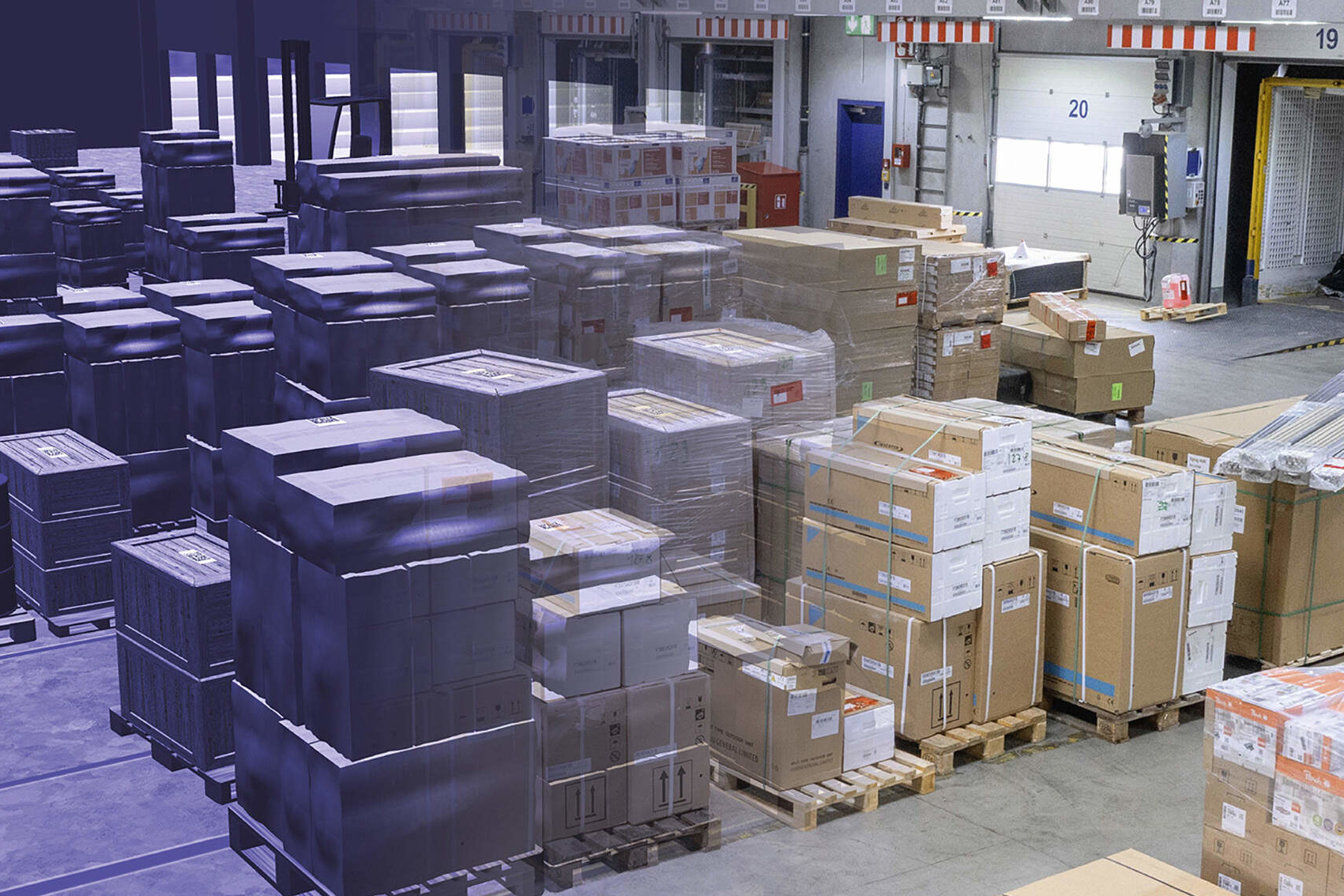
The digital twin is one of the key innovations for future-proof supply chains. What are the main technologies this system is based on? And what does it mean for daily transport and handling in logistics? The answers to these questions are promising.
Digital twins are a virtual counterpart to physical reality. The data they are based on is collected and visualized automatically, in real time. The real and virtual versions remain in constant connection and, in an ideal situation, in interaction.
A digital twin can represent individual objects, such as machines, vehicles, or buildings, as well as entire processes, for example on production lines, in warehouses, or even in intercontinental transport networks. In logistics, digital twins primarily record and display information about the current spatial position and status of objects in a specific area.
What has made these digital representations of reality possible is the availability of increasingly efficient and cost-effective electronic sensor technology. Small, energy-efficient electronic micro-sensors automatically record temperature, acceleration, incident light, and other parameters in real time. Various localization methods based on radio signals can also be used to determine the position of objects, both via private transmitters placed in buildings and warehouses, and in public spaces using cellular network stations and satellite signals. Over the last few years, the number of available radio technologies has steadily grown, and the most well-known examples include RFID, Bluetooth Low Energy (BLE), WLAN, 4G/5G, and GPS, all of which are in widespread use.
Recently, another important technology used to create digital twins has emerged: optical measurement systems that combine image and video recording with machine learning-based software. Based on data imagery, these systems can not only identify an individual object but also apply further logic to calculate its position in space, size, and even its very nature. In places where detecting the environment via cameras is difficult or impossible, companies may choose to use two-dimensional codes, such as QR or Data Matrix (DMC). Large amounts of data generated during image and video analysis require the use of advanced graphics cards that provide the necessary processing speed. Currently, data is increasingly being processed directly in the optical scanning device or on an on-site server (edge computing).
Increased visibility of faults and errors
The first advantage of a digital twin is the visualization of the status of objects and processes in real time. Thanks to this transparency, it is possible, for example, to immediately identify faults, which allows for their quick removal. This has a positive impact on timeliness and quality assurance in supply chains. Within seconds, it is possible to determine the point where a damaged machine requires maintenance or where a process might fail and take appropriate action immediately. The digital twin makes manual data collection and analysis processes obsolete.
Digital twins are a virtual counterpart to physical reality.
Thanks to the use of a digital twin, prescriptive analytics goes a step further. This tool uses data received in real time from the digital twin to simulate and evaluate future states and events. As a result, it can automatically display suggestions to avoid undesirable situations or even automatically make decisions to completely exclude such events. Combined with historical data and intelligent algorithms, prescriptive analytics can be used, for example, in transport logistics, such as to support the creation of vehicle schedules.
The digital twin also enables remote operation of devices, e.g., controlling vehicles over long distances in complex environments. Using a virtually generated 3D environment based on data from the digital twin, users can get an optimal view of a remote location and control a truck located on company premises. In logistics, this type of technology can be used as an emergency solution when using autonomous vehicles. The same technology can also be used to train both humans and artificial intelligence algorithms. In particular, extreme situations can be learned by AI with little effort and without posing a risk to humans.
Digital twins at DACHSER
In recent years, DACHSER has developed and implemented two overlapping digital twins. One of them visualizes processes in the European road transport network. The company has developed a special telematics platform that maps the position and arrival time of over 10,000 swap bodies and trailers in near real-time, which significantly facilitates planning. It uses specially developed solar radio modules with 5G/LPWAN and GPS positioning. Another digital twin was created in cooperation with @ILO (Advanced Indoor Localization and Operations) for a DACHSER transshipment warehouse. This is where the first pilot systems can automatically identify, locate, and measure shipments and forklifts in real time. The relevant data is made available to terminal staff via displays and monitors. The core technology used in this case is optical scanning units combined with two-dimensional codes.
– From the perspective of the Polish organization, we are watching the systemic evolution in our company with great enthusiasm and curiosity. We know that implementing the concept of process digitalization and creating digital twins of our Xdocks is only a matter of time. The value that this change brings proves that DACHSER is the undisputed leader in groupage transport on the European market – emphasizes Krzysztof Słaby, Operations Manager at DACHSER Poland.
Digital twins offer logistics an important new database for future control, optimization, and quality assurance of logistics processes.
“Laboratory of the future” presents the results of research conducted by the Corporate Research & Development Division, which works closely with various departments and branches, as well as with the DACHSER Enterprise Lab at Fraunhofer IML and other research and technology partners.
Source: Dachser