









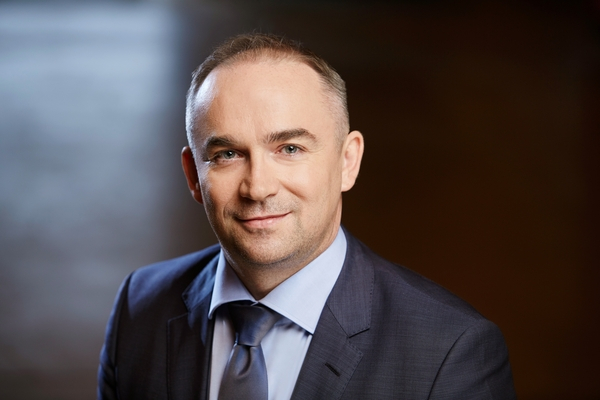
At the end of September, GEFCO Poland celebrated 20 years of operations in our country. During the anniversary conference, the company’s CEO, Rafał Krajewski, emphasized how important investments in innovation and new technologies are for the company’s development. Continuing this topic, we asked him how electromobility will affect the logistics and transport market, whether new technologies herald a revolution in this sector, and how, amidst all this, we can reduce the impact of transport on the natural environment.
Editorial: The automotive market, on the verge of an electric revolution, must face many challenges. What do radical changes in the construction of electric cars mean for logistics?
Rafał Krajewski: Changes are inevitable. The production logistics are already being affected by the very construction of powertrains for electric vehicles. Electric motors have significantly fewer moving parts than internal combustion engines, which translates into the volumes of parts and components transported for production. On the other hand, electromobility means new challenges. For example, managing the transport of batteries, which are classified as Class 9 dangerous goods and subject to regulations on the international road (ADR) and maritime (IMDG) transport of dangerous goods, requires better traceability of goods and compliance in transport and management.
Ed.: Does this pose a problem for logistics operators and carriers?
R.K.: Such a broad and precise range of services can only be provided by supply chain management experts specialized in the automotive industry. Batteries are not everything – an electric car weighs on average about 300 kg more than a car with an internal combustion engine. In relation to one or a few vehicles, this number is not impressive, but on a macro scale, it means the need to adjust transport means and change existing patterns. Many experts argue that we are not on the verge of a revolution, but are already at its heart, and changes in logistics affect the automotive industry and every other sector of the economy. Some people associate GEFCO with the automotive and industrial sectors because that is our origin, but the reality is that as a logistics operator, we are very well prepared to leverage the potential of digital change to work for clients from every sector.
Ed.: What do manufacturing companies expect from logistics operators in the current situation?
R.K.: For a long time, I have been observing growing expectations regarding business flexibility. Manufacturers and distributors want to react as quickly as possible to consumer behavior, adjust production to demand, and diversify business economically and geographically, without being dependent on the politics or economic conditions of a given region. At GEFCO, we see that all these needs are brought together by logistics and transport, which must keep pace with them.
Ed.: And are you keeping pace?
R.K.: In some areas, we are even ahead. New technologies and the search for innovation help us in this. We have launched an Innovation Factory, which is an aggregator of interesting ideas from employees, and we cooperate with start-up accelerators. Thanks to the popularization of the Internet of Things (IoT), we can provide better insight into the flow of goods, both between the production plant and the warehouse, and between the warehouse and the store. This makes the supply chain more predictable and flexible – and as I mentioned, this feature is of strategic importance to clients. In our daily work, process automation and the use of “robots” to better plan flows between production plants and warehouses also help us a lot.
Ed.: So the future lies in flexible and sustainable logistics?
R.K.: This is not the future; it is already the present. At the GEFCO Group, we believe that logistics must become part of a broader process where all stages are connected, and customer relationships are conducted on a partnership basis, in line with the GEFCO motto – Partners, Unlimited. Flexibility in production and logistics also serves the environment. For example, when a company decides to move production to an area with higher renewable energy resources, such as wind, it can count on savings.
Ed.: Exactly: the good of the environment, strict CO2 emission standards – how does this affect GEFCO’s operations?
R.K.: We have 300 branches spread all over the world, and we strive to minimize our environmental impact. For the second year in a row, we have managed to reduce CO2 emissions by another 2%. All this is thanks to the optimization of transport flows, modernization of the vehicle fleet, and the promotion of multimodal solutions that offer effective alternatives to road transport. We are analyzing new ways to reduce the impact of transport on the environment. Recently, we have been testing a single-fuel LNG-powered truck. We have been talking mainly about new technologies so far, but let’s remember that there is a person behind every change. It is thanks to the strength and commitment of our employees that, after 20 years of presence in Poland, we are at the forefront of the largest TSL companies, and for another year in a row, we have maintained our position as a leader among companies declaring transport services as their main source of revenue in the TSL Companies Ranking. This is due, among other things, to the clear growth in GEFCO Poland’s revenues. We are strengthening our position in Poland and developing cooperation with clients from many sectors.
