








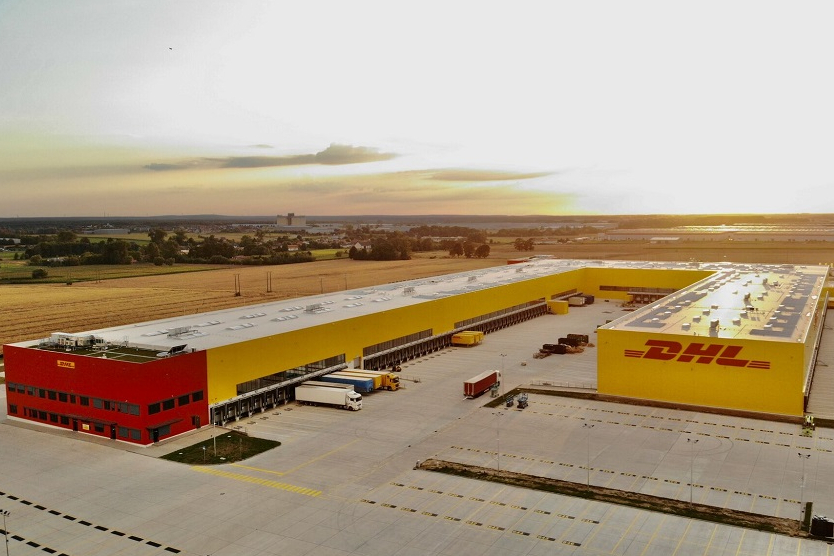
The modern sorting and distribution center is a response to the growth of the e-commerce shipping industry across Europe. Cooperation with retailers and online sellers in the Poznań region offers a potential of 1 million parcels per day during peak periods. DHL eCommerce and Post + Parcel Germany are leveraging synergies in the e-commerce industry.
The DHL Group celebrates the opening of its International Logistics Center in Robakowo near Poznań. The modern center is a joint project of three different DHL divisions: DHL eCommerce, Post + Parcel Germany, and DHL Freight.
The new facility, in which 180 million euros have been invested, covers an area equivalent to five football pitches. It features 3,000 meters of conveyor belts and a sorting capacity of 45,000 parcels per hour. In addition, DHL Freight has a terminal dedicated to handling palletized shipments and less-than-truckload (LTL) cargo for its customers from Poland and Europe. This combination, enabling the employment of approximately 500 people, positions the facility as one of the largest and most advanced parcel sorting and logistics centers in Europe.
“With the new International Logistics Center, we are increasing our capabilities to meet the growing volume of e-commerce shipments. The use of state-of-the-art infrastructure, cooperation between three DHL divisions, and the utilization of our experience in cross-border shipments make this facility an excellent addition to our European network. This strengthens DHL’s commitment to providing fast and reliable cross-border shipping services, in line with the service promise made to our customers,” said Tobias Meyer, CEO of the DHL Group.
The strategic importance of the Poznań location was a key factor in its selection. Many international retailers and online sellers use Poland as a hub for their e-commerce shipments to and from Europe, especially Germany. Major retail brands and online sellers have established their fulfillment centers and warehouses in western Poland, making it an increasingly important e-commerce gateway to Europe. Moreover, the domestic parcel market in Poland has recorded extraordinary growth of nearly 120 percent over the last five years, driven mainly by the rapid growth in the e-commerce segment.
Growth factors and synergies in the shipping industry
In addition to international e-commerce and domestic shipments in Poland, the facility will also handle shipments for Post + Parcel in Germany, including domestic shipments to Germany and returns from Germany. In this way, by shifting volumes, the new location will support parcel centers in Germany, particularly in the Berlin-Brandenburg region near the Polish border. The cooperation between DHL eCommerce and Post + Parcel Germany unlocks the potential to handle a total volume of 1 million parcels per day during peak periods. Due to the cross-border nature of e-commerce, both divisions can derive significant benefits from this cooperation.
Supplementing the European road transport network
DHL Freight operates a state-of-the-art terminal at the new International Logistics Center, covering 4,170 square meters with 50 cross-dock facilities and 1,360 square meters of office space. The terminal, employing 100 people, replaces the terminal in Koninko and offers import connections from Germany, the Netherlands, Sweden, and Denmark, as well as export connections in the opposite direction. By providing daily road connections, temporary storage, and consolidation of partial loads, the terminal plays a key role in the DHL Freight European network, serving various industries, including automotive, retail/consumer, and technology.
Best practices in sustainability in the logistics industry
The International Logistics Center was built in accordance with DHL’s sustainability strategy, focusing on minimizing the ecological footprint. It features a photovoltaic system that meets one-third of the facility’s energy needs. The remainder is provided by the purchase of green energy, minimizing the consumption of energy from fossil fuels. The facility uses a range of environmentally friendly transport solutions. Electric trucks are used to move trailers and containers, eliminating noise and exhaust emissions. The center also has about 40 charging stations for electric cars, vans, and trucks. An automated traffic management system at entrances and exits reduces vehicle waiting times and minimizes noise and exhaust emissions. The facility has already received the Gold Innovation Award, highlighting its focus on sustainability and recognizing the investment in the logistics industry.