









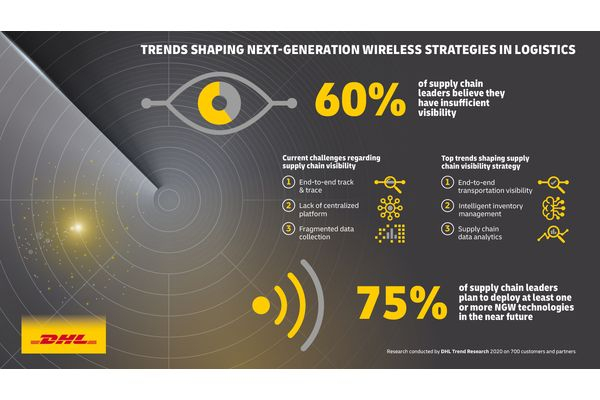
DHL has published a report titled “Next-Generation Wireless in Logistics,” which highlights this year’s trends in the global logistics industry. It covers topics such as the evolution of wireless networks and Internet of Things-based technologies. The report presents the perspective of logistics industry representatives, showcasing data and statistics. It also points to examples of the use of various wireless technologies and the opportunities that digital transformation opens up for the sector.
Connecting everyone, everything, everywhere
Even before the current COVID-19 crisis, the media frequently discussed issues related to the capabilities of wireless communication technology. Most recent headlines have focused primarily on the 5G wireless cellular network, which is currently being deployed in many countries. It brings many benefits to end-users, businesses, and telecommunications operators – from faster speeds and greater bandwidth to personalized services for a new generation of smart and connected devices.
However, wireless is not just 5G. The development of new networks opens up further opportunities for the logistics industry. They increase transparency, maximize operational efficiency, and accelerate automation processes. For industrial applications, both popular and well-known technologies such as Wi-Fi or Bluetooth have been developed, as well as more niche ones, such as Low Power Wide Area Networks (LPWAN) or Low Earth Orbit Satellites (LEO). It is these types of innovations that will enable the next step in the communication revolution, thus bringing us closer to a new world where everyone and everything will be connected to each other anywhere in the world.
Building a fully connected future for logistics
In a recent survey conducted by DHL among 800 supply chain managers, 60 percent of respondents stated that their supply chains are currently not transparent enough. The three key challenges they noted are: achieving real transparency, the lack of a single centralized platform to drive Internet of Things-based initiatives, and fragmented, selective data collection from diverse supply chains.
For this reason, the three most important priorities to increase transparency are: comprehensive transport and asset visibility and the implementation of analytics for data generated by supply chains. Meanwhile, 75 percent of respondents declared their willingness to implement at least one wireless technology in the near future to achieve their transparency goals.
A future where everyone and everything is connected to the network will allow for the development of three key trends in the logistics sector:
1. Total transparency – Every delivery, logistics asset, infrastructure, or facility will be connected thanks to the wide availability of networks and affordable, high-performance sensors. This will enable highly efficient automation, process streamlining, faster and more transparent incident resolution, and – most importantly – the best quality of service for both B2B and B2C customers.
2. Autonomy on an even wider scale – All autonomous vehicles – whether robots in centers or cars on public roads – rely on very fast and reliable wireless communication to navigate and traverse the world effectively. The popularity of such solutions is already growing, but it is next-generation wireless communication that will be the key driver that will fuel their widespread use, moving the world toward autonomous supply chains.
3. Perfecting predictions – Many devices are already operating in online mode. The amount, speed, and variety of data we collect will triple compared to the large datasets we are already generating. The constant progress of machine learning and artificial intelligence systems, combined with the very low latency of next-generation wireless technology, means that predictive systems collecting information and dealing with forecasts, delivery time estimates, and routes will no longer be limited by long response times or the state of wireless networks.
Although most of the projected growth will be achieved using technologies we already know, truly universal integration will require the right approach. However, the benefits are numerous: greater capacity, wider coverage, faster speed, better energy efficiency, or lower costs.
Next-generation wireless communication is a wide range of opportunities to use technology, supporting the fulfillment of diverse – and often conflicting – goals. The DHL report also includes a special section on news in the area of wireless technologies. It shows several innovative projects currently being conducted in the industry, providing implementation guidelines for organizations dealing with supply chains.
The full report is available below in PDF format.
The report comes from the website: www.dhl.com/next-gen-wireless-logistics