








The engineering and manufacturing sector is changing to meet modern trends and market conditions, as supply chain management becomes a key element in creating successful future business models. This is one of the primary conclusions of a new white paper published by DHL Customer Solutions & Innovation, focusing on the industrial sector in 2025 and beyond.
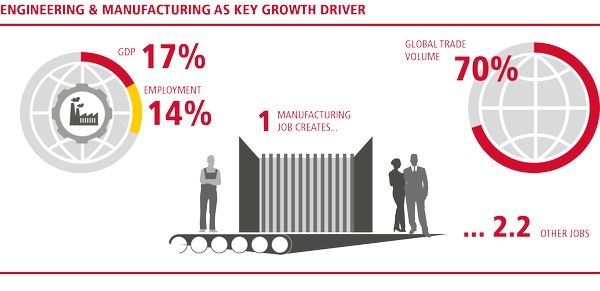
The manufacturing sector, which accounts for approximately 17% of GDP and 14% of jobs worldwide, is the driving force of global trade – 70% of the value of global trade is generated by manufacturing companies. Consequently, the report’s authors emphasize that supply chain concepts require regionalization, interconnection, greater durability and balance, as well as increased flexibility to meet trends such as changing markets, individualization of orders, or increased regulatory compliance.
The report “Building the World – The Future of Engineering and Manufacturing Supply Chains from a DHL Perspective” identifies the six most significant trends in the fields of economy, environment, politics, social sciences, and technology, and their consequences. Based on these key findings, the paper presents appropriate sector responses and five implications for future supply chains.
– Overall, we expect supply chain managers to face even greater complexity in the future – explains Reg Kenney, President of Engineering and Manufacturing, DHL Customer Solutions & Innovation. – Customers will expect a broader portfolio of more customized products. Combined with the shift in growth markets, meaning more suppliers, a shortage of skilled workers, and new technologies, this will force companies to re-evaluate their current supply chain models.
Regionalized supply chains must be more durable
As business and end-user expectations have changed, engineering and manufacturing companies have begun restructuring their production processes and adjusting business models to focus more on the customer and increase competitiveness. In the future, this will also include smart and sustainable production methods and new collaboration models across the entire value chain. Supply chains require adjustment due to the boom in new markets and companies moving production closer to emerging markets. To accelerate delivery and react immediately to changes in customer demand, a global network of more regionalized supply chains is essential. This will also be a challenge for supply chain managers, who will be required to comply with the relevant regulations and guidelines in force in a given country.
Greater volatility in customer demand also means that supply chains must become more resilient in the future. Companies will be forced to constantly trade off between efficiency and redundancy, and contingency plans will become a necessity. At the same time, future supply chains in the engineering and manufacturing sector must be more flexible, faster, more effective, and capable of responding to handle smaller batches of customized products or unpredictable changes in demand. This may include solutions such as: 3D printing, smarter inventory management, as well as logistics service provider concepts relating to procurement for manufacturers and logistics operators.
Furthermore, future supply chains in the engineering and manufacturing sector must be more sustainable. Customers are increasingly choosing suppliers based on their approach to environmental protection. To reduce their environmental impact, engineering and manufacturing companies must increase visibility across the entire supply chain, which will allow them to control the carbon footprint of all suppliers. Connected and integrated supply chains are part of this solution. By analyzing data collected from suppliers and their sub-suppliers, supply chains can be connected end-to-end and in real-time. This will increase transparency and improve collaboration between different stages of the supply chain.
In these conditions, the diversity of the engineering and manufacturing sector is an opportunity. Many engineering and manufacturing companies are already successfully using innovative supply chain concepts that the entire sector can leverage. Moreover, proven concepts from other sectors are already ready for application in the engineering and manufacturing industry, in particular, concepts developed for the automotive and technology industries.
The white paper “Building the World – The Future of Engineering and Manufacturing Supply Chains from a DHL Perspective” is available for download at http://www.dhl.com/emtrends_whitepaper.html.