









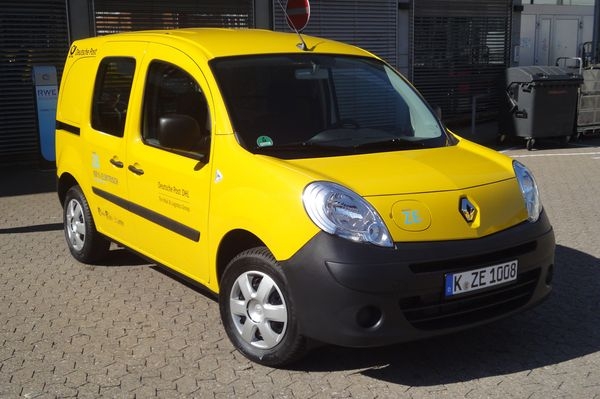
Last year, Deutsche Post DHL, a leader in the logistics industry, expanded its fleet of alternative vehicles by over 4,000 cars, bringing the total number to 10,500. Investing in new technologies and alternative fuels is part of the GoGreen climate protection program implemented by the DHL Group.
Worldwide, DHL uses 300 electric vehicles, over 300 hybrid vehicles, and nearly 2,500 vehicles powered by biofuel, gas, ethanol, and dual-fuel systems. Furthermore, to significantly reduce CO2 emissions, DHL has introduced aerodynamic modifications.
– We are among the leading companies testing alternative drives: electric-powered vehicles are particularly useful for urban parcel deliveries on specific routes, where the low CO2 emissions, low noise levels, and cost-effective system can be fully utilized. Currently, we are successfully using Renault Kangoo Z.E. cars in several European countries. Renault is our leading and reliable global partner in this field. We are passionate about driving change in the logistics industry, and in the future, we want to expand our cooperation with Renault – says Manoella Wilbaut, Global Head of Commercial Development for the Automotive Sector at DHL.
As part of its current operations, Deutsche Post DHL has signed a letter of intent regarding a potential future framework agreement for cooperation with the car manufacturer, Renault. The framework agreement will regulate the future purchase of Renault Kangoo Z.E. cars. The Kangoo Z.E. is an electric-powered vehicle currently used for deliveries in France, Aruba, Belgium, Denmark, and Germany. Currently, DHL uses 304 electric-powered vehicles, including the Kangoo Z.E., Renault ZOE, and Renault Twizy.
– Renault, the leading manufacturer of electric-powered cars in Europe, is proud to support DHL’s global efforts to use sustainable fuels while maintaining business requirements. The Kangoo Z.E., with a cargo space of 4 cubic meters, is an excellent tool for parcel deliveries in cities around the world. Thanks to this agreement, Renault and DHL will accelerate the deployment of the Kangoo Z.E. in more countries across all continents – says Uwe Hochgeschwurtz, Senior Vice President of Corporate Sales.
As the first company in the industry, Deutsche Post DHL has set a goal to reduce CO2 emissions across the entire company by 30 percent by 2020 compared to 2007. DHL invests not only in its vehicle fleet but also in network and operational optimization and the sustainable use of energy in its buildings and operations.
Part of Deutsche Post DHL’s global efforts is cooperation with all major car manufacturers worldwide. These vehicles, intended for use at all levels of commercial transport, utilize various technologies, from biogas to electricity. To test new technologies, DHL collaborates with car manufacturers and is part of several industry working groups, such as Green Freight Europe or aireg. The latest project is being implemented in Bonn, Germany, where all parcel deliveries within the city and surrounding areas will be carried out using electric-powered vehicles. By 2016, 140 vehicles will be in use, including a dozen or so Renault Kangoo Z.E. cars.