









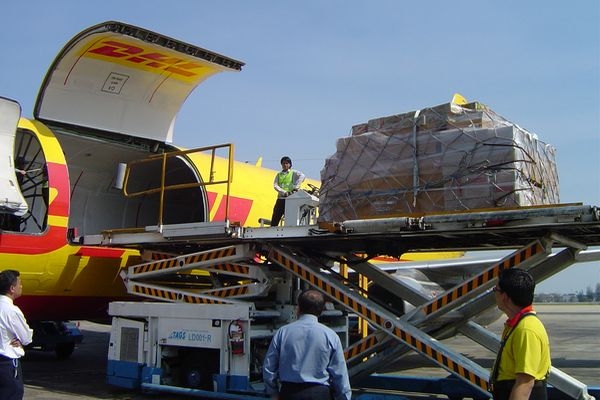
The Disaster Response Team (DRT) of Deutsche Post DHL (DPDHL) Group will remain on site until the end of May. The extension of the stay is due to another strong earthquake that hit the region on May 12 and caused additional damage. The DRT will continue to play a key role in ensuring the continuous operation of Tribhuvan Kathmandu International Airport. The DRT was deployed less than 48 hours after the first earthquake on April 25. As the only international airport in the mountainous country, the airport is the main gateway for international organizations sending humanitarian aid to Nepal.
An 18-member group of DHL volunteers, who are logistics specialists trained in disaster management, arrived in Nepal in three stages and were tasked with streamlining logistics operations at Tribhuvan Kathmandu International Airport to receive incoming humanitarian aid. Over the past three weeks, the DRT has received over 2,000 tons of relief goods, sorting and transporting the goods using modest equipment to centralized warehouses at the airport, managed by the UN World Food Programme, for further distribution by international non-governmental organizations (NGOs).
The airport has one runway serving both passenger and cargo aircraft. It can handle 9 aircraft simultaneously, with a load capacity limit of 196 tons of cargo. The airport’s capacity, combined with the current lack of equipment and resources in the current, very difficult situation, are significant factors affecting the speed of delivering aid to those in need.
– We are dealing with further strong tremors – this indicates that rescue operations will be needed for a long time to come. The Disaster Response Team handles a crucial element of the aid chain. When we first arrived there, it took a lot of work to clear the airport apron, which was cluttered with relief goods – this is a basic action in a crisis situation. If we hadn’t done that, the airport would likely have closed within the first 48 hours after the earthquake because there would have been a lack of space and equipment, and NGOs would not have been able to locate their rescue equipment and relief goods. We have implemented a system to maximize the use of limited resources for ongoing rescue work. We are working closely with civil aviation authorities, the local military, international aid organizations, and the UN; we are aware of all daily arrivals. We have also created procedures for receiving cargo at the airport to make all necessary decisions in the shortest possible time – said Chris Weeks, Director of Humanitarian Affairs at DPDHL Group.
– Given the aftershocks in Nepal, we are glad to have logistics professionals on site at the Nepalese airport who are helping us in the Herculean effort of managing the flood of incoming humanitarian aid. It is hard and thankless work, but extremely important, as Nepal relies on the uninterrupted operation of its airport, thanks to which it receives help from the international community. The speed and dedication of the DPDHL Group Disaster Response Team are truly worthy of the highest praise – said Alex Marianelli, Senior Logistics Coordinator, Nepal Rescue Team, World Food Programme.
The DRT, which was established at the request of the UN Office for the Coordination of Humanitarian Affairs (UNOCHA), has worked closely with the Nepalese authorities, the UN World Food Programme, numerous governments, humanitarian aid agencies, and NGOs. The team uses all available resources – from locally borrowed forklifts, tractors, and makeshift carts to airport loaders donated by the UK to speed up logistics operations, allowing humanitarian aid to be delivered by US Osprey vertical take-off and landing aircraft, and even local tractors.
Rapid unloading at a small airport and expert storage is the basis for maintaining continuous airport operation and ensuring that the right equipment reaches the right aid organizations as quickly as possible. For nearly three weeks, the DRT has been involved in coordinating the receipt and distribution of food, makeshift shelters, medicines, and water, including over three million high-energy biscuits from the US Department of Agriculture, a 35-ton inflatable hospital from Medecins sans Frontieres, solar-powered lamps, reconstruction equipment, and plastic sheeting. The team also handled one chartered DHL aircraft carrying relief goods from sponsors in the Middle East.
– The generosity of people is literally overwhelming in such situations, and help comes in many forms and shapes. We initially had to unpack some of the huge air pallets before we could move them because there was simply no equipment to unload them in their entirety. Despite the latest earthquake on May 12, we are still able to operate as a DRT because we now have the equipment and systems to handle the incoming humanitarian aid that Nepal will so desperately need for many months to come. Aircraft can now be unloaded quickly, and aid reaches the hands of needy Nepalese more effectively – said Gagan Mukhia, Country Manager of DHL Express Nepal.
In addition to the ongoing work of the Disaster Response Team volunteers, DHL’s commercial aid and rescue service has transported over 100 tons of relief goods for organizations such as ShelterBox and Norwegian Church Aid. Additionally, we have already received bookings for over 90 tons of cargo to be transported in the coming weeks.
The DPDHL Group Disaster Response Team consists of highly qualified volunteers who provide their logistics support free of charge to help coordinate humanitarian aid at the airport for further distribution to victims in the shortest possible time. The DRT network consists of over 400 trained DHL volunteers who can be deployed within 72 hours. Since 2005, Disaster Response Teams have been deployed worldwide more than 30 times, most recently in Vanuatu after the tragic Cyclone Pam in March 2015 and in the Philippines after Typhoon Haiyan.
GoHelp is the DPDHL Group’s disaster management program and includes the “Get Airports Ready for Disaster” (GARD) program and disaster response through Disaster Response Teams. Operating since 2005 in partnership with the United Nations, DPDHL Group provides the UN with free access to its core logistics competencies, its global network, and employee know-how. To date, the GARD program has been implemented in partnership with the UN Development Programme at over 29 local airports in countries such as Armenia, Bangladesh, the Dominican Republic, El Salvador, Indonesia, Jordan, Lebanon, Nepal, Panama, Peru, the Philippines, Turkey, and Sri Lanka. In cooperation with UNOCHA, DPDHL Group has also created a global network of Disaster Response Teams to support airports in the event of a natural disaster.