








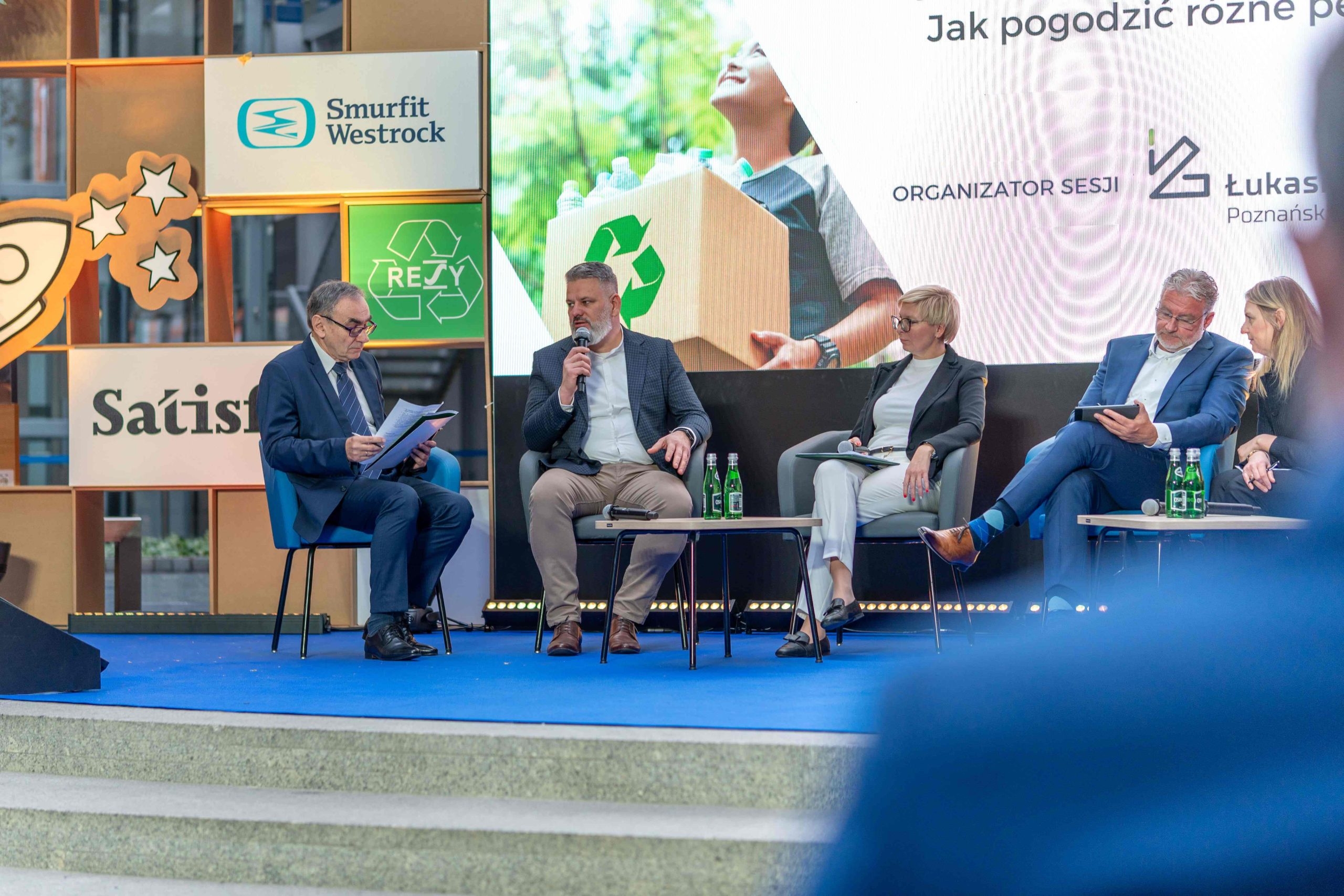
We must understand that there is no turning back from the deposit-refund system – said Tomasz Markowski from Łukasiewicz – PIT during the panel discussion “Deposit-refund system: challenges for the industry and local governments. How to reconcile different perspectives?”. As Robert Jansen from Deutsches Pfandsystem GmbH added, everyone should commit to moving in the same direction and that this is the only option.
The Żabka chain has been actively involving its store customers in the collection of reusable or recyclable packaging for several years, testing various forms of return. In addition to introducing EKOmat machines, i.e., machines for selective collection, it is also checking how to encourage customers to return packaging and which forms of communication with them are most effective. The reward for the customer in this case is points in the loyalty application, and engagement in the collection grows with the number of points awarded. Tests are being conducted in Bydgoszcz and Zielona Góra, among others.
– To return packaging to a store, the consumer needs an efficiently operating system. It must be universally accessible – argued Joanna Kasowska, Quality Standards & Climate Protection Director at Grupa Żabka. – The placement of collection points and their efficient operation are very important, so that it is easy to deliver used bottles to them and, of course, return them – she added.
Tomasz Markowski, Director of the Center for Digital Transformation at the Łukasiewicz – Poznań Institute of Technology, agreed with this. His team created a recycling machine that – apart from printing receipts or handling cards – also returns money to an account without the need to have a payment card or phone with you – it is enough to encode your account number in the application beforehand in the form of three words: Two main factors determine the level of returns, the amount of the deposit and convenience. While we have no influence on the first one, we do have influence on the second. We have created a solution that moves towards the convenience of return and allows for collecting packaging where it is generated. We also ensured that the transactions were secure – he said.
Drawing from good examples
In Germany, the deposit-refund system has been operating since May 1, 2006, and its sole operator is Deutsches Pfandsystem GmbH.
– We didn’t have any regulations, standards, or specifications – recalled Robert Jansen, General Manager at Deutsches Pfandsystem GmbH. – The government simply announced to entrepreneurs that it was introducing a deposit-refund system, because otherwise it would ban the sale of single-use bottles, and that the deposit would be 25 euro cents. We had to develop such a system ourselves.
It took a year and a half, but today the recovery rate is 98 percent. It took several years to educate and convince consumers.
– In 2006, we focused on television commercials, where we wanted to explain the entire bottle cycle in a simple way – from purchase to recycling. We placed pictorial instructions on the recycling machines on how to use them. For us, it was most important that people accepted the deposit-refund system – adds Robert Jansen.
The deposit-refund system also requires education
Other panel participants also pointed to the issue of education.
– We already have several deposit-refund system operators today, and there will be even more. In addition, we have several large retail chains that will be required to collect packaging as part of the system. It is important that their communication, the operators’ communication, is uniform – explained Joanna Kasowska from Grupa Żabka.
Education and communication are important because the introduction of the deposit-refund system will affect the increase in beverage prices. Not only the deposit will be added to them, but also a fee that producers will have to pay to the system operator.
– The deposit-refund system will also affect the costs of waste collection, because the amount of plastic and glass waste will decrease, and companies will have to compensate for this – noted Tomasz Markowski.
Joanna Kasowska also pointed out that the success of the deposit-refund system will largely depend on three factors. These are: the commitment of stores and their employees, the commitment of consumers, and efficiently operating operators. All participants in the deposit-refund system must also act on the basis of clear and stable law. – In smaller stores, some of the collections will be done manually. Their owners must know that it will pay off for them, that the system operator will pay them an appropriate amount for it – she added.
Packaging and store size
Small stores may also have a problem with storing large quantities of returned packaging, which is why their effective reverse logistics will be important.
The panel took place during the TAROPAK International Trade Fair for Packaging and Labeling Technology, and it was organized by the Łukasiewicz – Poznań Institute of Technology. The discussion was moderated by Prof. Ryszard Cierpiszewski, Head of the Department of Industrial Product Quality and Packaging at the Poznań University of Economics and Business.
Source: Łukasiewicz Research Network – Poznań Institute of Technology