









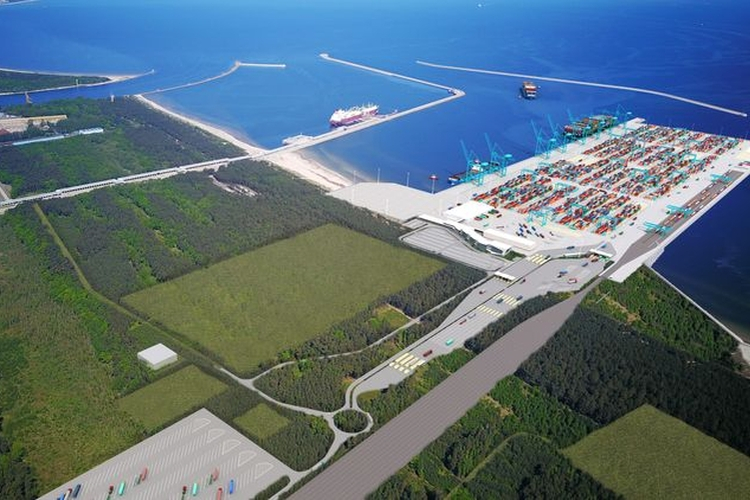
The investment is intended to strengthen and consolidate the market position of the port complex. The Szczecin and Świnoujście Seaports Authority is accepting offers from parties interested in implementing the project until January 28. The contractor and operator will be selected in the first quarter of next year.
The deepwater container terminal in Świnoujście is part of the government’s “Program for the Development of Seaports until 2030,” adopted for implementation last year. The goal of the project is to turn the ports into key hubs of global supply chains for Central and Eastern Europe. The investment also aligns with the EU’s Europe 2020 Strategy. Its main assumptions are the creation of modernized, intelligent, and integrated transport infrastructure networks. “The plan to create a single European transport area – striving for a competitive and environmentally friendly transport system” is also an element of the White Paper, which sets out the directions for the development of the European Community’s multimodal transport corridors.
– We have created the general framework for the deepwater container terminal in Świnoujście, which is ultimately intended to reach a handling capacity of at least 2 million TEU – emphasizes Krzysztof Urbaś, President of the Szczecin and Świnoujście Seaports Authority. – We expect concepts for the terminal from interested parties. The selected entity will implement the project by developing part of the Bay and real estate in accordance with our concept. The winner of the procedure will have to minimize the impact on the surroundings and the environment both during the construction period and the subsequent operation of the terminal. This is to be a “green terminal”.
The westernmost seaports – Szczecin and Świnoujście – lie on the border of Poland and Germany, on the shortest route connecting Scandinavia with Central and Southern Europe along the Baltic-Adriatic international transport corridor (Trans-European Transport Network TEN-T). Through the A11 and A20 motorways, they are connected to the European motorway system, and through the S3 national road (E-65) with southern Poland, the Czech Republic, and Slovakia, and further to the south of Europe. Both ports also have convenient rail connections – through the Oder main line, they connect with industrial centers in Western and Southern Europe. The location therefore enables the service of a rich, international hinterland as well as customers from the Baltic Sea area. The existing Ferry and Ro-Ro Terminal in Świnoujście can become one of the most important centers for handling Scandinavian cargo brought by seagoing vessels from various continents, including the Far East. We also cannot rule out that the effects of the pandemic will influence the emergence of new shipping connections from other areas of the world. An additional opportunity is created by the direct proximity of the LNG terminal. More and more ships, including large container ships, are equipped with LNG-powered propulsion. The possibility of bunkering fuel in the immediate vicinity of the transshipment site may become a serious incentive to choose Świnoujście as a port of regular calls.
The terminal will become a workplace for at least several hundred people, depending on the degree of automation. One job in a seaport creates on average two jobs in the port sector and four more in the immediate environment. At the same time, more than 30 other jobs in the Polish economy depend on each job directly in the seaport.
Source: Szczecin and Świnoujście Seaports Authority