








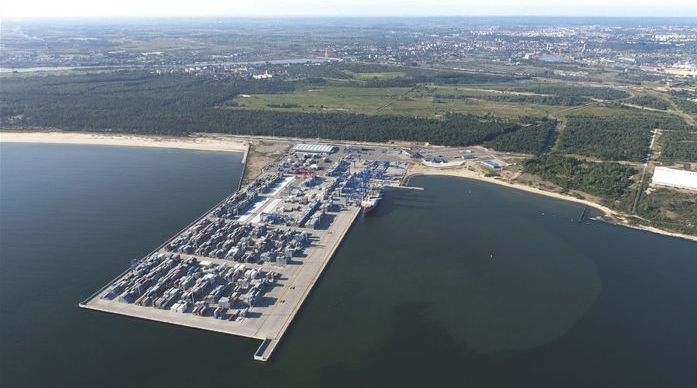
The globalization of the world economy has become one of the factors stimulating the development of global supply chains. The constant increase in imports of goods by European countries and the USA from China and other Asian countries such as South Korea, Taiwan, Japan, Singapore, and recently also India, has caused changes in the commodity and geographical structure of world trade.
This trend is reflected in the growth of trade in processed, consumer, and investment goods, while simultaneously increasing transport distances. This is expressed by the fact that world trade is increasingly being carried out using container technology. The share of containerized cargo accounts for approximately 25% of world maritime trade in so-called dry cargo. The above factors have led to the formation of permanent cargo flows and global supply chains, in which container shipping is of particular importance. The main container routes run latitudinally and connect the most industrialized regions. These are services on the Asia-Europe, Asia-North America, Europe-North America, and internal Asian market routes. In 2009, over 60% of the world’s containerized cargo volume was transported on 20 main routes. Over the years, a decline in the share of the North Atlantic market has been visible; container turnover between European Union countries and the USA (westbound) accounts for 2% of global transport, while in the opposite direction (eastbound), transport does not exceed 1%. The above data reflect the structure of world trade. The share of the 5 main destinations is shown in Table 1.
The dynamic development of globalization processes causes the spatial and temporal distancing of business partners and, consequently, the separation of tasks in the sphere of supply, production, and distribution between entities located in different parts of the world. The result of these processes is the creation of the aforementioned global supply chains. The requirements placed on these chains are often contradictory. On one hand, their task is to ensure the efficient flow of goods. On the other hand, long lead times and uncertainty regarding meeting delivery deadlines, the need for consolidation and deconsolidation of shipments, and the existence of many links between which multiple functional connections occur, require efficient organization of flow and adaptation of chain configurations to customer needs.
The efficiency of global chains is largely dependent on maritime transport. Besides price, the standard of services provided by container operators plays a fundamental role in serving customers – cargo owners, including such differentiators as transit time between the port of loading and unloading, frequency, punctuality, and access to the network of connections.
The article contains 17,550 characters.
Source: Logistyka Magazine 5/2012.