









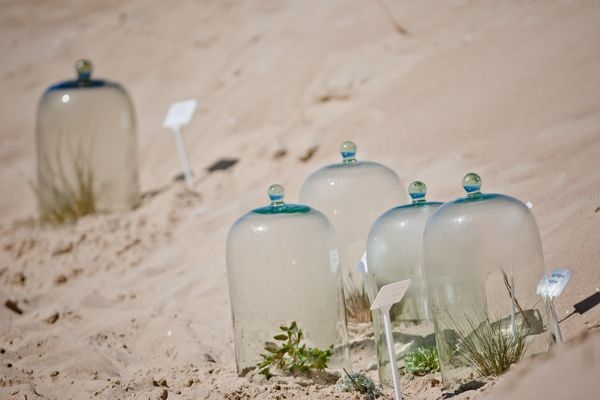
DCT Gdańsk S.A. container terminal, the University of Gdańsk Development Foundation, and the University of Gdańsk are partners in a project titled “Dune Laboratory” at the Biological Station of the Faculty of Biology, University of Gdańsk.
The Regional Directorate for Environmental Protection, following consultation with DCT Gdańsk and biologists from the University of Gdańsk, has issued a decision to take action to protect the most valuable plant species located in the area designated for the expansion of the DCT container terminal.
The main goal of the project is to create a substitute dune habitat for dune (psammophilous) species. The project fulfills cognitive, educational, and nature conservation objectives.
As part of the project, a metaplantation (translocation of plants from a habitat that will soon be transformed to a site not threatened by changes) of dune species will be carried out into newly created habitats.
In the near future – once appropriate funding is obtained – technical and educational infrastructure will be built around the dune, which will, on one hand, secure the plants, and on the other, allow the dune area to be made available for educational and didactic purposes to students, school children and youth, as well as the local community and tourists. The plant species that will be moved to the dune at the biological station include, among others, sea holly, immortelle, Festuca polesica, sand sedge, and sea pea.
DCT Gdańsk S.A. container terminal
The owner of DCT Gdańsk is Gdansk Port Holdings Sarl. DCT is the largest and fastest-growing Polish container terminal and the only deep-water terminal in the Baltic Sea region directly served by vessels from the Far East. The DCT terminal, located in the heart of the Baltic Sea – in the Port of Gdańsk, is the easternmost terminal within the range of the Gdańsk – Le Havre ports.
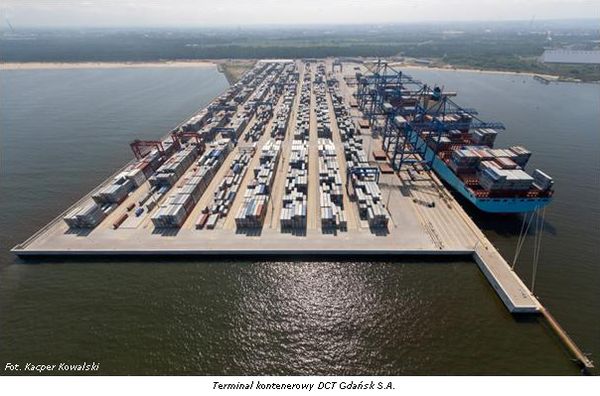
The terminal handles Polish imports, exports, transit, and maritime transit. Thanks to good access from the sea provided by an approach channel with a depth of 17 m and up to 16.5 m (along the quay), the lack of icing, and excellent operational capabilities, DCT is a natural gateway for containerized trade in Central and Eastern Europe. Thanks to infrastructure investments carried out by the Polish government and the city of Gdańsk, the DCT terminal is very well connected to inland locations and is a true gateway to Central and Eastern Europe.
In March 2013, with the signing of a lease agreement for investment areas with the Port of Gdańsk Authority, the DCT Gdańsk terminal began work on the expansion and construction of a second deep-water quay – the so-called T2 project.
The project to build the second quay (the T2 project) is currently in the phase of gathering the documentation necessary to begin construction. Work is underway to create a preliminary design of the terminal and obtain permits to start construction work; a tender has also been issued for a General Contractor who will execute the project in a “design and build” mode, which ensures that no assumptions will be made at the design stage that would significantly affect the time or cost of the project execution.
The T2 terminal will have similar parameters to the existing quay and will be fully prepared to handle the largest container ships currently being built. The entire terminal, after the T2 project is commissioned, will have a handling capacity of up to approx. 3 million TEU per year (TEU = twenty-foot equivalent unit, a unit used to define the size of ships and container terminals) – in 2013, the terminal handled 1.15 million TEU.
The T2 terminal should be commissioned by the beginning of 2017, in accordance with the lease agreement signed with the Port of Gdańsk Authority.
Since April 18, 2014, when the environmental decision issued by the Regional Directorate for Environmental Protection became final, DCT Gdańsk has been conducting compensatory work for birds (protecting the ringed plover, goosander, common shelduck, and little tern), as well as for plants and bats.