








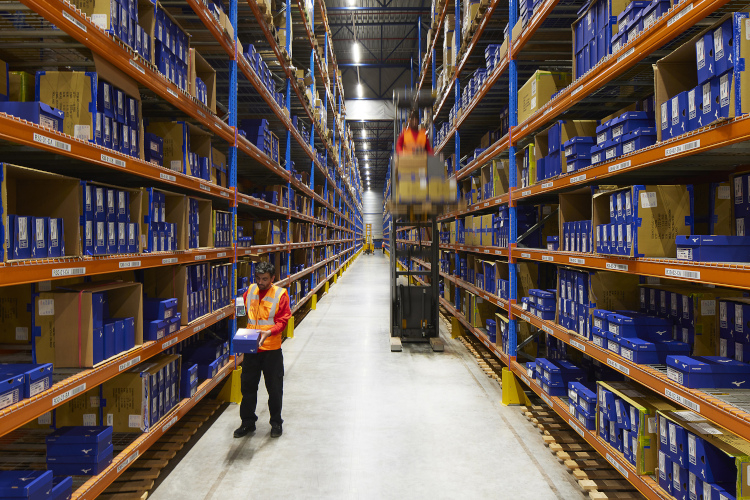
Digitalization and access to information are the foundation of the logistics industry’s evolution today. What is of key importance for contract logistics is the Data Lake. What is it and what role does it play in managing warehouse operations? Experts from CEVA Logistics, a global 3PL logistics leader that operates over 700 goods distribution centers worldwide, including in Poland, share their experience.
A Data Lake is a repository where large amounts of data are stored in any format. It is an important and fast source of information for users and analysts. Simply put, just as lakes are fed by rivers, a data “lake” is fed by the flow of data from various sources.
Data Lake in contract logistics
Using a Data Lake in contract logistics enables adaptation, improvement, and the introduction of further innovations, which allows for meeting the ever-changing requirements of the logistics industry. As CEVA experts note, the data lake has already revolutionized the way warehouse operations are managed. It is not just about easy access to information, but also about implementing an entire data-oriented culture that enables informed decision-making.
For rapidly developing contract logistics, the use of a Data Lake is a foundation that allows not only for reacting to changes but also for proactively shaping the future. Such a focus on data utilization allows CEVA to make the right decisions, increase transparency, and improve processes.
Greater oversight and accountability
The greater transparency provided by the Data Lake allows contract logistics teams to oversee global warehouse operations. It also supports the possibility of continuous improvement through data validation, which in turn stimulates growth.
As CEVA emphasizes, the keys to success in using data are:
- Their appropriate application. If data is to be useful and thus well-utilized, it should be closely linked to key business initiatives. For example, CEVA uses data from various sources, such as inventory management and order processing, to optimize supply chain operations. Identifying and eliminating “bottlenecks” has significantly shortened delivery lead times and improved order fulfillment rates.
- Stable configuration. Collaboration between IT, data, and business development specialists is crucial for sharing data from source systems. This is why CEVA has invested in building a data infrastructure that integrates information from various platforms, including its own Warehouse Management System (WMS) and Enterprise Resource Planning (ERP) software. Integration ensures that the data lake is fed with accurate, real-time data, allowing for a quick response to changing market conditions.
- Flexible project management. It is crucial for the continuity of data quality checking, user acceptance, and implementing necessary changes. A flexible approach to project management allows for adapting to ever-changing data requirements. For example, with the growing importance of sustainable logistics practices, CEVA was able to quickly develop a set of digital tools to analyze energy consumption, emissions, and overall environmental impact. This allowed for significant changes and a reduction in the carbon footprint.
- Data communities: data providers and administrators play a significant role in the effective use and communication of available information. For example, CEVA’s data communities enable the exchange of information between contract logistics managers and process engineers. The result of this collaboration is the development of a predictive maintenance system, which has significantly minimized downtime and reduced equipment maintenance costs in warehouses managed by CEVA.
Support for contract logistics specialists
Data integration enables contract logistics managers, operations leaders, controllers, process engineers, and other specialists to understand, measure, and manage productivity, operational quality, safety, and environmental initiatives in over 700 CEVA warehouses worldwide.
This brings concrete benefits:
- Demand forecasting. CEVA contract logistics managers, using historical sales and inventory level data, have the ability to accurately predict customer demand. This, in turn, allows for optimizing inventory levels by reducing storage costs and minimizing shortages.
- Insight into financial data. Controllers can rely on data stored in the data lake to access financial information from across the organization. This enables them to identify cost-reduction opportunities and allocate resources more effectively.
- Process efficiency. CEVA process engineers analyze data on warehouse operations, identifying areas where automation and robotics can be integrated to increase productivity. The result is the implementation of automated picking systems, which significantly lowers labor costs and improves order accuracy.
- Safety and sustainability. Data analysis allows CEVA to monitor situations related to safety and environmental impact. Identifying patterns of safety-related incidents has enabled the preparation of dedicated training programs. Sustainability initiatives are also based on data. Their use supports actions taken by CEVA to reduce emissions and allows for managing warehouse operations in a more environmentally friendly way.
Ready for future challenges
CEVA Logistics will continue to engage in transforming operations based on data analysis to prepare for new challenges and opportunities. The key to success is expected to be team commitment and progress in implementing further innovative solutions.
Source: CEVA Logistics