








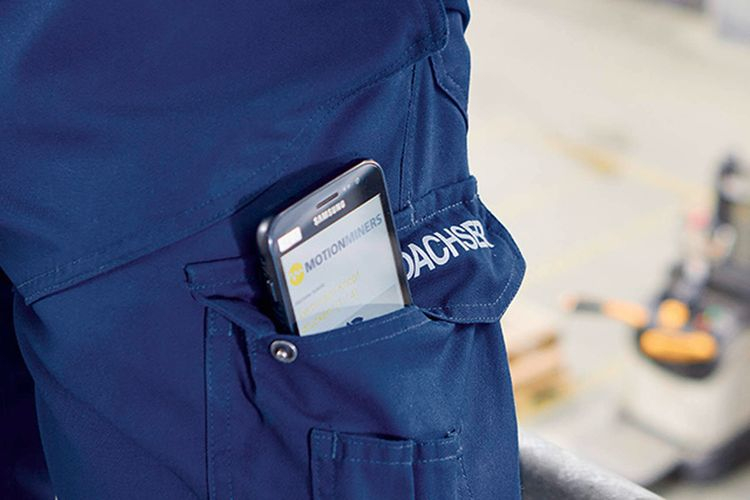
To better understand how individual work stages in a transshipment terminal proceed, DACHSER has joined forces with the start-up MotionMiners, which helps companies conduct performance and ergonomics analyses to optimize processes. A new quality improvement method, which contributes to better work ergonomics, has been tested in five branches.
Around the clock, thousands of DACHSER network employees work to ensure that customers’ supply chains run without disruption. Most of them are involved in operating transshipment terminals, responsible for the smooth flow of goods. A significant portion of cargo handling work is performed manually: unloading trucks, scanning goods, moving pallets to temporary storage areas, or loading them directly onto another truck.
The terminal’s work utilizes proven, well-functioning processes. Nevertheless, there is always room for improvement and simplification of tasks performed by employees in terms of work ergonomics. This usually requires analysis based on measurement results. Unfortunately, many of these are not fully objective. Traditional methods also have many weaknesses.
For example, not everyone is comfortable with the presence of another person observing their work, and some conventional analytical methods use this way of gathering information. In this case, employees usually try to ensure they are doing everything correctly and as quickly as possible. Although this approach yields results and provides important clues about how a given process works and what can be improved, data collection is not only subjective but also time-consuming. Therefore, DACHSER began searching for new solutions in terms of performance and ergonomics optimization, and thus improving the quality of service during cargo transshipment. Help came from the Dortmund-based company MotionMiners, which was founded in October 2017 by three employees of the Fraunhofer Institute for Material Flow and Logistics IML. Since the summer of 2019, the start-up has been operating independently of the Fraunhofer Institute.
Driving force of development
In search of innovative solutions, DACHSER has long been actively involved with logistics start-ups. The DACHSER Enterprise Lab maintains a close partnership with Fraunhofer IML in Dortmund to identify research and development projects that will drive the development of the DACHSER network. The company is particularly interested in digital technologies such as data science and artificial intelligence, real-time positioning and the 5G mobile communication standard, the Internet of Things, autonomous vehicles, and adaptive warehouse systems. This is exactly how DACHSER learned about MotionMiners. The company initially focused on finding potential for optimizing warehouse operations. In cooperation with the logistics operator, it also expanded into cargo handling in freight forwarding.
MotionMiners provides technology that facilitates the collection of real data on task organization and the work environment without the need to gather information about employees. Over the past few months, measurements have been carried out in five DACHSER branches in Germany using mobile wearables, worn on the wrist or clipped to clothing, which collect anonymous data. These types of motion tracking devices are mainly used by athletes, but the founders of MotionMiners use their automatic activity detection to optimize intralogistics processes.
Combined with stationary sensors mounted in the terminal or on warehouse shelves, they record the activities performed. This enabled the collection of data regarding cargo handling, such as loading and unloading, scanning, or placing pallets in the terminal. In addition to the duration of these processes, the sensors also detect unhealthy and strenuous employee movements.
Before data collection began, the project was discussed in detail with the IT committee of the General Works Council. Participation in the study was voluntary for employees, and the collected anonymous data was then evaluated. Such conditions allowed employees to work as they do on a daily basis.
Steffen Faul, Operations Manager of the transit terminal in Langenau, one of the measurement sites, admitted: – There was no problem convincing employees to participate in the project. People did not find the sensors intrusive.
Meanwhile, Mauritius Herden, Team Leader of Production Processes at DACHSER Food Logistics, who is responsible for the project, considers the ability to objectively evaluate operations recorded in their entirety, along with all unpredictable events, a major advantage.
– The data obtained gives us a completely new level of process transparency that we did not expect before – added Cornelius John, Team Leader of Production Optimization at DACHSER headquarters in Kempten.
Another interesting aspect is heat maps. Areas marked on the terminal plan show which paths employees take most frequently and where they encounter bottlenecks and long queues. These can then be analyzed on-site and quickly eliminated.
Reducing physical strain
– The most interesting thing is what we learned about ergonomics – admitted Mauritius Herden. Motion tracking devices document how often employees have to bend down while working, for example, when scanning labels on the bottom edge of a pallet or picking something up. In another case, it turned out that unloading requires many movements using raised arms. – For the first time, the measurements provided us with so much information allowing for a real assessment of the physical strain on employees – said Herden.
By the end of December 2020, 1,800 hours of data had been collected at five locations. The initial assumption of this project was to determine the duration of the process. Based on this, it will be possible to develop specific recommendations and measures to approach cargo handling in a more strategic and efficient way and better support logistics operators in their daily work. For Faul, who manages cargo handling in Langenau, this is a big advantage.
– We were able to measure the actual physical strain on employees, which will allow us to prevent health-related absences and even occupational diseases.
While previously recommendations for individual branches were based more on assumptions or random checks, the company now has solid, objective data. This will allow for the development of recommended courses of action in the future and offer the best organizational structures.
The pilot project lasted over a year and is currently being continued in other locations. In the future, it is planned to collect this type of data in most branches in Germany and other countries, as well as to use this method in other warehouse processes and operations. John announced the gradual expansion of measurements in the DACHSER network in the coming years. Steffen Faul also hopes that the measurements will be repeated in branches where they have already been carried out: – Tasks change over time. Therefore, I would like the measurements to be carried out again, also here in Langenau.
Ultimately, it is about ensuring that customers also benefit from the data obtained. As John explains, they primarily benefit from increased transparency in cargo handling, as this provides a starting point for optimizing production processes, which translates into the quality of logistics services.
MotionMiners uses beacon technology to make cargo transshipment processes more transparent and measurable. These small wireless transmitters with a built-in power source can be quickly installed in appropriate locations. Measuring devices capture wireless signals from the transmitters, which, similar to GPS, allows for determining the current location. Activity and positioning data are always collected in an anonymous form, without being linked to any employee.
Source: Dachser