The data center market is accelerating like a well-oiled machine. Investors are putting billions of dollars on the table, and the demand for data center services is so high that not only office spaces but even warehouse spaces are being adapted for server rooms. However, experts have doubts about the viability of such investments.
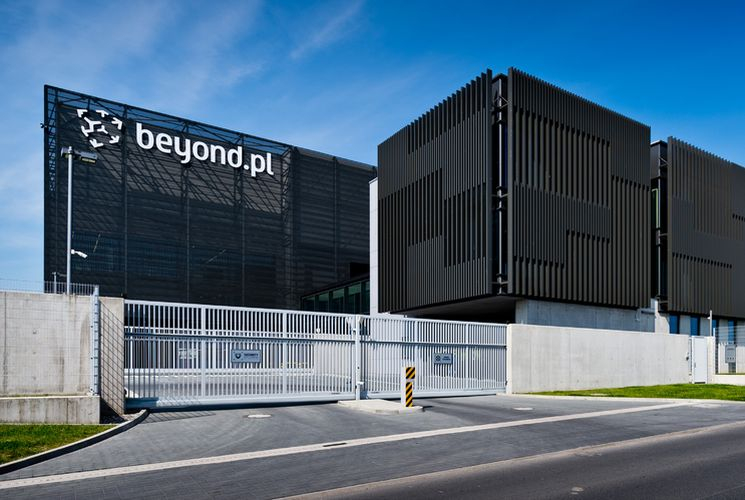
Microsoft, Google, Vantage, Beyond.pl. Global players, as well as local operators in these demanding pandemic times, are investing huge sums in building modern data centers instead of tightening their belts. Although Google has not officially indicated the value of its investment in Poland, the estimated figure is $1.5 – 2 billion. A huge investment is also being carried out by the Poznań-based Beyond.pl. The Beyond.pl campus, powered by green energy, will increase its capacity 5-fold, from 8 MW to 42 MW (megawatts), and its area will increase almost 4-fold.
– On one hand, we are making the investment with Polish companies in mind, which have accelerated or are launching digitalization projects due to the pandemic. On the other hand, we are expanding the data center for cloud providers entering Central Europe, companies offering SaaS solutions, and large corporations looking for providers outside Western Europe. For them, for many reasons, Poland is an exceptionally good location – points out Wojciech Stramski, CEO of Beyond.pl.
Infrastructure shortages
Analyses by research firms confirm that we are experiencing an investment boom. PMR forecasts suggest that the resources of the Polish data center market will double by 2025.
 Wojciech Stramski, CEO of Beyond.pl.
“It is a fact that every one of the largest IaaS providers in the world is both building its own facilities and collocating space in third-party data centers. In the case of Poland, the latter model is more significant, as it has the chance to move the domestic data center market to a completely different level through a leap in resource growth, as well as guarantee solid prospects for development and further expansion of facilities” – explain the authors of the PMR report “Data Center Market in Poland 2020. Market analysis and development forecasts for 2020-2025”. There is no doubt that one of the factors influencing the rapid development of the market is COVID-19. The pandemic has accelerated digitalization. Trade, work, and education have moved online. At the same time, COVID-19 has caused uncertainty to dominate the market, which encourages companies to look for savings and make decisions about outsourcing IT services.
– Until now, companies very rarely measured TCO, i.e., total cost of IT. However, if we itemize and properly measure the costs of electricity consumption, office and technical space usage, or human resources, it turns out that they account for up to 80 percent of the costs of maintaining IT infrastructure on one’s own. This changes the perspective and influences the relocation of servers to external data centers, which are more cost-optimal – argues Wojciech Stramski.
Additionally, with the development of technologies such as Big Data, cloud computing, or the Internet of Things, we are producing more and more digital data. According to statistics, in 2010 we generated 2 zettabytes of data. In 2020, estimates already speak of 59 zettabytes of digital information, and by 2025 even 175 ZB.
– The generated data must be processed and then stored. Meanwhile, in Poland, we have only a few significant players in the data center market and few facilities that meet the stringent requirements of large clients regarding security and business continuity. This is important because in the online world, a lack of access to a service can very strongly affect a company’s reputation and results. ITIC estimates that for 98% of organizations, an hour-long outage in access to information means losses of at least $100,000, and 85% of organizations need a data center that guarantees at least 99.99% availability to ensure business continuity. There are few data centers in Poland today that meet these requirements – points out the CEO of Beyond.pl, Wojciech Stramski.
Warehouse for a data center?
The demand for data centers is so high that facilities are being built in places that were not originally adapted for this purpose. In June this year, Savills Investment Management, a company managing, among other things, real estate and funds in the form of investment mandates, leased 21,000 sq. m. of warehouse and office space in the Warsaw Gate One Business Park for 15 years. The client of the complex, located 5 km from Okęcie airport, turned out to be a data center operator.
– The agreement is the first such long-term lease in an urban location on the Warsaw warehouse market. It is also one of the first such significant lease agreements concluded in Poland with a company providing data center services – commented Julia Racewicz, Senior Asset Manager at Savills IM, on the transaction.
Savills IM carried out a major renovation at this location in 2019, but experts point out that when building a data center, one must take into account many more factors than when building offices and warehouse space. These include access to appropriate energy infrastructure, fiber-optic networks, and internet exchange points. In addition, there are very high requirements related to access security and infrastructure.
– A typical warehouse that does not contain cold storage or freezers requires about 50 kW of energy per 1000 sq. m. of space. Meanwhile, a data center of the same size, with average quality infrastructure and typical server density, requires about 2 MW of energy, which is 40 times more! A data center must be able to operate in continuous mode. Therefore, it should be protected against power outages, electrical surges, and internet network failures. This requires access to at least two energy sources and a backup power system installation. Furthermore, access to at least two fiber-optic internet sources and the existence of separate infrastructure for individual internet providers is necessary – explains Janusz Gutowski, CEO of AXI IMMO Services.
One operator learned the hard way how important the location of a data center is, having placed a capital city data center next to a warehouse with flammable materials. A fire in the warehouse caused the data center to have a significant service outage.
PUE, or the fight for costs
Besides security, experts also point to costs.
– Server spaces that are adapted, rather than prepared from the beginning with a data center in mind, are inefficient in terms of both security and costs. Even if we ensure redundancy of key resources, such as energy, cooling, and connectivity, it is impossible to adapt office or warehouse facilities to support high-density solutions or renewable energy power supply. It will be unprofitable. This affects higher expenses that must be allocated to maintaining infrastructure in the long term – points out Wojciech Stramski from Beyond.pl.
We write more about logistics in the cloud in the magazine Logistyka 6/2020.
The e-edition of the magazine is available in our offer!