









New technologies are emerging, more and more data is being generated, and this is changing the market. Data centers are becoming an important segment of the commercial real estate market. Experts from AXI IMMO have examined their specifics in the Polish reality.
Currently, there are 115 data centers in Poland – most of them in Warsaw, Katowice, and Krakow. Their number will certainly grow, especially after the decision of IT giants Google and Microsoft to add Warsaw to the list of global cloud regions and invest USD 2 billion and USD 1 billion respectively for this purpose. The Covid-19 pandemic is also an impulse for the dynamic development of data centers.
The real estate sector covering data centers is definitely different from traditional ones – it has different requirements. Key aspects for it are: electrical installation infrastructure, energy costs, access to the internet backbone network, and proximity to internet exchange points, which is not significant in the case of office, retail, or warehouse space.
– A typical warehouse, not containing cold storage or freezers, requires about 50 kW of energy per 1000 sq m of space. Meanwhile, a data center of identical size, with average quality infrastructure and typical server density, requires about 2 MW of energy, which is 40 times more! A data center must be able to operate in continuous mode. Therefore, it should be protected against power outages, electrical surges, and internet network failures. This requires access to at least two energy sources and a backup power system. Furthermore, access to at least two fiber-optic internet sources and the existence of separate infrastructure for individual internet providers is necessary – explains Janusz Gutowski, CEO of AXI IMMO Services.
The most important data center market in Poland is still Warsaw. In the capital, where most government and financial institutions are located, the first such facilities began to emerge. Google and Microsoft decided to locate their 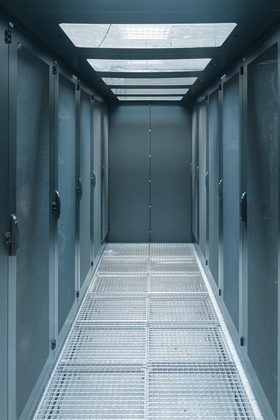 cloud infrastructure in Warsaw, which is intended to serve the CEE region and other parts of Europe. As many as 35 of all 115 Polish data centers are located here. However, the capital may soon not be able to provide enough energy for the needs of larger data centers. Moreover, the cost of energy in the capital is more expensive than in other locations.
– Warsaw will remain an important hub for colocation data centers, i.e., those occupied by many users with low demand for server space. However, the largest data centers used by large technology companies and cloud operators, which require exceptionally high amounts of power, will in the future be more often located in places that are able to provide inexpensive energy. The necessity to meet EU standards regarding green energy should promote locations with access to renewable energy sources. Locating a data center, for example, near wind farms in northern Poland can help meet EU standards as well as generate significant savings. A ten-year corporate power purchase agreement from wind farms for a location close to such a farm is about 30% cheaper compared to a standard contract signed by a company based in Warsaw with a traditional energy supplier. Locating data centers further away from cities has already begun in other parts of the world. In some countries, for example in Scandinavia, data centers are located even several hundred kilometers away from the nearest conurbation. This has been made possible by technological progress, and in particular by the fact that a modern data center can be managed almost entirely remotely – comments Roger Mroczek, Investment Sales & Capital Markets Director, AXI IMMO.
Investor interest in the new real estate market sector is growing. Its attractiveness stems from the stability of income due to the low rate of tenant relocation. Clients are attached to their data centers due to high initial rental costs, including dedicated IT infrastructure and advanced ventilation, cooling, and air conditioning systems, as well as the huge risk and cost of potential data migration.
It is predicted that the further development of data centers will be driven by the growing popularity of social media, the Internet of Things, big data, artificial intelligence, and VR (virtual reality) and AR (augmented reality) technologies. These technologies will require shorter data transmission times, which involves the need to create more local server rooms. New requirements regarding personal data protection, including the EU GDPR, and the trend of Polish companies moving data to the cloud will also be of great importance.
– Poland also has a chance to become a European data hub. EU law from 2019 has facilitated the flow of non-personal data between member states. The second lowest energy costs in the European Union and the planned gas pipeline to Norway, which will improve the country’s energy security, may attract more companies offering cloud solutions across Europe. The domestic market also benefits from attractive construction costs and relatively low land prices, combined with constantly developing transport and digital infrastructure, as well as large resources of qualified employees, especially in the IT sector – concludes Roger Mroczek.
Source: AXI IMMO