








Sustainability and climate action are an integral part of DACHSER’s corporate culture. Renewable energy, e-mobility, and in particular the development of emission-free supply chains for European cities play a fundamental role here. All these activities involve the need to integrate learning processes and personal experience. And what does this look like in practice? Let’s take a look at Freiburg. Hendrik puts it in reverse and drives the “Bigster” up to the pallet, slides the forks underneath, and silently lifts the load. He quickly secures the goods, scans the delivery data, and sets off. The Bigster is a cargo bike designed by Roc-Ket Cargo Bikes GmbH in Freiburg, bearing the characteristic yellow and blue colors of DACHSER.
Roc-Ket Cargo Bikes GmbH is a manufacturer of cargo bikes specializing in last-mile logistics in city centers. Its headquarters are located on Neulindenstrasse, near the former freight station. On-site, the company operates a micro-hub for handling parcels and groupage shipments destined for the center of Freiburg, for example on behalf of clients such as DACHSER. On the motor-assisted bike, Hendrik pedals to a bank office building less than two kilometers away, located near the main railway station, which is awaiting a delivery of marketing materials. Even though (or perhaps because) Freiburg is considered the cycling capital of Germany, the cargo bike always attracts curious looks from passersby. “It’s really interesting,” says a young man just leaving the bank building, seeing Hendrik riding past with his pallet.
In this way, DACHSER delivers 2 tons of goods to customers in the center of Freiburg every day. Furthermore, cargo bikes, including Hendrik’s bike, are specifically designed for heavier loads.
– Our delivery bikes are equipped with tires, rims, spokes, and brakes like those used in mopeds. The initial motor power ranges from 400 to 600 watts and also allows for reversing. This is a great help when loading cargo weighing up to 250 kilograms – says Thomas Ketterer, founder and Managing Director of Roc-Ket. – Our electric bikes are assisted by the motor only while pedaling, and their maximum speed is 25 kilometers per hour, even when going downhill. This allows them to travel on bike paths, which means that the traffic jams characteristic of the city center are not a problem for us.
While Hendrik delivered a 135-kilogram pallet of marketing materials to the bank, other shipments handled by DACHSER arrived at the micro-hub via a yellow-and-blue eCanter, a fully electric 7.5-ton Mercedes FUSO e-truck. This truck provides shuttle transport from the DACHSER logistics center in Freiburg, located in the Breisgau industrial park about 30 kilometers away, to constantly supply the 150 m² transit terminal with new orders.
DACHSER has developed a way to combine electric trucks and delivery vans with electrically assisted cargo bikes and StreetScooter scooters so that deliveries in specific inner-city areas are completely emission-free. This concept is called DACHSER Emission-Free Delivery and is currently regularly used in road transport in 13 cities across Europe.
We are ready for the mobile transformation
– Climate action in all its dimensions has become an integral part of our corporate strategy and management. In this way, we remain true to how we perceive ourselves and fulfill our social responsibility – says Burkhard Eling, CEO of DACHSER. – DACHSER views sustainability and climate action as fundamental tasks within its comprehensive responsibility for society and the environment. It is precisely because of this deep conviction and through a comprehensive climate protection strategy that we support the climate goals of the global community.
In the short term, the DACHSER Climate Protection strategic program focuses on developing and implementing a variety of measures in four defined areas: energy efficiency, process efficiency, research and innovation, as well as social responsibility beyond the DACHSER business model (Corporate Citizen+).
– At the same time, we are adapting our current way of operating to new market requirements emerging from our customers and regulatory frameworks – explains Burkhard Eling. – In this way, sustainability and climate action will always be an integral part of DACHSER’s corporate culture.
The challenges associated with active climate action are already very visible in daily logistics operations. – We expect that in the coming years, urban road transport will switch to emission-free trucks. At our locations covered by the DACHSER Emission-Free Delivery concept, we are already conducting significant preparations for this far-reaching transformation, which will improve the quality of life, especially in congested inner-city areas – explains Alexander Tonn, COO Road Logistics at DACHSER. – Emission-free deliveries within designated inner-city areas are a key element of the development of electromobility at DACHSER. They also play a key role in optimally preparing the company and our customers for planned or already existing bans on combustion engine vehicles in larger metropolitan areas.
Currently, DACHSER provides emission-free deliveries of non-refrigerated groupage shipments in specific inner-city areas in 13 European cities: in addition to Freiburg, in Berlin, Dortmund, Hamburg, Munich, and Stuttgart, as well as in Copenhagen, Madrid, Oslo, Paris, Porto, Prague, and Strasbourg. Eleven more major European cities are to be added by 2025.
As part of the DACHSER Climate Protection strategic program, the company is testing processes and energy efficiency in its operations and branches at various levels. The company is also delving into the topic of research and innovation, which promote emission-free vehicles and renewable energy. Our social commitment goes beyond the company’s borders and its core business.
The DACHSER Climate Protection program is led by Andre Kranke, Head of Corporate Research & Development in the executive unit led by Stefan Hohm, Chief Development Officer (CDO).
– As part of the climate protection strategy, the company is preparing to achieve the long-term goal of net-zero emissions. A key element here is the transformation project towards emission-free vehicles and the use of renewable energy – says Andre Kranke. – While high-performance electric trucks are already available in urban logistics, there are still many obstacles and unanswered questions in long-haul transport that need to be addressed.
For this reason, at the beginning of 2022, DACHSER established special e-mobility locations in Freiburg, Hamburg, and Malsch near Karlsruhe to accelerate research and development in this field.
– We are working there on the basic concept of e-mobility in order to then implement it in all our European facilities – explains Andre Kranke’s action plan. We are focusing on battery-electric trucks and passenger cars and their charging infrastructure, on the use and self-production of electricity from renewable sources, as well as on intelligent energy and load management. In addition, DACHSER is testing hydrogen-powered trucks and their refueling infrastructure.
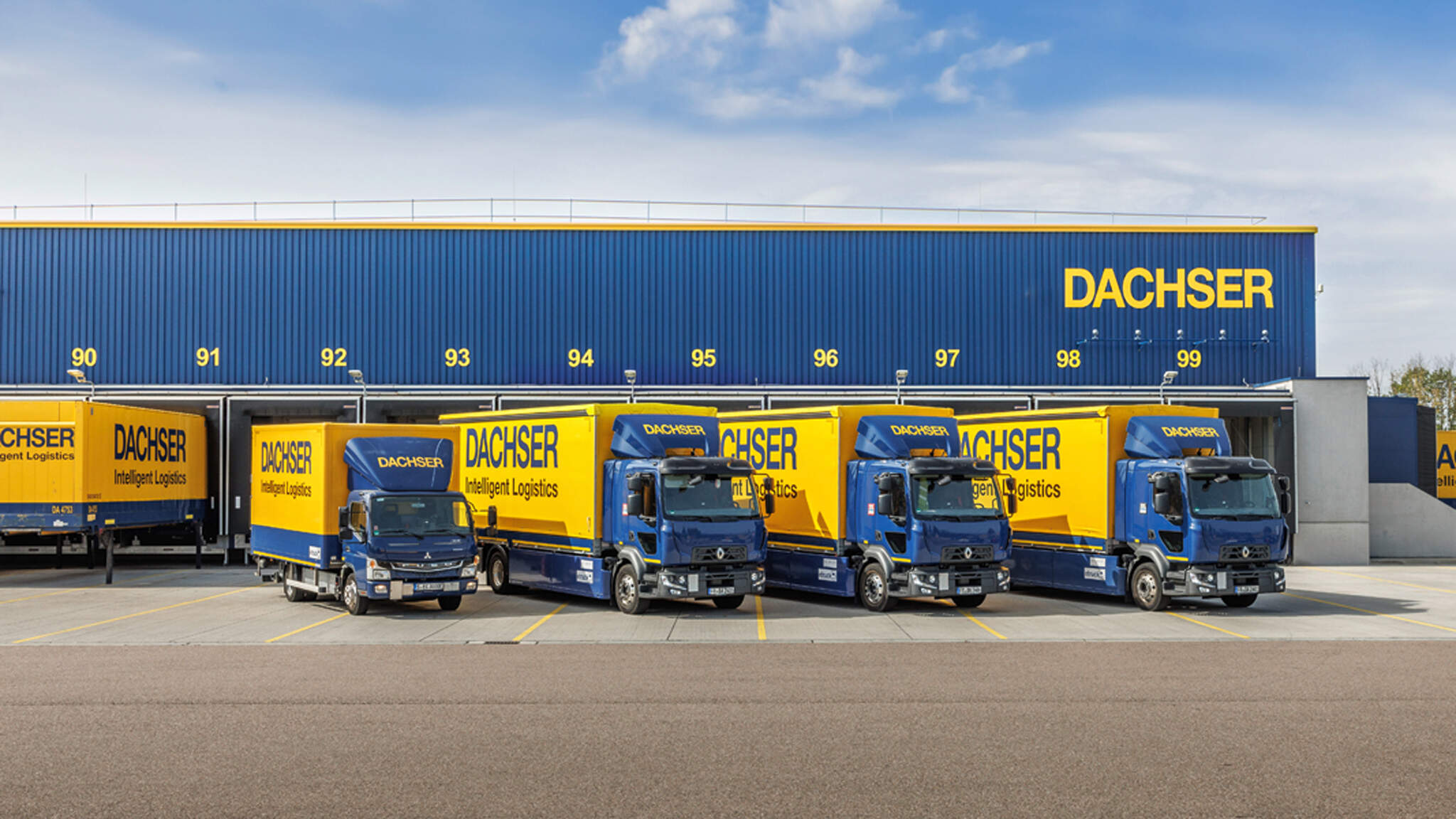
Michael Gaudlitz, General Manager of the DACHSER logistics center in Freiburg, approaches the project with great enthusiasm. He and his team are among the pioneers of e-mobility in the DACHSER network. – Together with Roc-Ket, we started our cooperation in 2017, carrying out deliveries to the city center, including using electric cargo bikes. In 2019, DACHSER introduced the eCanter, a prototype of an electric 7.5-ton truck with a range of about 100 kilometers. Since then, we have been constantly expanding our electric fleet – For example, the eCanter in the Freiburg branch’s fleet recently received a “boost” in the form of three 16-ton Renault e-trucks.
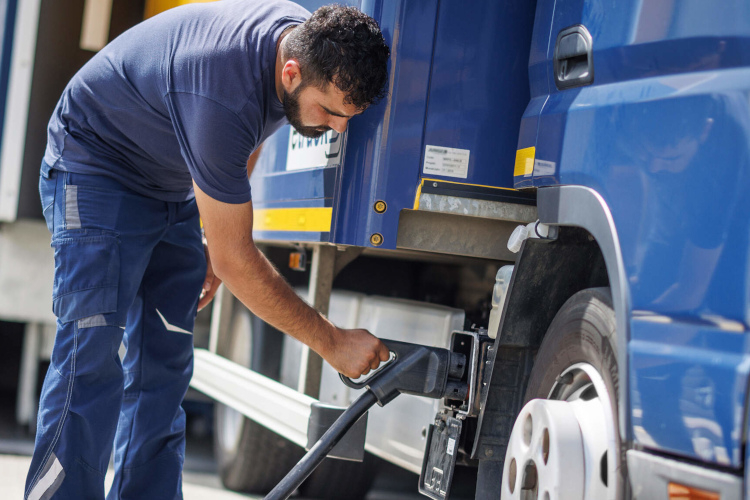
One of the drivers making deliveries in Freiburg is Rafiullah Faqiri. The 23-year-old professional DACHSER driver, whom everyone simply calls Rafi, has been driving electric vehicles at the company since his internship. “Driving an electric vehicle is very different from driving a diesel truck: it is much quieter, more relaxed, and at the same time more dynamic,” says Rafi. “And wherever we go with these vehicles, we are greeted with beaming faces and huge enthusiasm for e-truck deliveries.”
E-mobility that brings joy
Freiburg deliberately uses the advantages of e-mobility to make the work of professional drivers more attractive. “From the very beginning, we have been trying to introduce our apprentices to new technologies, and thus to the future of urban logistics,” says Rolf Hügel, Operations Manager Inbound at the DACHSER logistics center in Freiburg. “Our drivers should enjoy their work and also be proud that their efforts contribute to ensuring a bright future.”
Rafi claims that driving an e-truck also involves skills that need to be learned. For him, this means, for example, planning routes with the dispatcher and managing the fleet so that battery charging can always take place at the DACHSER branch.
– Finding a fast-charging station somewhere on the road is almost impossible – says the young professional driver. – Fortunately, I haven’t had the experience of getting stuck somewhere on the road yet. At some point, you simply know the vehicle’s capabilities and limitations inside out.
Nevertheless, there is no shortage of challenges associated with incorporating e-mobility into daily logistics.
– Introducing new technologies always involves certain problems. For example, we had to deal with predictable, energy-efficient driving, proper battery charging, and developing appropriate, high-performance charging infrastructure. Everyone involved had to go through a learning process – recalls Michael Gaudlitz.
Benefits of experience
One example of the “learning by doing” approach is Rolf Hügel, who today plays a key role in overseeing the operational part of the e-mobility facility in Freiburg. “Electricity is a science in itself,” notes Rolf Hügel, a logistics specialist by training. At first, I had some difficulty distinguishing between alternating current and direct current – alternating current flowing from a wall outlet and direct current from a battery, both rechargeable and regular. The engineering department certainly had to show patience with me,” he says with a wink. “However, like many other people in our branch, I delved into the topic and set out to learn as much as possible about e-mobility and in as much detail as possible. Today, I am familiar with the most important topics, and by comparing notes with our electricians and construction experts, I can figure out what will work and what won’t in DACHSER’s daily operations. It gives me great pleasure.”
The eCanter in the company’s Freiburg branch fleet is a perfect example of learning on the job. Rolf Hügel recalls how in 2019, when DACHSER began operating this vehicle, the company’s service partners had little or no experience in maintaining and repairing electric trucks. The DACHSER workshops also lacked high-voltage specialists who would be qualified to work on such a vehicle.
– Initially, in order to repair the eCanter, we had to bring in a service team from Japan, so the work was significantly delayed. This was one of the important lessons for everyone involved – says Rolf Hügel. – In the meantime, we have significantly expanded our network of workshops, gained control over repair and maintenance cycles, and are benefiting from the extensive experience gained during the expansion of power and charging infrastructure.
Ready for the next step
With e-mobility occupying an important place in the DACHSER network, we now want to take the next step towards climate action in Freiburg,” says General Manager Michael Gaudlitz. “This means significantly expanding our electric fleet and appropriately adapting the infrastructure. In addition to the eCanter and three 16-ton Renault trucks, at the beginning of 2024, the fleet will be expanded by two distribution vehicles, a terminal tractor, and three 40-ton tractor units. In 2025, DACHSER will add another two tractor units, three swap-body trucks, and another electric terminal tractor.
– To operate a fleet consisting of a total of 16 e-trucks, we need an appropriate amount of electricity – says Michael Gaudlitz. – That is why we are investing in five more fast-charging stations, ten wall chargers for the branch’s trucks, and an additional transformer substation. We are also installing a photovoltaic system on the terminal building and purchasing batteries for energy storage to meet the highest loads when the demand for electricity and charging is high.
Michael Gaudlitz points out, however, that the branch would not be able to handle such an undertaking on its own – Expanding zero-emission deliveries is a task that must be carried out within a strong network. To this end, we are in close contact with other branches and specialists from the headquarters in Kempten.
DACHSER supports the branch’s investments with funds from the budget allocated for the climate protection project, but also with extensive network knowledge. For example, members of the Freiburg team recently met with the construction department in Kempten to discuss all the technical and construction challenges associated with the upcoming expansion of the charging infrastructure.
– We are not just focusing on the development of our own branch, it is much more about achieving quality for the network – emphasizes Gaudlitz – That is why we regularly share our knowledge and all our experience with project managers at DACHSER headquarters and with other DACHSER branches. In this way, everyone wins.
In the meantime, in the center of Freiburg, after finishing his route with the Bigster, Hendrik returned to the micro-hub on Neulindenstrasse, and Rafi just unloaded a new delivery for his colleagues and their cargo bikes. While the cargo data transfer is in progress, the DACHSER drivers have a few minutes to talk. Shortly after, both are on their way again.
Source: Dachser