








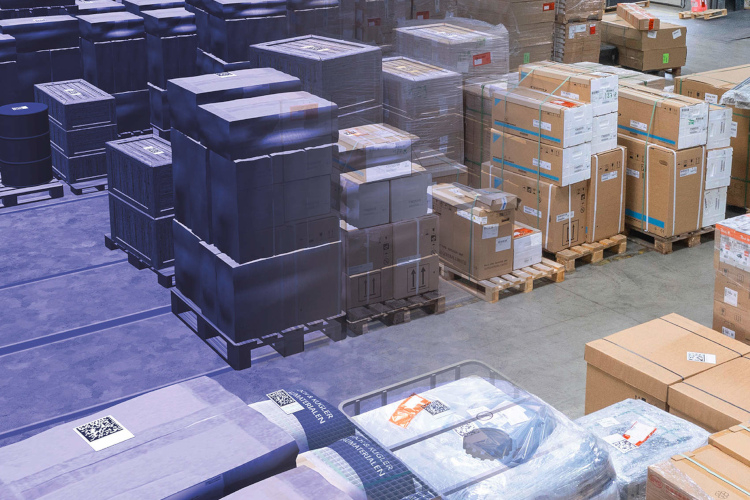
In cooperation with the Fraunhofer IML Institute, Dachser has developed and implemented an innovation in groupage logistics. In the so-called @ILO terminal, a complete digital image of all packages, resources, and transit terminal processes is created fully automatically and in real time. This “digital twin” accelerates inbound and outbound processes and ensures continuous updates on the location of every package, benefiting not only logistics operators and drivers but also planning and customer service staff.
The technological innovation is already proving its worth and is being used in real-world operations at the transit terminals of Dachser’s branches in Unterschleißheim near Munich and Öhringen near Heilbronn. The name @ILO is an acronym for Advanced Indoor Localization and Operations. It is a research project of the DACHSER Enterprise Lab, conducted by the logistics service provider together with the Fraunhofer Institute for Material Flow and Logistics (IML). It is based on the jointly developed @ILO software. Artificial intelligence-based algorithms interpret data captured every second by optical scanning devices, using them for the automatic and immediate identification and localization of all packages. In this way, a complete, always up-to-date image of the terminal and the processes occurring within it is created – its digital twin. It is expected that in the future, the system will provide real-time data on every pallet shipment in Dachser’s European transport network.
– The technological innovation is already proving its worth and is being used in real-world operations at the transit terminals of Dachser’s branches in Unterschleißheim near Munich and Öhringen near Heilbronn. The name @ILO is an acronym for Advanced Indoor Localization and Operations. It is a research project of the DACHSER Enterprise Lab, conducted by the logistics service provider together with the Fraunhofer Institute for Material Flow and Logistics (IML). It is based on the jointly developed @ILO software. Artificial intelligence-based algorithms interpret data captured every second by optical scanning devices, using them for the automatic and immediate identification and localization of all packages. In this way, a complete, always up-to-date image of the terminal and the processes occurring within it is created – its digital twin. It is expected that in the future, the system will provide real-time data on every pallet shipment in Dachser’s European transport network. Consistent digitalization of our core processes will allow for further improvement in the quality of our services. We are not stopping at just state-of-the-art technologies. We also want to introduce our employees to the digital world, just as in the @ILO terminal. This innovation offers clear benefits for daily work in the transit terminal and thus has the potential to become a milestone on the road to even more efficient and sustainable logistics operations – said Burkhard Eling, CEO of Dachser
Operations have been successfully completed at two locations: AI-based algorithms fully automatically identify, locate, and measure all shipments in the transit terminal. This first step eliminates the need for manual scanning and labeling of packages and speeds up departure times. There is a high probability that in the future, artificial intelligence will also support and optimize loading.
Fully automatic identification and precise tracking with one-meter accuracy. In the @ILO terminal, packages are identified fully automatically upon entry and exit, as well as during their stay, and are recorded in the transport management system. This eliminates manual barcode scanning and additional package labeling. The technological foundation of the system is provided by two-dimensional DataMatrix codes on the top of each package, serving as identifiers, along with several hundred optical scanning devices in the ceiling area of the facility that register the entire floor. This configuration also enables precise tracking with one-meter accuracy in real time for all pallets within transit terminals, which can often be the size of a football pitch. Cargo locations and the position of ground conveyors can be visualized in real time and displayed on websites, apps, or mobile screens along with internal transport instructions, significantly improving transparency in the warehouse and accelerating search and loading processes. A new feature is the automatic connection between ground conveyors and packages. The @ILO system automatically detects when a ground conveyor picks up a pallet and continuously transmits information about each package to employee displays. This is another feature that reduces the time required for logistics tasks and can change the flow of processes in the transit terminal.
– The @ILO terminal takes us to a new level of supply chain monitoring and tracking. We have been working on the digital twin with Fraunhofer IML for over four years. Thanks to the vast knowledge, ideas, and above all, the passion of the teams, which consist of both researchers and experts working in the field, the Internet of Things and the vision of Logistics 4.0 have also become a reality in groupage logistics. – Stefan Hohm, DACHSER CDO
Constant package measurement
Another technological improvement for the @ILO terminal is in preparation: fully automated and constant measurement of all packages. In pilot operations, the system is already able to identify package dimensions with great accuracy. Once it is fully ready for practical application, it will be possible to feed the obtained volume data for each package into intelligent algorithms to, for example, assist drivers and transit terminal staff in planning loading and routes or to increase the utilization of swap bodies, trailers, and local transport vehicles. The consequence would be a reduction in transport kilometers, and thus also an important step in the pursuit of zero emissions.