









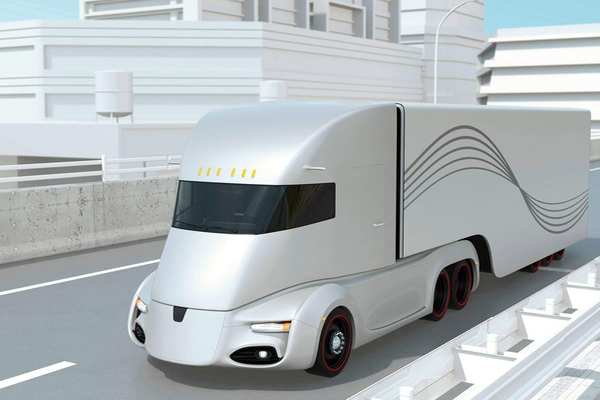
Logistics specialists from various departments at DACHSER are testing alternative drive technologies and their practical applications within the logistics network. The operator is committed to using more environmentally friendly modes of transport. However, it is not currently possible to implement any ready-made solution in practice.
– We are researching current and future technologies together with our internal specialists and branches, and discussing them with external partners. We are focusing on evaluating alternative drive systems and fuels, as well as the new logistics concepts associated with them, especially in heavy-duty transport – says Stefan Hohm, Corporate Director of Solutions, Research and Development at DACHSER.
In its R&D activities and test projects, the company conducts an interdisciplinary dialogue with experts from Road and Air & Sea Logistics. However, it will not be possible to introduce a ready-made solution to the market in the near future.
– Currently, it is not possible to apply any of the alternative drive systems or emission-free, sustainable fuels in practice, either for technical or economic reasons – explains Andre Kranke, Head of Research and Development and Innovation Management.
Electromobility
There is no doubt that in the long term, the future belongs to the electric motor, powered by battery electricity or hydrogen fuel cells. DACHSER is already using its first battery-powered trucks as part of new urban logistics projects, e.g., in Stuttgart, Berlin, or Hamburg. However, with a range of up to 200 km, the possibilities for using these vehicles are still limited.
– Using this technology, we are unable to provide a cost-effective range-load-loading time ratio that would be profitable on long-haul transport routes – says Andre Kranke.
Germany is testing a way to power electric vehicles via overhead power lines on the “eHighway” along the A1 motorway near Lübeck and in other locations. However, this solution does not work for long-haul electric transport.
– One of the reasons why this solution does not work is the constant need to transfer loads between short-haul and long-haul transport. Secondly, long-haul freight traffic would require a pan-European overhead line system. Such a system currently seems impossible to create due to high investment costs and varying conditions in different geographical areas – claims Stefan Hohm.
The diesel engine is still the most cost-effective and most common. Combined with second-generation biofuels, diesel engines can significantly contribute to reducing greenhouse gas emissions in some EU countries and can thus be a bridge on the way to electromobility.
Natural gas-powered engines
Researchers are also looking for opportunities to use natural gas in the form of compressed natural gas (CNG) or liquefied natural gas (LNG) in truck drive systems. However, the use of natural gas, which is also a fossil fuel, does not bring significant climate benefits.
– Depending on the technology used, we are talking about CO2 savings of about 10-15 percent compared to a modern diesel truck – says Hohm.
There is also much discussion in logistics about synthetic fuels, i.e., liquid or gaseous fuels (diesel, LNG, methanol, etc.) produced synthetically using electricity. To be climate-neutral, they must be produced using power-to-X technology. The power-to-gas process converts sustainably generated electricity – mainly from wind and solar energy – into green hydrogen, which is the basis for all synthetic fuels. Since the amount of energy lost during the transition from electricity through green hydrogen to synthetic fuel is still extremely high, the idea is not profitable.
Fuel cells
Fuel cells convert hydrogen into electricity, which then powers an electric motor. They have already become an indispensable part of space travel and have proven their suitability for everyday use in ground conveyors, but this technology has not yet proven itself on the roads.
– We are still a long way from large-scale production of fuel cell trucks replacing diesel trucks in the near future – notes Kranke.
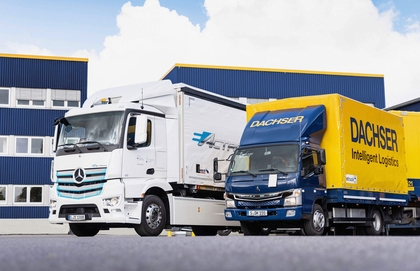 However, DACHSER is not giving up on searching for solutions that are good for both transport and the environment.
– We continue to develop alternative drive systems for freight transport. To this end, we are intensifying cooperation with initiatives and associations, manufacturers, and research partners, and expanding our knowledge by participating in pilot projects. In this way, we aim to achieve our climate goal by 2050 – concludes Stefan Hohm.
Source: DACHSER