








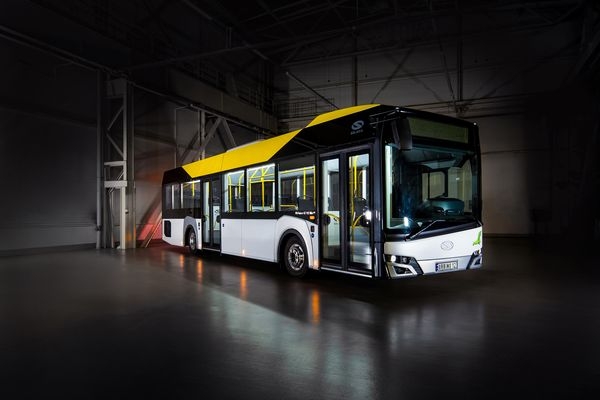
During the 8th edition of the Czechbus trade fair in Prague, Solaris is presenting two buses. The first is the well-known Solaris Urbino 12 electric, while the second vehicle on display is a complete novelty in the offer of the Polish market leader – the Solaris Urbino 12 LE lite hybrid. It is a bus with low operating costs and a lighter construction than the standard one. A novelty among this year’s Solaris exhibits is also the fact that they are presented in a new design.
The Solaris Urbino 12 LE lite hybrid, where “lite” refers to the vehicle’s “low-calorie” name, points to the premiere bus’s greatest advantage: low fuel consumption. As a result, the Urbino 12 LE lite hybrid is characterized by lower operating costs compared to similar designs available on the market. The main goal of the engineers at the Solaris Research and Development Office working on the new Urbino model was to develop a bus design that would achieve fuel consumption of less than 30 liters per 100 km in the SORT 2 test.
To achieve this goal, the engineers focused their efforts on many areas. Undoubtedly, one of the most important challenges was reducing the vehicle’s weight. The Solaris Urbino 12 LE in the lite hybrid version has 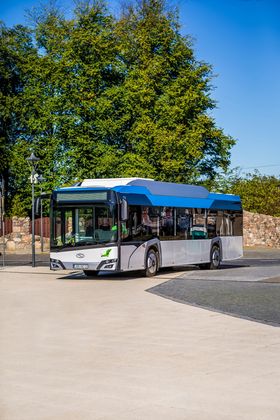 a curb weight of less than 9 tons. In turn, the total weight of the bus with passengers is 15.5 tons.
The heart of the new model’s powertrain in the Urbino family is a Cummins ISBE6 engine with a capacity of only 4.5 liters. The unit, which meets the strict EURO 6 emission standard, has an output of 210 hp and 850 Nm of torque. An additional element of the Urbino LE lite hybrid drive is an electric machine with a rated power of 11.5 kW. Its task is to recover energy during braking and to assist the internal combustion engine when starting. Thanks to this, the system consumes less fuel.
The Solaris Urbino 12 LE lite hybrid is available in a version with two pairs of doors in a 2-2-0 layout. The bus can carry up to 85 passengers, 41 of whom can be seated. The front axle of the vehicle is a ZF RL55 solution, while the drive axle is a DANA G150 type. The wheel size used in the vehicle differs from those used as standard in Solaris city buses. This time, the vehicle will be equipped with smaller diameter wheels – 19.5 inches. The wheelbase of the Solaris Urbino LE lite hybrid is 5900 mm, with a front overhang of 2700 mm and a rear overhang of 3240 mm. Despite the “slimming down” of the construction and the use of several new components, the Solaris Urbino 12 LE lite hybrid, like all Solaris brand products, is uncompromising when it comes to the safety and comfort of both passengers and drivers. The vehicle meets, among others, the safety standards defined in regulations R29 and R66.
– The new Solaris Urbino 12 LE lite hybrid is an offer for those operators for whom the key parameter when purchasing a bus is low fuel consumption while maintaining maximum comfort for passengers and drivers. Our customers will receive the same guarantee of quality and durability that the Solaris brand commits to – says Zbigniew Palenica, Vice President of the Management Board of Solaris, responsible for sales, marketing, after-sales, and the Rail Vehicles Department, about the competition product.
Solaris Urbino 12 electric and e-mobility
In just eight years since the premiere of its first electric bus, Solaris has delivered or received orders for nearly 350 vehicles from customers in fourteen countries. At the Czechbus 2018 trade fair, the Polish manufacturer is showing zero-emission vehicles, drawing on over 9 million kilometers of experience. The latest technological solutions regarding heating, cooling, and steering systems were aimed at reducing energy consumption. Solaris offers its customers comprehensive project management, which includes not only the delivery of buses and charging systems but also ensures the preparation of their installation, including construction works.
New solutions
Along with the introduction of electric drives to its offer, Solaris is constantly working on technical solutions to ensure even better performance. Most of the effort put into the development of the heating system in electric buses is related to reducing energy consumption and ensuring a greater range. For this purpose, manufacturers often decide to use a diesel-powered heating furnace; such a solution – although effective at very low temperatures – is far from zero-emission. Solaris has proposed an innovative novelty, which is a hybrid heating system powered by LPG. This is a low-emission option and much cheaper than a traditional diesel furnace. Furthermore, LPG tanks are smaller than those used for CNG, making their installation less complicated.
A new choice has appeared in the heating and air conditioning system offer, in which the working medium is CO2, which is currently the most environmentally friendly solution. The use of an electric heat pump allows for the extraction of heat from auxiliary devices, thereby reducing energy consumption from the battery, which in turn results in extending the vehicle’s maximum range and guarantees efficient operation at low temperatures. Everything takes place with zero-emission operation.
Another change that Solaris engineers are already prepared for is the gradual reduction in the use of the R134a refrigerant used in current air conditioning systems. According to the provisions of the European Union, it is to be completely replaced by the much more environmentally friendly R513a by 2030. Thanks to the efforts of the Polish manufacturer and one of its suppliers, the air conditioning systems of vehicles from Bolechowo can already be refilled with a cleaner agent today.
Innovations have not bypassed the power steering system either. We are talking about an electric power steering pump powered by standard 24V batteries. For some time now, the new solution has been used as standard in all electric and hybrid buses leaving the Bolechowo factory and as an option in trolleybuses. The change results in reduced energy consumption – the pump does not load the main engine – thanks to which the vehicle’s range also increases. Further arguments in favor of this design are the variable rotational speed of the pump, thanks to which the steering assistance force is greater at low vehicle speeds and decreases as speed increases. Above all, however, this solution leads to a significant increase in safety, as the power steering pump itself is not dependent on other devices whose failure in extreme cases could result in a loss of vehicle control.
Remote diagnostics
A novelty is also the remote diagnostic system for electric buses called eSConnect. It improves and supports diagnostic and service capabilities and enables the analysis of specialized data collected by the vehicle. Buses equipped with the remote diagnostic system will allow the manufacturer to create a database of real operational data, which in turn can be used to further improve the solutions used.
The eSConnect system can be installed both in every newly produced electric bus and in those already delivered to customers. The first of them have already decided to implement 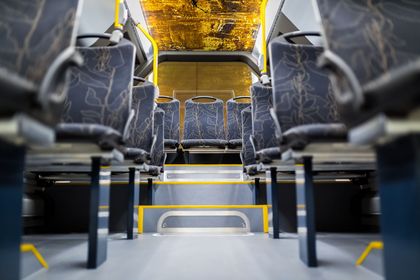 a pilot solution in their bus fleets. Importantly for vehicle users, they can also use the data to optimize fleet utilization. The remote diagnostic system, in addition to service functions, will also enable the manufacturer, which is the European leader in the production of electric vehicles, to optimize its designs, for which it was awarded the title of “Bus of the Year 2017”.
Among the data obtained remotely are, among others, the location of the bus fleet in time and space along with the current battery charge status, the route traveled by a given bus in a time specified by the user, or energy consumption. The eSConnect system also allows for remote identification of potential errors reported by the vehicle on the driver’s dashboard, monitoring of bus operating parameters, and generating statistics regarding the number of charging cycles and the duration of energy replenishment in the batteries.
The remote diagnostic system proposed by Solaris provides a number of benefits to customers. For buyers of electric buses, it means better utilization of the vehicle fleet and ensuring proper use of the buses by drivers. Furthermore, eSConnect provides the ability to collect and analyze data that facilitates the precise definition of technical requirements for buses for the needs of servicing individual lines.
Electromobility
For most cities and carriers, electric drives are a new solution. Wanting to enable them to optimally prepare for the electrification of given lines, Solaris conducts an individual feasibility study at the request of the interested customer. The Research and Development Office of the Polish manufacturer develops the most optimal solution in the field of e-mobility based on customer requirements and a whole range of input data, such as: the temperature range in a given city, necessary to estimate energy consumption not only in conditions not deviating from the norm but also in extreme situations, average speed, topography of the terrain through which the line runs, number of stops, passenger flows, timetable, and many others.
The result of the feasibility study is a report recommending the best technical solutions regarding electric buses. The study takes into account, among others, the place of operation of the electric bus and the carrier’s requirements. In practice, the document contains, among others: the size and type of battery, recommended charging infrastructure, projected energy consumption, and battery life. By sharing best practices and acquired knowledge, Solaris supports municipal transport companies in activities for the development of electromobility.
Presented Solaris Urbino 12 electric
The drive unit of the Solaris Urbino 12 electric presented at the Czechbus trade fair consists of two electric motors with a maximum power of 125 kW each (110 kW net power), integrated with the drive axle. The energy needed to power them is stored in Solaris High Energy batteries with a total capacity of 240 kWh. In the version presented at the trade fair, the vehicle can be charged via a stationary external charger or an on-board charger (34kW power) without the need to install additional infrastructure. The presented unit has a total of 28 seats, 12 of which are accessible from the low floor. The Solaris Urbino 12 electric bus is a model that was chosen as the city bus of the year in the “Bus of the Year 2017” competition.
Solaris has delivered nearly 200 electric-powered buses so far. Another 150 vehicles are in production. The electric Urbino have already covered over 9 million kilometers with customers in 14 different countries.