








In 2019, the international consulting firm Cushman & Wakefield published a report titled “The Changing Face of Distribution: The Shape of Things to Come,” which focuses on current and projected key logistics and transport corridors that will emerge by 2030 and support the development of the logistics industry in Europe. The report indicates that Europe’s main distribution corridor, stretching from the Benelux countries to northern Italy (known as the “Blue Banana” due to its characteristic shape), has transformed into several corridors in response to the EU enlargement and the emergence of new motorways.
According to Cushman & Wakefield (C&W) analysts from Paris and London who prepared the report (Lisa Graham, Elisabeth Troni, Rob Hall), European logistics corridors will continue to evolve due to factors such as: increasing freight volumes, which are expected to grow by 22% over the next decade, rising transport costs, labor shortages, and road traffic congestion. The development of e-commerce and new technologies, such as the Internet of Things, multimodal connectivity, and transport networks, also contributes to major changes in this area. Political issues, including the United Kingdom’s exit from the European Union, will also have a significant impact.
The report identifies 8 main logistics corridors that could influence the development of logistics in Europe. They are divided into new markets, 2025 markets, and 2030 markets, depending on when they will reach full operational readiness (some depend on the availability or reliability of infrastructure, or on the resolution of legal obstacles). The authors of the study defined them as follows:
- the original blue banana – a corridor through which goods are imported into Europe, running through ports in the Benelux countries, the Rhineland in Germany, and further to northern Italy. Due to the growing importance of Mediterranean ports, this corridor may be extended to Genoa, Italy, in the future
- the British corridor – as a result of Brexit, British maritime, road, and rail networks will no longer officially be part of the North Sea-Mediterranean corridor of the Trans-European Transport Network (TEN-T), and the importance of supply chains within the UK will increase. Brexit may cause the logistics industry to become more dependent on British ports
- the Irish corridor – a new maritime route is being established between ports in Cork and Dublin in Ireland and ports in Zeebrugge and Antwerp in Belgium. Due to the limited capacity of the port of Zeebrugge, nearby Ghent in Belgium and even Zeeland in the Netherlands may see an increase in demand for space
- the Iberian corridor – the availability of skilled and cheaper labor in Spain and Portugal is already attracting German automotive companies. Thanks to new railway lines and other transport connections, freight volumes could increase in the next 5-7 years
- the Central European corridor – investments in the motorway and rail network as part of TEN-T have already increased distribution efficiency along the existing corridor. If it is finally extended to northern Italy, it could connect with the blue banana route in Bologna and Milan
- the North Sea corridor – distribution within this corridor, connecting the port of Hamburg with Copenhagen and Malmö, will significantly improve after the completion of the tunnel between Rødby and Puttgarden in 2021, which will be accessible to heavy goods vehicles and freight trains
- the Black Sea corridor – a future distribution corridor that will be connected to the Central European “banana” after the completion of parts of the Rhine-Danube rail and motorway network as part of TEN-T, connecting Budapest with the Black Sea. For this reason, Romanian markets such as Bucharest could play a key role
- the Baltic corridor – the growing importance of the Baltic states as industrial locations will depend on the construction of a motorway, road, and rail network as part of TEN-T, which will connect this region with Finland, Poland, the Czech Republic, and Germany. Significant infrastructure investments are necessary, which could enable the further development of this corridor in the long term.
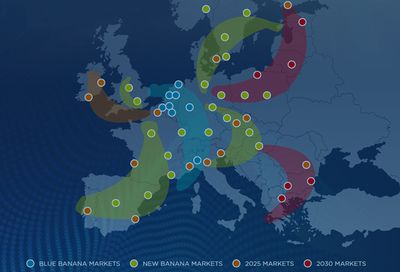
Fig. 1. Current and projected new key logistics corridors in Europe.
Source: Graham L., Troni E., Hall R., The Changing Face of Distribution: The Shape of Things to Come, Cushman & Wakefield, 2019, p. 2.
The C&W report points to Eurostat forecasts indicating an increase in demand for freight transport in continental Europe by as much as 182% between 2010 and 2050. However, the rising operating costs of logistics and transport companies (the value of which is estimated to increase from 40% in 2030 to 80% in 2050), related to, among other things, the negative impact of freight transport on the environment or the increasing use of access roads directly to recipients, will exert growing pressure on carriers to adapt to changes in terms of transport modes, supply chain organization, and fuel sources. In the meantime, the labor force will shrink, and congestion on European roads and motorways will increase. According to the latest Inrix* study, the 10 largest traffic hotspots in Europe could generate over 205 billion euros in economic costs by 2025.
More on the Cushman & Wakefield report in the next issue of “Logistyka” magazine.
* Inrix Research interprets real-time speed data for cities in Europe to provide annual measurements of congestion in their area.