









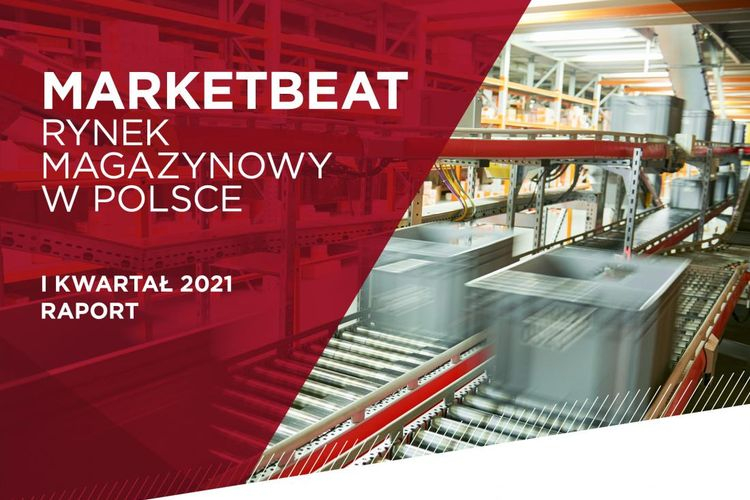
International advisory firm Cushman & Wakefield has summarized the first quarter of 2021 in the Polish warehouse real estate market. Despite the COVID-19 pandemic, demand in the warehouse market reached a record level of 1.6 million sq m. The highest number of transactions were concluded in the Poznań markets, the Warsaw region, Upper Silesia, and Central Poland.
Total demand in the first three months of 2021 reached a record level of 1.6 million sq m, representing a 70% year-on-year increase. Net demand, which consists of new leases and expansions, amounted to 1.1 million sq m, i.e., 71% of the leasing transaction volume, with the remaining 29% consisting of lease renewals. The highest number of transactions were concluded in the Poznań markets (23% of total demand), the Warsaw region (19%), Upper Silesia (17%), and Central Poland (14%). In the industry structure of demand, companies from the logistics (30% of total demand) and retail/FMCG (21%) sectors continue to hold the largest share, while the activity of manufacturing (13%) and automotive (11%) companies is growing. Under conditions of a disrupted global logistics network structure, many companies are changing their inventory management strategies, diversifying supply sources, and increasing warehouse space to maintain higher levels of strategic inventory.
– The main source of high demand for warehouse space in Poland remains the dynamic development of the e-commerce sector. Global e-commerce platforms such as Amazon and Zalando, online stores, logistics operators, and courier companies are active in the market, as are retail leaders developing omnichannel sales strategies for various product categories, including clothing, home furnishings/furniture, household appliances and electronics, FMCG, cosmetics, and food products. Consequently, tenants are actively modifying their distribution networks and increasing warehouse facilities, both near central metropolitan zones to improve “last mile” logistics, and investing in regional transshipment centers, cross-dock projects, and large BTS logistics projects dedicated to cross-border logistics – says Adrian Semaan, Senior Research Consultant, Industrial and Logistics Agency, Cushman & Wakefield.
The volume of vacant space remained at a stable level, despite the high scale of supply
At the end of Q1 2021, approximately 1.41 million sq m were available for lease in the warehouse market, which accounted for 6.5% of the total warehouse space supply in Poland. Despite the high scale of supply, the volume of vacant space remained at a stable level, while the vacancy rate decreased further by 0.3 pp quarter-on-quarter and 0.9 pp year-on-year. Base rents range from €2.50-3.80/sq m/month for BIG-BOX facilities to €4.00-5.25/sq m/month for SBU (Small Business Units) facilities in urban areas in key markets.
Continued growth in development activity
In the first quarter of 2021, developers completed nearly 750,000 sq m of warehouse space, and total stock increased to 21.5 million sq m. Among the 36 completed projects, the largest included: the second stage of the BTS investment for EURO-net at Prologis Park Janki, projects for BBK SA and DPD as part of Panattoni Park Gdańsk Airport, as well as the Panattoni BTS Czeladź investment for 4F and the BTS project for Polomarket at 7R Park Tczew.
High demand is generating further growth in development activity. In Q1 2021, construction began on 1.2 million sq m of warehouse space, and the total volume of investments under construction reached 2.47 million sq m. The number of investments implemented in the Poznań and Central Poland regions increased, as well as in the Western Poland market, where, in addition to a logistics center under construction, subsequent stages of logistics projects are being implemented in Gorzów Wielkopolski, Zielona Góra, and Zgorzelec, linked to the development of cross-border logistics and e-commerce operations. In the Warsaw and Upper Silesian markets, a decline in development activity is visible, which results from the high scale of supply recorded last year and the temporary state of oversupply currently visible in these markets. Taking into account other regional markets, a significant, over 10% increase in warehouse space stock is expected in the Tri-City, Szczecin, and Lublin markets, while an increase in development activity is also expected in the Bydgoszcz-Toruń market. Emerging markets such as Olsztyn and Kalisz are also on the warehouse investment map, and Wałbrzych and Siedlce should soon join this group. As of the end of Q1 2021, over 70% of the volume of investments under construction was secured by pre-let agreements, which means an increase in this indicator by approx. 20 pp compared to the state a year ago.
– In the coming months of 2021, we expect a continuation of high activity on both the demand and supply sides. Among the factors favoring the development of the warehouse market, one can mention the further growth of e-commerce, the development of the expressway and motorway system enabling geographical diversification of the logistics network, as well as the inflow of foreign investments to Poland due to the need to ensure the continuity of production processes in Europe (nearshoring). We will continue to observe high demand for logistics assets from foreign investment funds – says Joanna Sinkiewicz, Partner, Head of Industrial and Logistics Agency in CEE, Cushman & Wakefield.
The full report is available below in PDF format.
The report comes from the website: https://media.pl.cushmanwakefield.com.pl