










DHL has published a report on ensuring stable logistics for vaccines and medical products during the coronavirus pandemic and potential future crises.
Most likely, the first authorizations for the use of COVID-19 vaccines will be issued in the last quarter of 2020. Logistics service providers will therefore need to quickly adapt medical supply chains to handle the transport of over 10 billion doses of serum. DHL, in collaboration with the analytical firm McKinsey & Company, has developed a report on effective logistics for vaccines and medical products during the coronavirus pandemic and other crises in the future.
Scientific work on a coronavirus vaccine is still ongoing. Currently, over 250 vaccines are being developed and tested under seven programs. For some of them, specific guidelines regarding temperature maintenance (down to -80°C) during storage and transport will likely be imposed. This is a major logistical challenge for the current medical supply chain, which under standard conditions distributes vaccines at a temperature of approximately 2-8°C.
– There have been numerous pandemics in history, but in the 21st century, no one was prepared for such a massive scale and such serious consequences of a flu-like illness. This required governments, businesses, and the logistics industry to adapt quickly to new circumstances, which was quite a challenge for everyone. As a global leader in logistics, we want to share our experience to help implement new strategies in an increasingly connected world, despite the ongoing one of the greatest health crises in our history – comments Katja Busch, Chief Commercial Officer at DHL.
In the “White paper: Delivering pandemic resilience” report, DHL discusses how to effectively manage the transport of vaccines as highly temperature-sensitive products distributed on such a large scale. To ensure global coverage for COVID-19 vaccines, approximately 200,000 pallet shipments, 15 million deliveries in cooling boxes, and 15,000 flights in various supply chain configurations will be needed.
– In order to fight the coronavirus, some countries have taken on a more active role in medical supply chains. Over the past few months, we have proven that proper planning and effective cooperation within the supply chain can play a key role in government efforts to secure critical medical resources in crisis situations like this one – adds Katja Busch.
The coronavirus pandemic is a real testing ground for supply chains. Since its outbreak, the demand for medical supplies has increased. UNICEF, for example, delivered 100 times more face masks and 2000 times more medical gloves than in 2019. 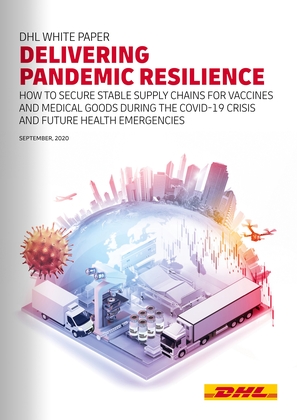 Importing medical supplies from distant locations for use on the front line was one of the most important actions in managing and responding to the pandemic in the first phase of the health threat. Internal logistics were a huge challenge due to the geographical concentration of production, limited transport capacity, and lack of quality control in air traffic. The authors of the report point out that to ensure stable medical supplies in future health crises, governments must establish comprehensive strategies and crisis structures in public health, within the framework of public-private sector cooperation.
– In the first months of the pandemic in Poland, we also faced increased demand for masks, protective gloves, and medical equipment. An efficient supply chain and fast, safe delivery often determine someone’s health or even life. The DHL report is a collection of useful tips for the public and private sectors to deal with the pandemic even better – comments Tomasz Buraś, CEO of DHL Express Poland.
DHL offers logistics companies ready-made schemes for cooperation with authorities, policymakers, non-governmental organizations, as well as the life sciences sector. These will help in creating stable and secure supply chains. Crisis response plans also include a partner network, logistics infrastructure, and IT technologies. More information in the DHL report.
Source: DHL