








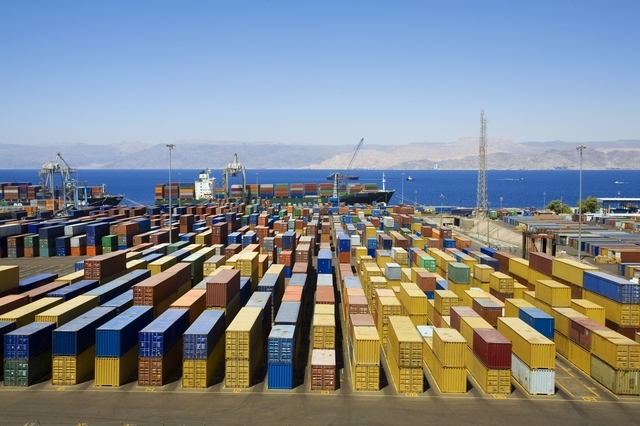
The globalization of the world economy has become one of the factors stimulating the development of transport systems. Maritime transport is the leading branch in handling international trade. In terms of volume, liquid bulk cargoes, mainly crude oil, and dry bulk cargoes such as iron ore, coal, and grain dominate its turnover.
However, the economic development of China, the increase in imports of finished goods from that country by European Union countries and the USA, as well as the increase in imports from other Asian countries such as South Korea, India, and Taiwan, have caused changes in the directional structure of international trade and an increase in the transport of general cargo carried in cargo units. This means that world trade is increasingly being carried out with the participation of container technology. Container shipping currently accounts for approximately 17.5% of world maritime trade. Taking into account so-called dry cargoes, the share of container transport amounts to approximately 25% of this segment. These factors have led to the formation of permanent cargo flows and global supply chains, in which container shipping is of particular importance. The efficiency of the chain often depends on the standard of services provided by container operators, and such differentiators as transit time between the port of loading and unloading, punctuality, and access to a network of connections significantly affect the efficiency of deliveries.
Global container market
The development of containerized cargo transport has influenced the formation of a characteristic model for organizing liner services. The need to concentrate cargo has led to a reduction in the number of ports served on ocean routes to selected, large ports, so-called hubs. Smaller ports located in their catchment area are connected to them by a network of feeder services. The development of this concept includes regional, shuttle, and round-the-world connections. This organization is based on the hub and spoke system. Consequently, this has led to the creation of large transshipment centers and networks of feeder container services. Such organization of container shipping is intended to ensure the efficient flow of cargo in global supply chains. The main container routes run latitudinally and connect the most industrialized regions. These are services on the Asia-Europe, Asia-North America, and Europe-North America routes.
Large vessels with a carrying capacity of 4,000 to 13,000 TEU are employed on these routes. The latter can be handled in a limited number of ports with appropriate infrastructure due to their operational parameters – length, width, and draft. An important element related to the handling of both ships and the containers themselves is the technical equipment of the port – the superstructure, as well as the organizational system for handling container ships, hinterland transport means, and containers, along with advanced IT systems. Hence, these terminals play a key role in the turnover of containerized cargo and constitute a part of an integrated maritime logistics system. (…)
The article contains 23,952 characters.
Source: Logistyka Magazine